

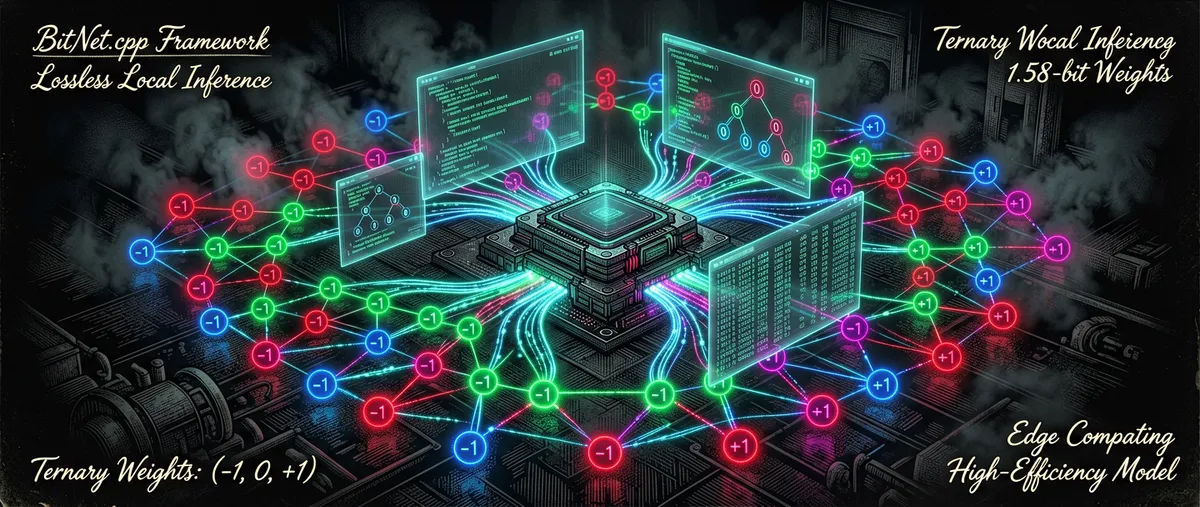
bitnet.cpp: local inference for ternary language models
microsoft/BitNet · 40,348★ · 3,740 forks
Everything worth knowing about microsoft/BitNet: Microsoft’s official framework for running 1.58-bit language models with optimized CPU and GPU kernels.
What BitNet is
bitnet.cpp is Microsoft’s official inference framework for 1-bit language models, specifically BitNet b1.58. Its purpose is to run ternary weights and quantized activations through specialized kernels, not to convert a conventionally trained model into an arbitrary quantization after the fact.
The project covers conversational generation and, since July 2026, multilingual embedding models. The latter produce dense vectors for retrieval, clustering, semantic similarity, classification, parallel-text mining, and reranking.
The origin: from a research line to an inference engine
The research preceding the repository traces back to the original BitNet paper, published on October 17, 2023; the README dates the presentation of BitNet b1.58 to February 27, 2024. The microsoft/BitNet repository was created on August 5, 2024, and its version 1.0 was announced on October 17 of that year.
The technical context is a tension between interest in ternary weights and the lack of a practical inference path at the edge. The 2024 report presents a software stack for fast, lossless inference of BitNet b1.58 on CPU, while the 2025 system report identifies mixed-precision matrix multiplication as the dominant cost and proposes the TL and I2_S kernel families.
No individual post was retrieved attributing the repository to a single person. The system report’s verifiable authorship includes Jinheng Wang, Hansong Zhou, Ting Song, Shijie Cao, Yan Xia, Ting Cao, Jianyu Wei, Shuming Ma, Hongyu Wang, and Furu Wei; the owning account is the Microsoft organization.
Philosophy and principles
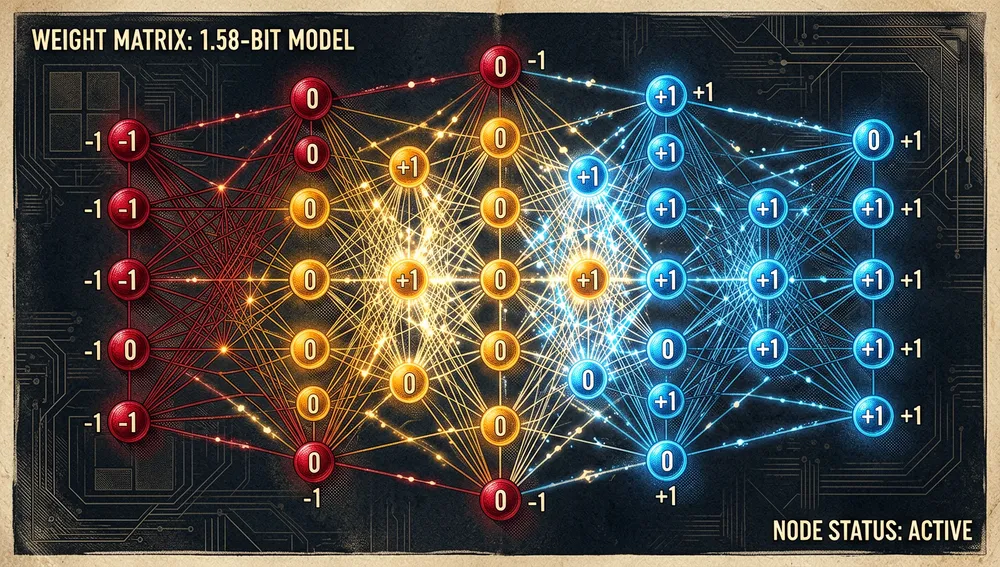
The pitch doesn’t promise that any LLM can be converted into a 1-bit model at no cost. BitNet models are trained with ternary weights {-1, 0, +1} and 8-bit activations; the embedding docs specify this isn’t post-training quantization.
Its operating principles are:
- Leverage the ternary structure from the kernel up: I2_S packs the weights and TL uses ternary lookup tables to reduce work and data movement.
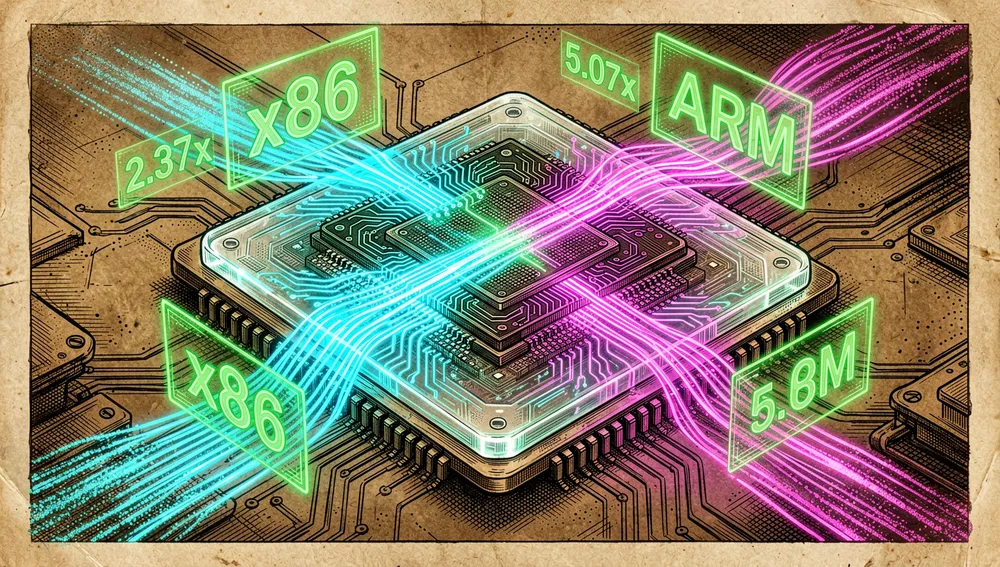
- Prioritize efficient local execution: the CPU report communicates speedups of 2.37× to 6.17× on x86 and 1.37× to 5.07× on ARM against full-precision baselines, under its experimental setups.
- Keep an interoperable path: the project builds on
llama.cpp, and its I2_S operations integrate into that framework’s compute graph; it isn’t an isolated replacement for the GGUF ecosystem.
How it works
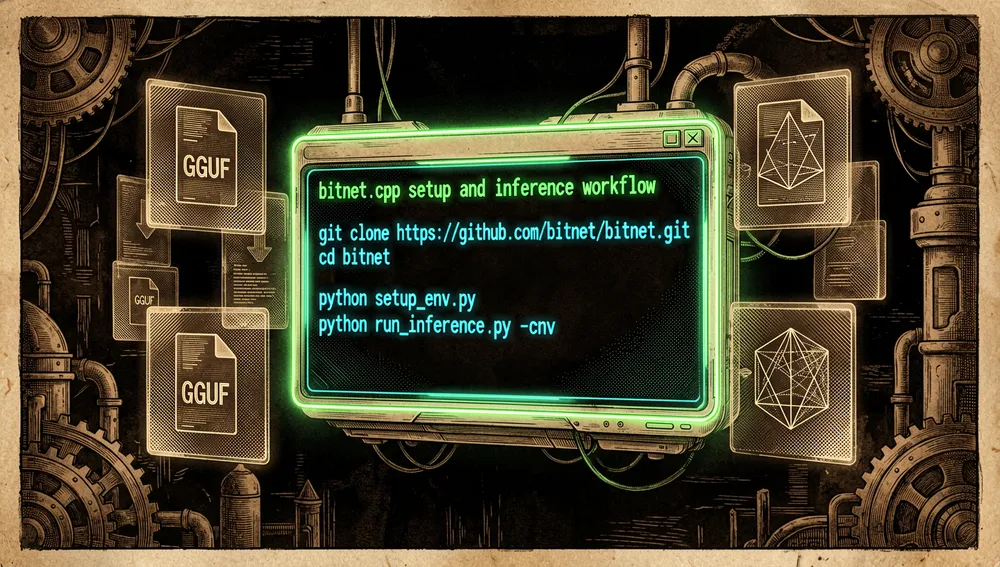
The usual CPU flow downloads a compatible GGUF model, builds the project, and runs run_inference.py. The executable accepts the model path, a prompt, token count, threads, context, temperature, and conversation mode.
On CPU, the kernels parallelize weight and activation computation and let you tune blocks and parallelism in include/gemm-config.h. The docs recommend activation parallelism for I2_S, since it amortizes weight unpacking.
There’s also a W2A8 GPU path: a CUDA kernel for a matrix-vector product with 2-bit weights and 8-bit activations. The guide describes 16×32 weight blocks, packing of two-bit values, and use of the dp4a instruction; its numbers are the project’s own measurements on a 40 GB NVIDIA A100, not an independent comparison.

Official and semi-official status
The repository explicitly describes itself as Microsoft’s official inference framework for 1-bit LLMs. It also links Microsoft’s official models on Hugging Face, including BitNet-b1.58-2B-4T and two embedding models.
Its semi-official status relative to llama.cpp is technical, not institutional: the README states the project builds on that framework and that its kernels draw on T-MAC’s methodologies. No evidence was retrieved that BitNet has been incorporated as a marketplace, a formal standard, or a certified product by a third-party company.
The ecosystem
Microsoft components and models
microsoft/T-MAC: a lookup-table methodology the README identifies as underpinning bitnet.cpp’s kernels; for general low-precision LLM inference, it recommends T-MAC.microsoft/VibeASR.cpp: a real-time, multilingual speech-recognition engine on CPU that the README announced on July 23, 2026, and that uses BitNet I2_S quantization.microsoft/BitNet-b1.58-2B-4T,microsoft/BitNet-embedding-0.6B, andmicrosoft/BitNet-embedding-270M: models linked by the project on Hugging Face. The embedding models are multilingual and are documented with retrieval, classification, and other semantic flows.
The repository doesn’t present a catalog of sibling components in its main information; the documented first-party relationships are T-MAC, VibeASR.cpp, and the models linked above.
Community adaptations and related projects
Beomi/BitNet-Transformers: a BitNet implementation for Hugging Face Transformers with a Llama architecture; the GitHub search returned 316 stars.Oxen-AI/BitNet-1.58-Instruct: an instruction-tuning implementation for BitNet 1.58; 33 stars in the same search.JohnMasen/BitNetSharp: a C# implementation of Microsoft’s BitNet; 2 stars.Liminal-Commons/bitnet-mcp: an MCP wrapper for text generation via allamaserver with BitNet-b1.58-2B-4T; the search returned it with 0 stars.
The exact search also revealed simple forks, such as Scottcjn/BitNet with 66 stars. It’s classified as a fork because it keeps the original’s description; it isn’t presented as an independent port. No non-English translation with an explicit relationship to the repository was retrieved.
Repo numbers
Measured: August 11, 2026, GitHub API.
| Metric | Value |
|---|---|
| Stars | 39,973 |
| Forks | 3,687 |
| Real subscribers | 349 |
| Commits | 110 |
| Open issues reported by the API | 315 |
| Primary language | C++ |
| License | MIT |
| Created | August 5, 2024 |
| Last code push | July 27, 2026 |
| GitHub releases | No formal release retrieved |
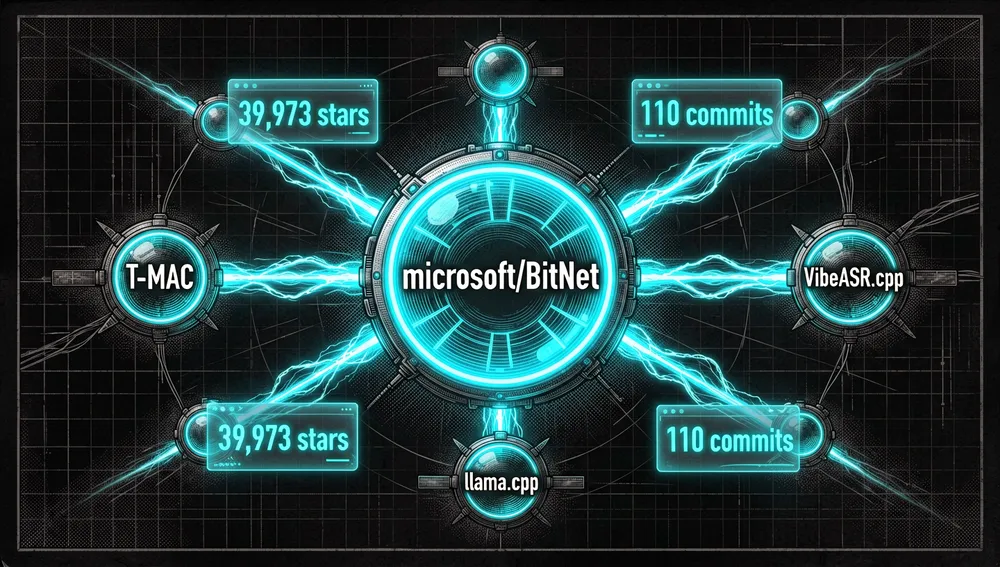
The 110-commit total comes from the API’s last pagination link. open_issues_count can include open pull requests. Likewise, watchers_count mirrors stars in GitHub’s general response; that’s why subscribers_count is reported as real subscribers.
The top contributors returned by the API, by contribution count, are potassiummmm (19), tsong-ms (16), younesbelkada (15), isHuangXin (11), and XsquirrelC (7).
How to contribute
No CONTRIBUTING.md guide or specific forking, branching, or pull-request policy was retrieved. A code of conduct and a security policy do appear at the root, and pull-request activity shows community proposals; that shows collaboration channels exist, but doesn’t amount to a documented contribution process.
Quick-start guide
Installation and first run
- Python 3.10 or later, CMake 3.22 or later, Clang 18 or later, and, as recommended, Conda are required.
- Clone including submodules and create the environment:
git clone --recursive https://github.com/microsoft/BitNet.git
cd BitNet
conda create -n bitnet-cpp python=3.10
conda activate bitnet-cpp
pip install -r requirements.txt- Download the official GGUF model and prepare the build:
huggingface-cli download microsoft/BitNet-b1.58-2B-4T-gguf --local-dir models/BitNet-b1.58-2B-4T
python setup_env.py -md models/BitNet-b1.58-2B-4T -q i2_s
The preparation step builds the project; the first useful output is the GGUF file in the models directory and the built binaries.
Common workflows
- Local conversation:
python run_inference.py -m models/BitNet-b1.58-2B-4T/ggml-model-i2_s.gguf -p "You are a helpful assistant" -cnvstarts conversation mode; the prompt is used as the system message. - Performance benchmark:
python utils/e2e_benchmark.py -m /path/to/model -n 200 -p 256 -t 4measures generation with 200 tokens, a 256-token prompt, and four threads. - Weight conversion: after downloading
safetensorsweights,python ./utils/convert-helper-bitnet.py ./models/bitnet-b1.58-2B-4T-bf16produces the GGUF variant. - Embeddings: with the submodule branch noted in the guide,
./build/bin/llama-embedding -m /path/to/save/model/bitnet-embedding-0.6b/ggml-model-i2_s.gguf -p "query: What is BitNet?" --embd-normalize 2 --embd-output-format arrayreturns a normalized vector.
Essential configuration
setup_env.py -md: sets the local model directory;-qselectsi2_sortl1.run_inference.py -t,-c, and-temp: control threads, context size, and temperature.include/gemm-config.h: containsROW_BLOCK_SIZE,COL_BLOCK_SIZE, andPARALLEL_SIZEto tune the CPU kernel for cache and architecture.--quant-embd: asetup_env.pyoption for converting embeddings to Q6_K.
Common pitfalls and fixes
- The current documentation uses
huggingface-cli; a recent pull request explains that newerhuggingface_hubversions removed that executable and proposes replacing it withhf. If you see “command not found,” it’s a known incompatibility in that documented flow; use Hugging Face’s available interface or follow the proposed fix. - On Windows you must use the Visual Studio 2022 Developer Console. If
clangisn’t recognized, the README says to initialize Visual Studio’s tools before building. - The README logs
std::chronoerrors when building thellama.cppsubmodule and points to a specific commit as the fix. There are also build issues with compiler flags that aren’t supported; don’t assume any GCC substitutes for the required Clang version. - For embedding models, the guide requires prepending an instruction to the query; omitting it degrades performance. There’s no need to add it to the document itself.
Integrations and migration
bitnet.cpp keeps formats and operations tied to llama.cpp, and the project itself presents it as its foundation. For low-precision workloads that aren’t ternary models, the README points to T-MAC instead of promising universal compatibility.
The MCP path found in the search is community-built and wraps llama-server; it isn’t part of Microsoft’s repository. For the GPU path, the official guide provides building and testing the CUDA kernel, plus an interactive generator.
How the community received it
There’s verifiable interest, but also concrete objections about the real availability of large models and the training process:
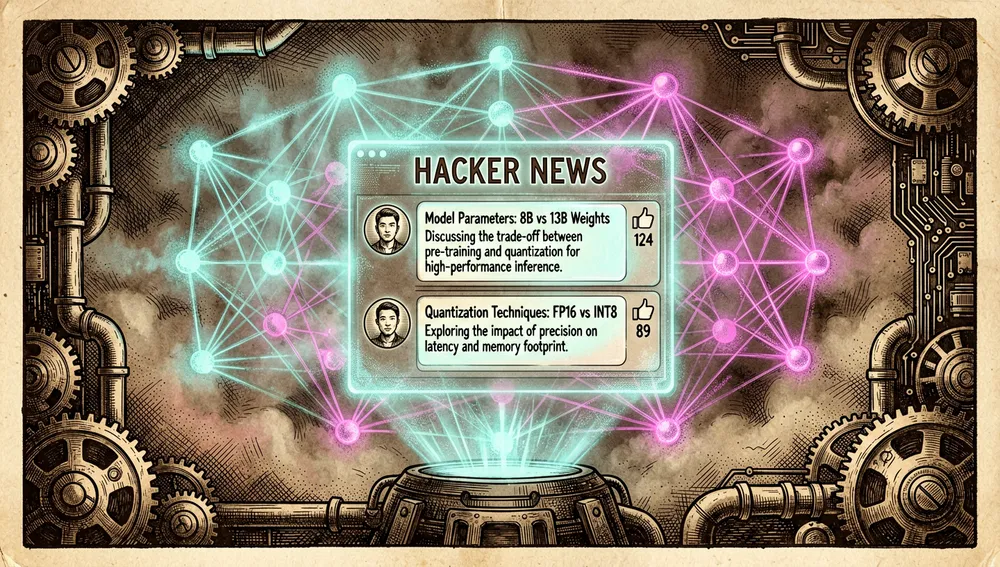
- The Hacker News thread 47334694, submitted by redm, linked directly to the repository and had 370 points and 167 comments. QuadmasterXLII questioned that the headline suggested a hundred billion parameters when the official models didn’t exceed ten billion; est replied that this wasn’t post-hoc quantization and that ternary use has to exist from pretraining onward.
- In the same thread, 152334H asked to distinguish between the framework’s capability and the existence of a trained 100B model. That reservation matches the README: it describes the capability to run a 100B BitNet b1.58 model on CPU, but doesn’t link an official model of that size.
- An earlier thread 41877609, submitted by galeos, reached 173 points and 33 comments. zamadatix explained that “1.58 bits” comes from three possible values; swfsql opined that local inference is the natural market, though they questioned the cost of training on a non-BitNet architecture. These are user interpretations, not experimental results.
Reddit exploration returned a 403 block, and Product Hunt also returned 403; no absence of posts is concluded from that.
The X search was retrieved as an app page, but didn’t offer a verifiable launch post.
The podcast search via iTunes didn’t return a verifiable exact match for the repository.
The YouTube search did return the LLM Master Cursos tutorial included in Resources; its title and duration were directly verified, but a view count wasn’t retrieved.
BitNet versus other approaches
| Approach | Verifiable relationship | Verifiable difference |
|---|---|---|
llama.cpp | bitnet.cpp builds on this framework and integrates I2_S into its compute graph. | BitNet contributes kernels and formats aimed at ternary weights; the source doesn’t show that all of llama.cpp is a BitNet implementation. |
microsoft/T-MAC | The README says T-MAC’s methodologies underpin its kernels. | The same README recommends T-MAC for low-precision LLM inference beyond ternary models. |
Beomi/BitNet-Transformers | Implements BitNet with Hugging Face Transformers and a Llama architecture. | It’s a PyTorch/Transformers implementation found in the search, not Microsoft’s official C++ inference framework. |
Oxen-AI/BitNet-1.58-Instruct | Implements instruction tuning for BitNet 1.58. | It focuses on instruction tuning; bitnet.cpp focuses on inference and kernels. |
Use cases and who this repository can help
- Teams running LLMs on x86 or ARM machines can evaluate a native BitNet model to reduce energy cost and improve local inference performance, always cross-checking the project’s numbers against their own hardware and workload.
- Developers of local assistants can use conversation mode, thread and context control, and the GGUF format to build an interactive experience without depending on a remote service.
- Semantic search and RAG teams can use the 0.6B or 270M embeddings and the
llama-embeddingexecutable to produce normalized vectors on CPU. The guide documents retrieval, reranking, clustering, and classification, and specifies how to phrase the query. - Performance and GPU engineering can test the W2A8 kernels and their CUDA test scripts; the available figures are the project’s own and need to be reproduced before being used as a production target.
Resources
- Repository: https://github.com/microsoft/BitNet
- Documentation and setup: https://github.com/microsoft/BitNet#installation
- Technical system report: https://arxiv.org/abs/2502.11880
- CPU inference report: https://arxiv.org/abs/2410.16144
- Official models: https://huggingface.co/collections/microsoft/bitnet
- Official GPU kernel: https://github.com/microsoft/BitNet/blob/main/gpu/README.md
- Official embeddings guide: https://github.com/microsoft/BitNet/blob/main/docs/bitnet-embeddings-i2s-guide.md
- Official demo: https://demo-bitnet-h0h8hcfqeqhrf5gf.canadacentral-01.azurewebsites.net/
- Video tutorial: https://www.youtube.com/watch?v=vgT12wWSHZA (LLM Master Cursos, 16 min 22 s)
- Conversations: https://news.ycombinator.com/item?id=47334694, https://news.ycombinator.com/item?id=41877609
Note: this article combines official documentation, technical reports, the GitHub API, and Hacker News conversations consulted on August 11, 2026. Figures change over time.

Comments