

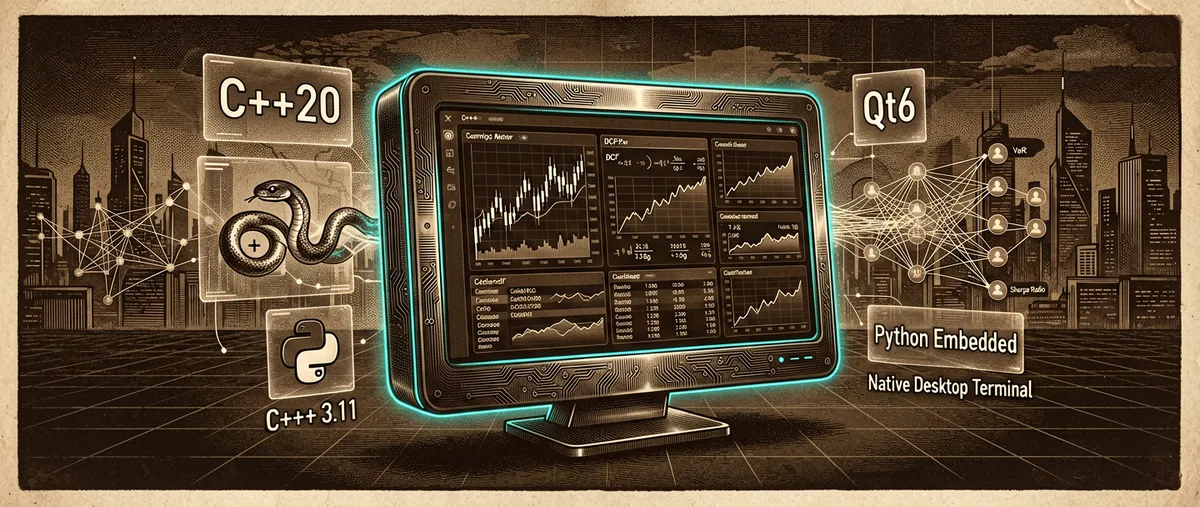
FinceptTerminal: the native C++ trading terminal that competes with Bloomberg from open source
Fincept-Corporation/FinceptTerminal · 31,980★ · 4,525 forks
Everything you need to know about Fincept Terminal: a native C++20 desktop financial terminal built with Qt6 and embedded Python, positioned as a free alternative to institutional terminals while doubling as the marketing funnel for a paid Enterprise edition.
What Fincept Terminal is
Fincept Terminal is a native desktop application — not a web app, not Electron — for financial research and analysis. It’s written in C++20 with a Qt6 interface and an embedded Python 3.11 runtime for the analytics layer. The README describes it as “a native terminal for financial research: Qt6 UI, embedded Python 3.11 analytics, single binary, no Electron”.
The README itself makes the project’s structure clear from the first line: there’s an open-source edition (AGPL-3.0, free) and a private, closed-source Enterprise edition sold to funds and research desks. The repository documented here is the open edition; Enterprise isn’t built from this repo.
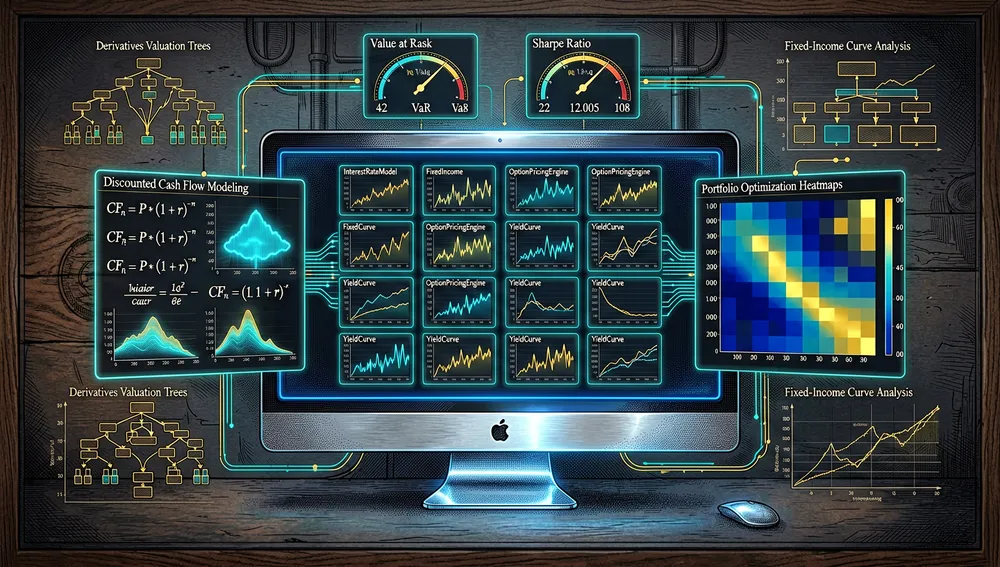
As of August 29, 2026, the README documents the following in the open edition:
- Analytics: DCF, portfolio optimization, VaR/Sharpe, derivatives pricing, fixed income, alternative assets, and an 18-module QuantLib suite.
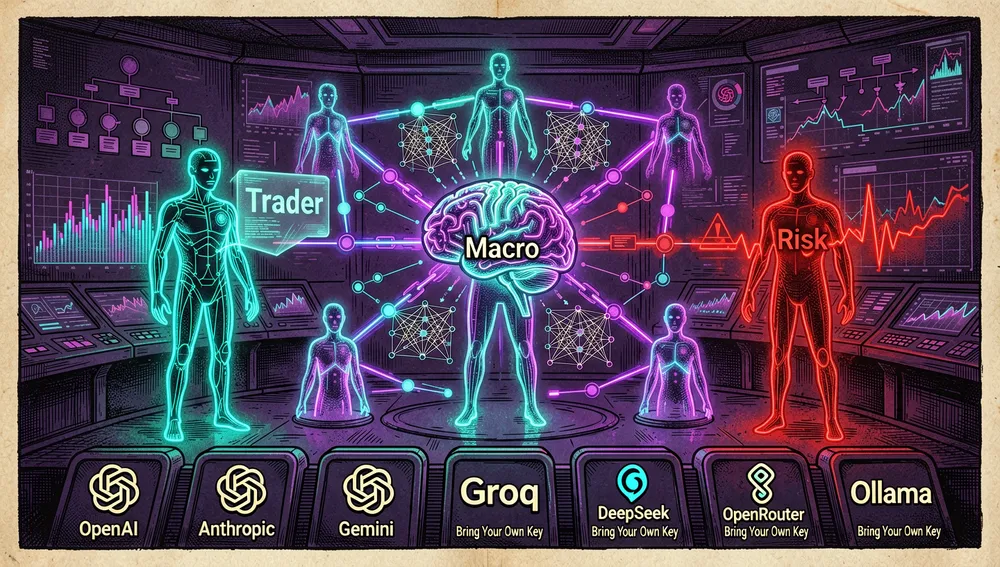
- AI: 37 trader/investor, economic, and geopolitical agents, bring-your-own-key (OpenAI, Anthropic, Gemini, Groq, DeepSeek, OpenRouter, Ollama).
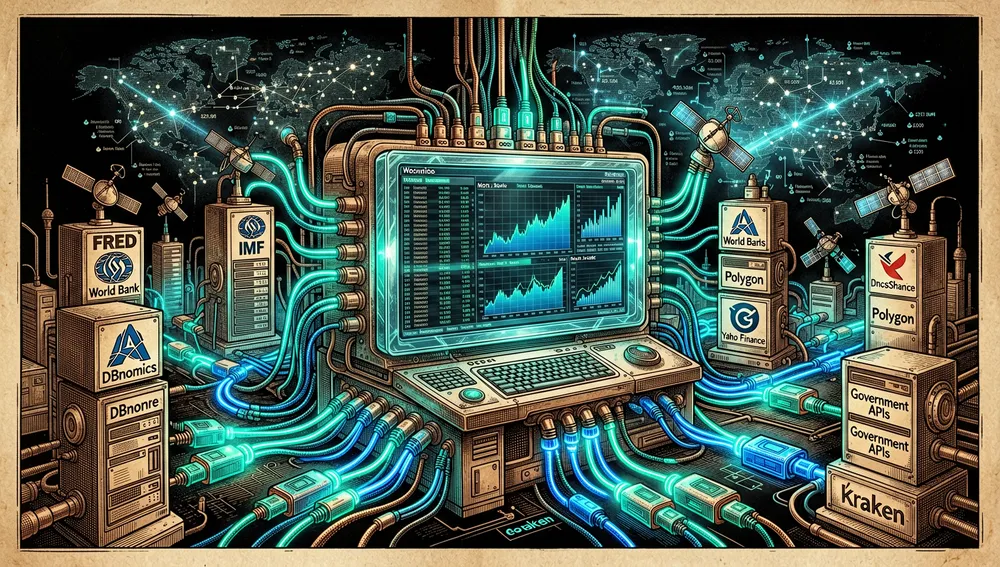
- Data: over 100 connectors (FRED, IMF, World Bank, DBnomics, AkShare, Polygon, Kraken, Yahoo Finance, government APIs).
- Trading: crypto and stock feeds, a paper-trading engine, and 16 broker integrations (the contributing guide says 18).
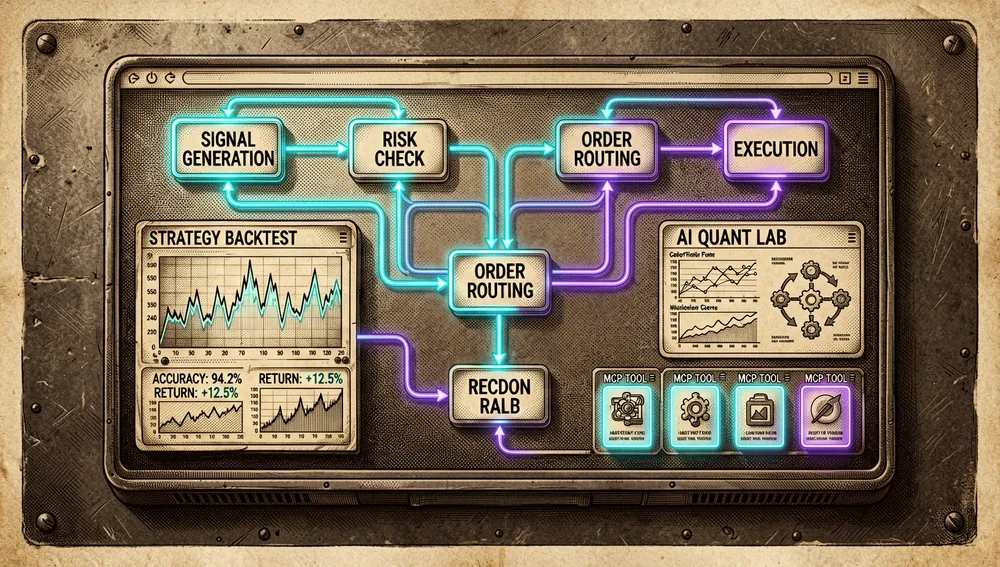
- Automation: a visual node editor, MCP tools, and an “AI Quant Lab” (ML, factor discovery, RL).
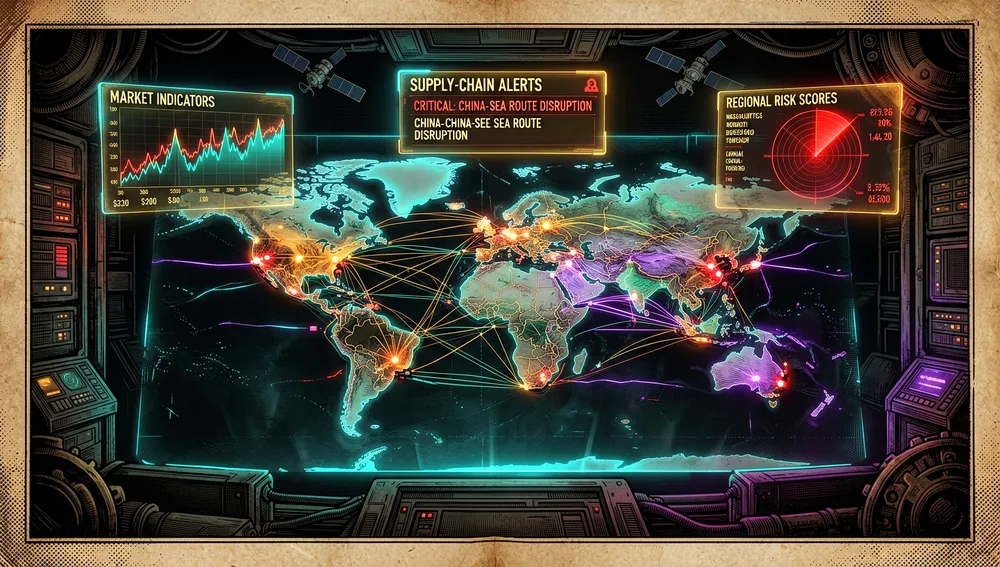
- Global intelligence: maritime tracking, geopolitical analysis, and relationship mapping.
The banner’s tagline reads: “Your Thinking is the Only Limit. The Data Isn’t.”
Origin
The repository was created on August 29, 2024. The first visible release tag is Production1 (September 1, 2024), followed by Production0.1.3 (September 19, 2024). The first Hacker News submission (“Show HN: Modern Terminal for Financial Investment and Economic Data Analysis”) went up on September 13, 2024, submitted by the 12tilak34 account.
The lead author, per the contributors API, is Tilak Patel (tilakpatel22, 817 contributions), whose GitHub account links to TLK INDUSTRIES PRIVATE LIMITED and whose bio lists interest in “Finance, Tech, Big Data and Analytics”. The organization maintaining the repo is Fincept Corporation, with the commercial site fincept.in. The 12tilak34 account (the one that submits the Show HN posts) returned no profile data in the queried API; the link between the two accounts is reasonable but is flagged as an inference, not a verified fact.
The project went through a documented shift in cadence: it used to ship continuously; now it “ships one release a month instead of continuous development, because the team’s day-to-day work is on Enterprise.” Everything already published “stays published” and the repo “stays public and won’t be removed.”
Philosophy and principles
The README and the getting-started guide lay out a direct economic thesis: professional terminals cost around $27,000 a year per seat, and market-data subscriptions run $20,000 a year, so the goal is a fast, native, open-source tool.
Verifiable technical principles:
- Native, not web: C++20 + Qt6, no Node.js or browser runtime, for “native performance and a single binary.”
- Embedded Python for analytics: taps Python’s financial ecosystem (yfinance, pandas) through a
PythonRunnerbridge. - Pinned versions: the toolchain is pinned (CMake 3.27.7, Ninja 1.11.1, Qt 6.8.3, Python 3.11.9); “newer or older versions are not supported.”
- Strong copyleft: AGPL-3.0. The README is explicit: distributing a modified build or running it as a service requires publishing the changes under the same license — which is why companies opt for Enterprise instead.
- Two editions on one data core: the difference is license, price, data, AI credits, live trading, and corporate controls.
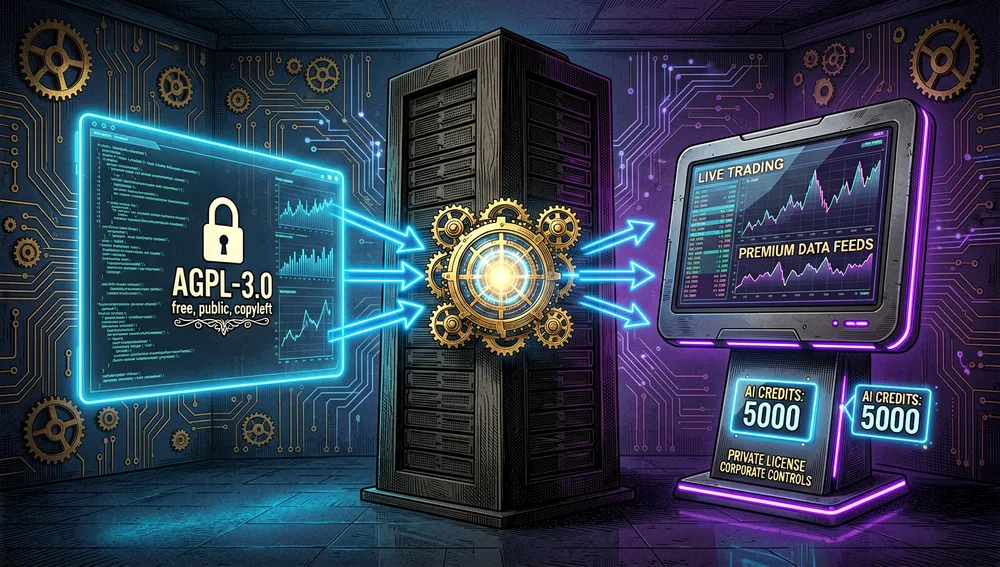
The central tension is commercial rather than technical: the open repo is both a learning product and a funnel toward the paid version.
How it works
The data flow documented in the getting-started guide:
- The screen (e.g.
MarketsScreen) only renders UI. - The data service (e.g.
MarketDataService) makes the HTTP request and handles caching. - Either an HTTP API is called (QNetworkAccessManager → JSON parsing), or a Python script runs through
PythonRunner. - The result (JSON) goes back to C++ and the UI updates.
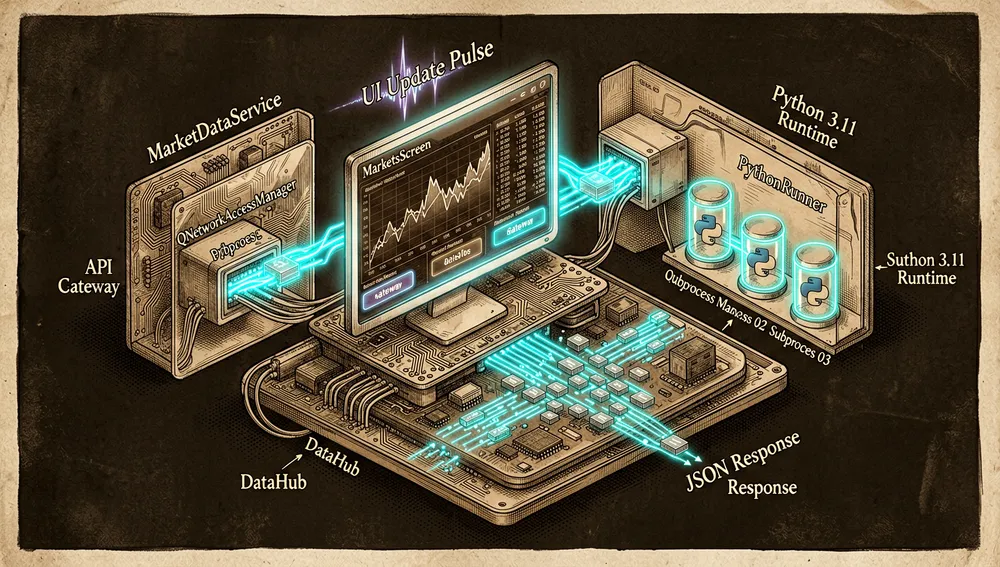
The architecture strictly separates screens (UI) from services (search, caching, processing), with a limit of 3 concurrent Python processes. There’s a DataHub layer for streaming data flows and an MCP infrastructure with 24 tool modules.
The “non-negotiable” architecture rules (a summary of CLAUDE.md, rules P1–P14 and D1–D5) include: never block the UI thread, lazy screen construction, timers in showEvent/hideEvent, Python subprocesses via PythonRunner, and data flows via DataHub.
The 37 AI agents (trader, investor, economic, and geopolitical) run on the user’s own key for OpenAI, Anthropic, Gemini, Groq, DeepSeek, OpenRouter, or Ollama.
The ecosystem
Organization and author repositories
Fincept-Corporation/FinceptTerminal— the main repository; 30,607 stars and 4,327 forks.Fincept-Corporation/quantcept-marketplace— an org repo created June 15, 2026; 7 stars and 1 fork, no description.Fincept-Corporation/.github— templates and workflows; 1 star.
Sibling projects cited in the README
- Fincept Data API (
docs.fincept.in) — over 500 REST endpoints, 423,000+ instruments, and 2,000+ sources, with a free tier included on any account.
- Quantcept (
quantcept.io) — described in the README as “an open-source (Apache-2.0) AI-powered command-line financial terminal.” Its site’s title is “Quantcept — Your AI Research Analyst, in your terminal.” There’s also akaung-khant-ko-ko-han/Quantceptrepo (1 star) with the same description (“Your AI research analyst, in the terminal. Open-source agentic CLI…”), but the link between that repo and the org’s site is unverified in this investigation.
README translations (native to the repo)
The README includes official versions in: German, Spanish, French, Hindi, Japanese, Korean, Simplified Chinese, and Traditional Chinese, under docs/translations/.
Community derivatives and forks
GitHub search returned 4,366 forks in total. The most notable by stars: fsdbtrenbzsern/FinceptTerminal (13), megatronyy/FinceptTerminal (7), rajpratham1/FinceptTerminal (7), Jaimin-ptl07/FinceptTerminal (6, described as a “comprehensive CLI tool”), and Fincept-Terminal/FinceptTerminal (5). These are mostly mirrors or repackages, not independent reimplementations. Figures obtained from GitHub search during this investigation; they don’t constitute a quality or support audit.
Curated lists
AI4Finance-Foundation/Awesome_AI4Finance— 296 stars; a curated list that includes the project.mrtnrocks/awesome-developer-finance— 14 stars; a list of OSS financial tools and APIs that mentions it.
Official / semi-official status
Fincept Terminal is not part of any official third-party marketplace and has no formal de-facto standard designation in the sources consulted. Its “official status” is commercial in nature:
- It’s an enterprise product from Fincept Corporation, with its own site (fincept.in) and a published pricing plan ($99/$199/$299 per user/month for Enterprise; universities at $699/month for 5 Exclusive Pro seats).
- The AGPL-3.0 license is the mechanism that separates free use from commercial use.
- It functions as a de-facto reference in the specific niche of “native open-source desktop financial terminal,” but no standards body, vendor, or marketplace formally endorses it.
In practice, its visibility rests on 30,000+ stars, a video with over 58,000 views, and the “free alternative to Bloomberg” narrative.
Quick-start guide
Installation and first launch
The simplest path is downloading the binary from the latest release (v4.4.1):
| Platform | File | Run |
|---|---|---|
| Windows x64 | FinceptTerminal-Windows-x64-setup.exe | Run the installer → FinceptTerminal.exe |
| Linux (AppImage) | FinceptTerminal-Linux-x64.run | chmod +x → run |
| Linux (Debian/Ubuntu) | FinceptTerminal-Linux-x64.deb | sudo apt install ./FinceptTerminal-*.deb |
| Linux (Fedora/RHEL) | FinceptTerminal-Linux-x64.rpm | sudo dnf install ./FinceptTerminal-*.rpm |
| macOS Apple Silicon | FinceptTerminal-macOS-arm64.dmg | Open the DMG → drag to Applications |
Release requirements: Windows 10/11 x64, Ubuntu 20.04+ / Debian 11+ / Fedora 36+ / RHEL 9+, macOS 13+ (Apple Silicon).
To build from source (Linux/macOS): git clone → ./setup.sh. On Windows, setup.bat from a VS 2022 Developer Command Prompt. The pinned toolchain is CMake 3.27.7, Ninja 1.11.1, Qt 6.8.3, Python 3.11.9.
First-run steps verified in the getting-started guide: click “Continue as Guest” (no signup needed), go to the Markets tab (you should see market data), and try switching between Dashboard, Markets, News, etc.
Common workflows
- Adding a Python data script: create the script following the
scripts/yfinance_data.pypattern (CLI args → JSON on stdout), test it standalone withpython my_script.py command arg1 arg2, and rebuild to bundle it into resources. - Adding a new screen: create
src/screens/your_feature/, subclassQWidget, register the.cppfile inSCREEN_SOURCESinCMakeLists.txt, register it inMainWindow.cppviaScreenRouter, and add the entry inNavigationBar. - Fixing a bug:
git checkout -b fix/issue-NNN-description, fix it, rebuild withcmake --build build --config Release, test, and open a PR linking the issue. - Incremental build:
cmake --build --preset <platform>-releaseafter each code change.
Essential configuration
The 3–5 settings a user will touch first:
QT_DIR(environment variable) orCMAKE_PREFIX_PATH— where Qt 6.8.3 is installed; CMake auto-detects it if you use the default path.CMakeUserPresets.json(copied fromCMakeUserPresets.json.example) — a per-clone persistent alternative to pin Qt’s path.- The build preset (
win-release/linux-release/macos-release) infincept-qt/CMakePresets.json— picks the platform and release/debug mode. -DFINCEPT_MAX_COMPILE_JOBS=N— limits parallel compile jobs to avoid exhausting RAM.- Your own LLM key — the repo is “bring your own key” (OpenAI, Anthropic, Gemini, Groq, DeepSeek, OpenRouter, Ollama) to enable the AI agents.
Common pitfalls and fixes
These come from the getting-started guide and GitHub discussions:
- Windows: “Cannot open include file: ‘stddef.h’” — you’re not in a VS Developer Command Prompt. Open it or run
vcvars64.bat. - Extremely slow compiles or a locked-up machine — almost always RAM exhaustion, not a broken toolchain. Leave ≥5 GB free (the final link needs ~3–4 GB); tune with
-DFINCEPT_MAX_COMPILE_JOBS=N. A normal incremental rebuild should take ~5–6 s. - CMake can’t find Qt6 — set
QT_DIRor pass-DCMAKE_PREFIX_PATH. - OpenGL errors on Linux —
sudo apt install libgl1-mesa-dev libglu1-mesa-dev. - Python scripts “not found” — verify Python is on PATH and test the script directly.
- Crashes / “no market data” / install issues on macOS ARM — several Discussions threads cover this (e.g. “macOS Apple Silicon build/release issue on FinceptTerminal 4.0.1”, “It’s crashing for me”, “No market data”).
Integrations and migration
- MCP: the repo exposes a Model Context Protocol infrastructure with 24 tool modules, so it can act as a tool provider for MCP clients.
- Brokers: 16–18 integrations under
src/trading/brokers/following theBrokerInterfacepattern. - Data connectors: 100+ sources (FRED, IMF, World Bank, AkShare, Polygon, Kraken, Yahoo Finance, government APIs).
- Migration: the README itself doesn’t document a formal migration path from or to another tool. In HN thread 42949949, a user (
ai-christianson) asks what sets it apart from OpenBB, and the author replies that it has more data sources, a real-time-updating UI that OpenBB doesn’t offer in its CLI version, and the goal of supporting more libraries and sources with a live UI.
Repo numbers
Measured: August 25, 2026, GitHub API.
| Metric | Value |
|---|---|
| Stars | 30,607 |
| Forks | 4,327 |
| Subscribers (watchers) | 170 |
| Commits (main branch) | 1,096 |
| Open issues per API | 14 |
| Primary language | C++ |
| License | AGPL-3.0-or-later (API flags NOASSERTION) |
| Created | August 29, 2024 |
| Last push | August 20, 2026 |
| Latest release | v4.4.1, August 20, 2026 |
The top contributors by contribution count (API) were tilakpatel22 (817), github-actions[bot] (68), Jaimin-ptl07 (28), anan-1027 (21), rudrasheth (17), Sujallukhi04 (17), and Aviral2610 (16).
Caveats: the commit count (1,096) was obtained from the rel="last" pagination link of the commits API, so it’s approximate. GitHub’s open_issues_count can include open pull requests, so it shouldn’t be read as an issues-only count. watchers_count mirrors star count; subscribers_count (170) is reported as the real follow figure. The API’s license field returns NOASSERTION/Other, but the LICENSE file and README state AGPL-3.0-or-later.
How to contribute
The documented process is strict and governed by two files: the policy (.github/CONTRIBUTING.md) and the how-to-build guide (docs/CONTRIBUTING.md).
- Open an issue first and wait for a maintainer to add
good-first-issue,help-wanted, orscope:approved. - One logical change per PR, minimal diff, linked with
Closes #NNN. - Never PR from your fork’s
main: use a topic branch (feat/...,fix/...,docs/...,perf/...,refactor/...). - No autoformat churn: don’t run
black/clang-format/isort/prettieron files you didn’t touch. - The PR must build and run: the
build-cpp.ymlCI must pass. - Describe the change: “fix bug” or “small improvements” aren’t acceptable descriptions; the PR gets closed.
PRs without a scope-approved issue are auto-flagged by the PR Scope Gate workflow and closed after 7 days. The repo carries the hacktoberfest-excluded topic, and October PRs that don’t follow the policy are closed as invalid/spam. The contributor list is manually curated: it requires 3+ non-trivial merged PRs (over 50 lines of real code) or one substantive accepted feature.
Documented contribution paths: C++/Qt (screens, services, infrastructure), Python (analytics, agents, fetchers), data sources (brokers, connectors), documentation, and testing.
How the community received it
The evidence gathered shows real media visibility but limited debate and several concrete criticisms:
- On Hacker News, the submission with the most traction was 42919378 (“AI-Hedge Fund (With DeepSeek R1)”), 15 points and 11 comments, submitted by
12tilak34.MacTavish_001asked how the terminal handles real-time data and regulatory compliance; the author’s (37345y) reply was “Performance is not up to the mark but seems we can improve over time.” Other users (Lio_Parker9090,kamlesh-25,Rock_Salt) showed general interest. - On 42949949 (“Show HN: Fincept Terminal v1.0”, 6 points, 5 comments) the harshest criticism appeared: user
rvzflagged that newly created accounts (shown in green) were running “upvote rings” to promote the post, against HN norms, and that “this is not the first time” it’s happened with that submission. In the same thread,ai-christiansonasked what sets it apart from OpenBB, and the author replied citing more data sources and a real-time-updating UI. - On 42823395 (3 points),
Kon-Pekiaccused: “You have Gemini API keys in your repo. Delete your repo, fix, repost?” — the author replied “Surely looking into it.” It’s a concrete signal of an early credential leak. - On 47837697 (April 2026, “Fincept Terminal”) there were 2 points and 0 comments.
- On Reddit, the presence is mostly self-promotion with very little interaction: posts in
r/finceptTerminal,r/SideProject,r/ProductHunters,r/fintech,r/opensource,r/Python, andr/algotrading, almost all with 1–2 points and 0 comments. One technical post inr/opensource(“Building Custom Charting Widgets with Textual: A Developer’s Journey”) offers a genuine development angle, with 1 point. - On YouTube there are demos with notable views: “He open-sourced a $30k AI trading terminal, 21k stars on github” (58,854 views), “Bloomberg Terminal Alternative? This One is FREE! | Fincept Terminal Walkthrough” (5,409 views), and “Fincept Terminal: 342,000 Lines of C++ to Replace a $27,000 Seat”, plus tutorials in Spanish and Japanese.
No large-scale Hacker News thread (hundreds of comments) independently validating its performance claims was found; reception reads as “curiosity + skepticism about shilling and early security,” not a massive favorable consensus.
Fincept Terminal versus other approaches
| Project | Verifiable overlap | Verifiable difference |
|---|---|---|
OpenBB (OpenBB-finance/OpenBB, 72,247 stars) | An open data platform for analysts, quants, and AI agents; the same financial-research niche. | OpenBB is a data/API platform plus a CLI version; Fincept’s own author claims Fincept adds more data sources and a real-time-updating UI that OpenBB doesn’t offer in its CLI. (Difference attributed to the author on HN [42949949], not an independent evaluation.) |
ai-hedge-fund (virattt/ai-hedge-fund, 63,028 stars) | Uses teams of AI agents for investment decisions. | ai-hedge-fund focuses on the “team” of AI agents; Fincept is a full data + analytics + trading terminal with AI as one of its layers. |
Quantcept (quantcept.io) | An AI-powered financial terminal from the same organization, described as an open-source (Apache-2.0) CLI. | Quantcept is a command-line tool; Fincept Terminal is a native C++/Qt desktop app. |
| Bloomberg Terminal (commercial) | The price/feature reference Fincept cites directly (~$27,000/seat). | Bloomberg is a paid corporate service with proprietary data; Fincept positions itself as a free alternative for learning and personal use. |
The most useful comparison is by model: Fincept stands out when you want a free, native desktop terminal; OpenBB and ai-hedge-fund are the references for data ecosystem and agent teams respectively, with far more stars.
Use cases
- Students, academics, and finance hobbyists who want to experiment with quantitative analytics (DCF, VaR, Sharpe, derivatives pricing, QuantLib) and macro/economic data without paying for an institutional subscription: the AGPL-3.0 edition is explicitly aimed at “learning, personal use, and academic research.”
- Developers who want to add data connectors or brokers can follow the documented patterns (
scripts/yfinance_data.pyfor fetchers,BrokerInterfacefor brokers) and contribute integrations; the contribution flow with a scope-approved issue is clearly defined. - Teams building financial AI agents can leverage the 37-agent layer (sentiment, fundamentals, geopolitics) and the MCP infrastructure with 24 modules, using their own LLM key.
- Quants and traders looking for paper-trading can use the paper-trading engine and crypto/stock feeds with 16 broker integrations; real live trading is reserved for the Enterprise edition.
- Anyone needing a terminal for commercial use (funds, family offices, research desks) will find in Enterprise the features the open repo doesn’t cover: private datasets, point-in-time history, live broker routing, SSO/SAML, audit logs, and RBAC — at a cost of $99–299/user/month.
Resources
- Repository: https://github.com/Fincept-Corporation/FinceptTerminal
- Documentation / manual: https://fincept.in/manual · Getting-started guide: https://github.com/Fincept-Corporation/FinceptTerminal/blob/main/docs/GETTING_STARTED.md
- Contributing guide: https://github.com/Fincept-Corporation/FinceptTerminal/blob/main/docs/CONTRIBUTING.md · Policy: https://github.com/Fincept-Corporation/FinceptTerminal/blob/main/.github/CONTRIBUTING.md
- Enterprise / pricing: https://fincept.in/enterprise · https://fincept.in/pricing
- Fincept Data API: https://docs.fincept.in
- Quantcept (sibling CLI): https://quantcept.io
- Releases: https://github.com/Fincept-Corporation/FinceptTerminal/releases
- Community / Discord: https://discord.gg/ae87a8ygbN · Reddit: https://www.reddit.com/r/finceptTerminal/ · X: https://x.com/finceptcorp
- Video tutorials / demos: https://www.youtube.com/watch?v=pl6_5DWPWLk (walkthrough) · https://www.youtube.com/watch?v=KGjA0iLvbzc (“He open-sourced a $30k AI trading terminal”, 58k views)
- Relevant HN threads: https://news.ycombinator.com/item?id=42919378 · https://news.ycombinator.com/item?id=42949949 · https://news.ycombinator.com/item?id=42823395 · https://news.ycombinator.com/item?id=41534248
- Curated lists: https://github.com/AI4Finance-Foundation/Awesome_AI4Finance · https://github.com/mrtnrocks/awesome-developer-finance
This article combines the README, the GETTING_STARTED.md/CONTRIBUTING.md/contribution-policy guides, release notes, the GitHub API (metrics and contributors), the organization API, fork and mention searches, Hacker News threads, Reddit posts via PullPush, and YouTube results consulted on August 25, 2026. Star and view counts change over time. Unverified elements are explicitly flagged.
Comments