

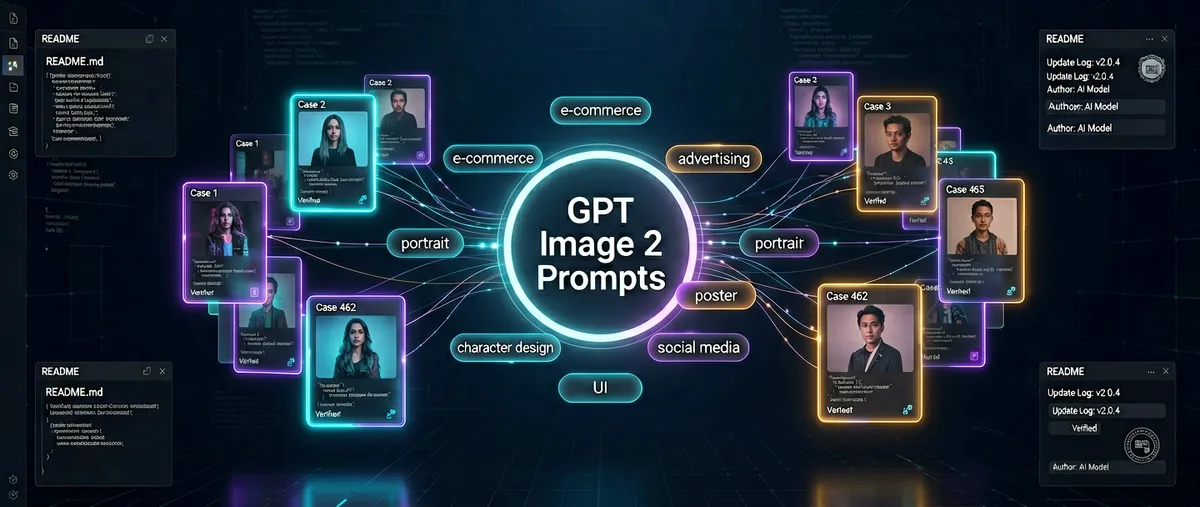
awesome-gpt-image-2-API-and-Prompts: 462 curated, traceable prompts for GPT Image 2
EvoLinkAI/awesome-gpt-image-2-API-and-Prompts · 17,245★ · 1,738 forks
A library of 462 curated prompt cases for GPT Image 2, OpenAI’s image generation and editing model, maintained by the EvoLink team and updated in near-daily batches.
What it is
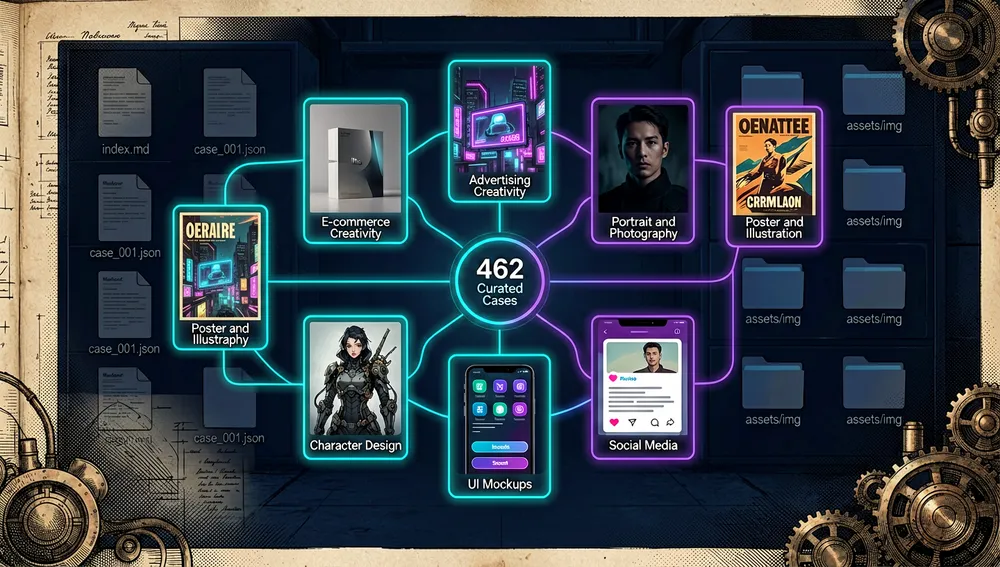
awesome-gpt-image-2-API-and-Prompts is a prompt library, not an executable tool. Its core product is 462 curated cases, numbered continuously from Case 1 to Case 462, each with a title, the output image, the full prompt text in a code block, and attribution to the original author (almost always a public X/Twitter post).
The README describes the collection as “prompt-first”: you browse by category, copy a complete prompt, and adapt its variables or constraints to your own image. The categories are e-commerce, advertising creativity, portrait and photography, poster and illustration, character design, UI mockups and social media, and community comparisons/examples. The canonical reading is in English, and the categories and READMEs are localized into ten additional languages: Spanish, Portuguese, Japanese, Korean, German, French, Turkish, Traditional Chinese, Simplified Chinese, and Russian.
The name includes “API,” but the current README contains no runtime instructions for any API: as of July 16, 2026 the repository was deliberately repositioned as a pure prompt library, and the API pieces are linked out to separate repositories and documentation (see The Ecosystem).
Origin
The repository was created on April 18, 2026 by the GitHub user account EvoLinkAI, whose homepage points to evolink.ai, a commercial service offering access to language, image, and video models through a single API (“Access leading LLM, image, and video models through one EvoLink API,” per the Evolink-AI organization’s description).
The timeline is the most telling detail. Hacker News thread 47854083 “GPT Image 2 Launch” (April 21, 2026, 5 points) links the model’s announcement on X, and the GitHub API shows the first case recorded in the repo’s source registry (data/ingested_tweets.json) dates to April 22, 2026. The repository was thus born right in GPT Image 2’s preview window: issue #5, where a user flags an old prompt as marked inappropriate, gets a maintainer reply explaining it “probably came from the initial preview phase, when the moderation threshold was looser.”
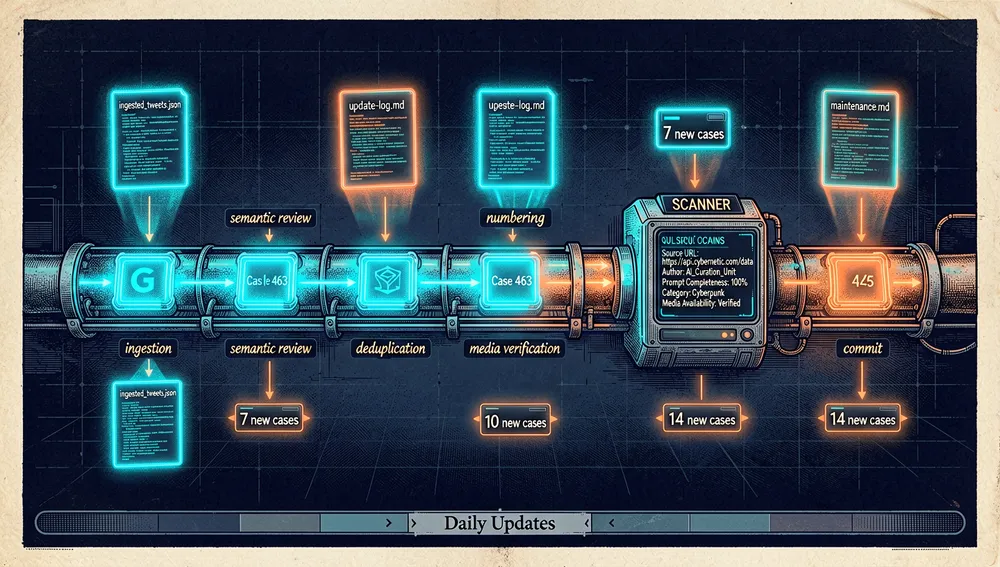
Maintenance runs on a “daily image-prompt update loop”: the changelog (docs/update-log.md) documents batches of 7 to 14 new cases nearly every day between June 14 and June 30, 2026, each one selected “through semantic review and checked for source, prompt boundary, deduplication, and media availability before modifying the repository.” The maintenance docs (docs/maintenance.md) further reveal that the pipeline runs with coding agents: the process’s local artifacts live under ignored .codex/ paths, indicating that curation, review, and syncing the eleven READMEs are automated with a Codex agent.
Philosophy and principles
The verifiable principles documented in the repository itself:
- Prompt first, not infrastructure: on July 16, 2026 the repository was repositioned as a pure prompt library; the API instructions were extracted and turned into links to independent repositories and documentation. The README says it explicitly: “this repository owns the curated prompt library; API automation, invocable skills, and image-to-video flows are separate surfaces.”
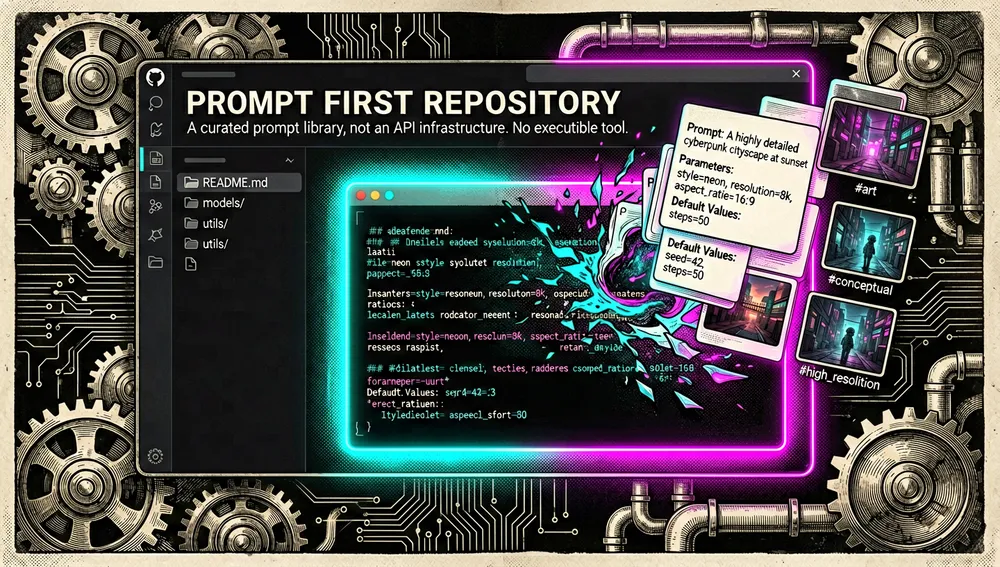
- Public source and traceability: a case only gets in if it has an original public URL, an author, a complete reusable prompt, a category, verifiable media, and a deduplication key (usually the source URL). Candidates that are “deferred, doubtful, rejected, duplicated, or incomplete don’t enter the public prompt sections.”
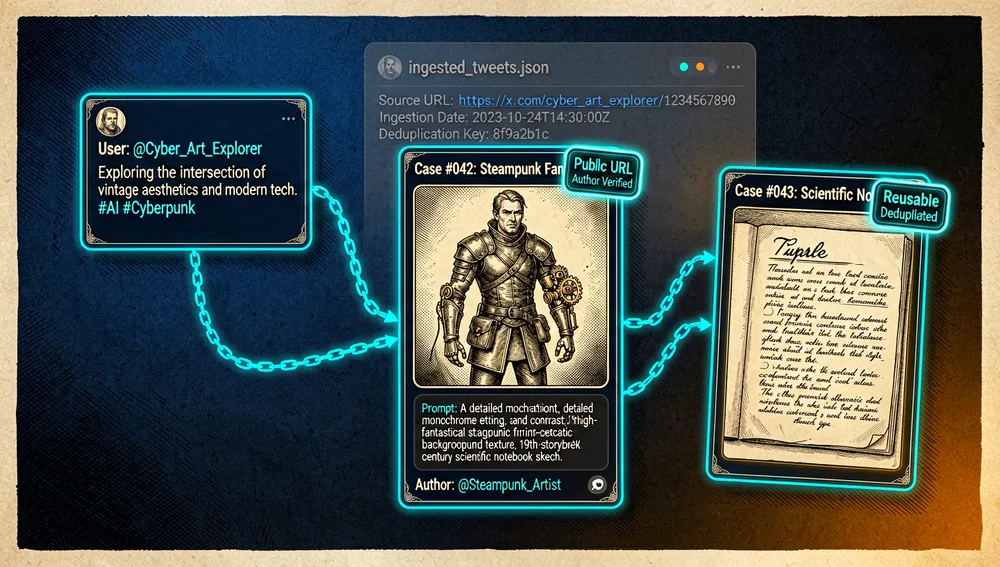
- Attribution as the norm: every case links the author’s original post; the Acknowledge section lists hundreds of X creators, with the honest caveat that “we cannot guarantee every case is attributed to the original creator,” plus a channel to correct attributions.
- Single canonical domain: the English README is the source of truth; exactly 462 unique sources numbered continuously, with localizations preserving that order and numbering.
- Reproducibility, not a gallery: showcase posts without a public prompt “cannot be presented as reproducible prompt cases.”
How it works
The repository is a Markdown corpus with an automated maintenance infrastructure:
- Ingestion: prompts are collected from public posts (almost exclusively X/Twitter) and logged in
data/ingested_tweets.json, which acts as the source-URL registry for deduplication and provenance. - Semantic review: each candidate gets a decision (selected/high confidence, deferred, doubtful, rejected) with a reason; only selected ones move forward.
- Global numbering: the next
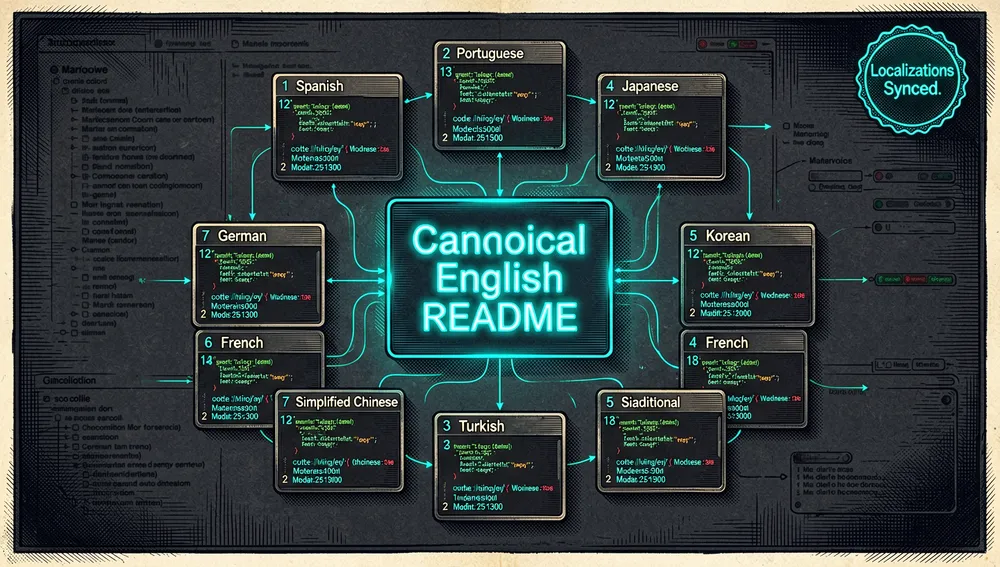
Case Nnumber is assigned from the English README, andREADME.md, the matching category page incases/*.md, the source-index anchor, the media, and the changelog are all updated. - Localization: the eleven README files and category pages are translated with “real visible-text translation”; prompt blocks, URLs, and model identifiers are not translated.
- Verification:
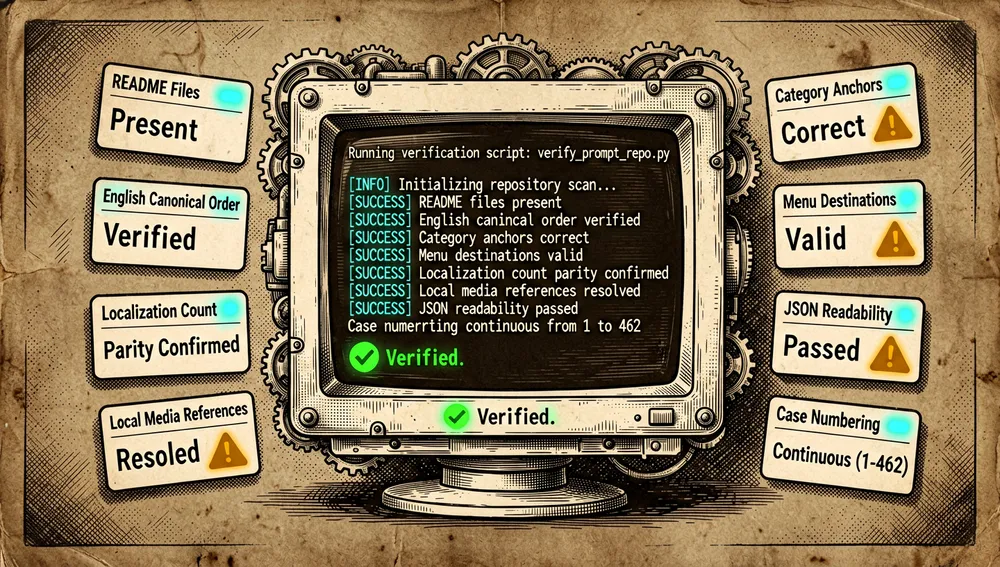
python3 scripts/verify_prompt_repo.pyruns, checking the required README set, heading order and anchors, menu destinations, count parity across localizations, referenced local media, and JSON readability, among other things.
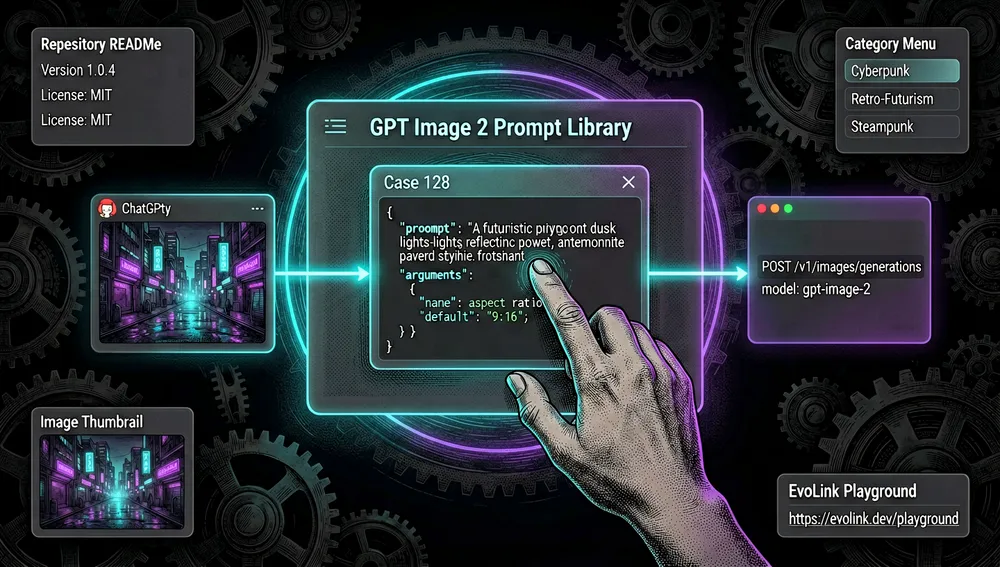
A case’s format is uniform: a title linking to the public source, an output image (300px, hosted in the repository and linked to the EvoLink site), and the full prompt in an untagged code block. Some prompts use argument placeholders like {argument name="aspect ratio" default="9:16"} to mark variables with defaults, e.g. aspect ratio, video duration, or product name.
The ecosystem
The Evolink-AI organization (36 public repositories)
The Evolink-AI organization describes its mission as “accessing leading LLM, image, and video models through one EvoLink API.” Among its repositories, the most relevant to this project (GitHub API figures, August 25, 2026):
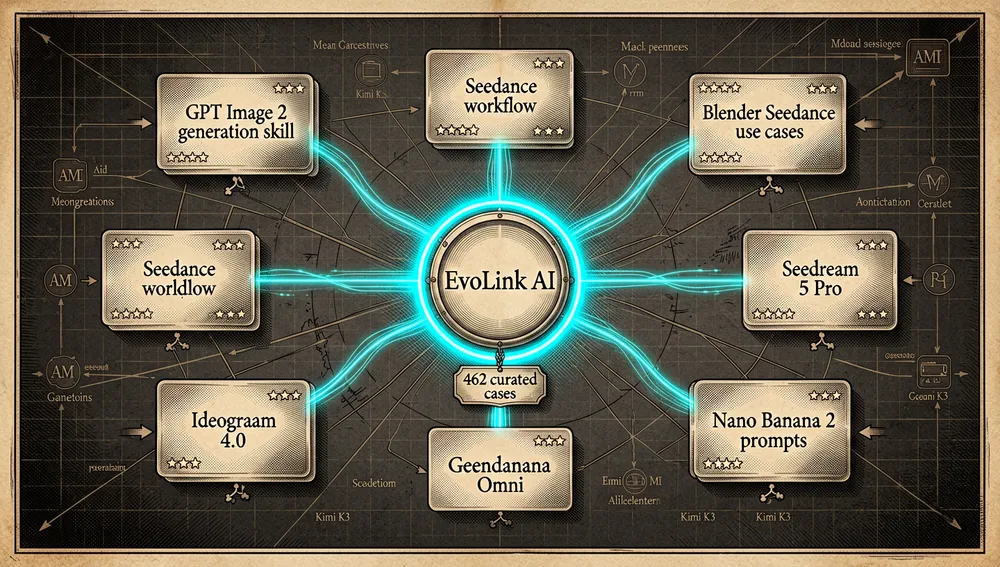
Evolink-AI/gpt-image-2-gen-skill: the API package and invocable agent skill for GPT Image 2; 0 stars. It’s the execution “companion” repo the README points to.Evolink-AI/GPT-Image-2-Seedance2-Workflow: GPT Image 2 → Seedance 2 image-to-video workflows; 4 stars and 2 forks.Evolink-AI/awesome-gpt-image-2-API-and-Prompts: a copy of this same repository under the organization; 74 stars and 16 forks. (Note: on August 25, 2026, the direct endpoint for both preceding repositories returned 404 even though the org’s repo list includes them; this looks like a recent visibility or rename change, so the org-list figure is cited.)Evolink-AI/Awesome-Blender-Seedance-Workflow-Usecases: Blender + Seedance workflows for AI filmmaking (previs, camera control, Blender MCP); 344 stars and 26 forks.Evolink-AI/awesome-kimi-k3-usecases: Kimi K3 use cases; 61 stars and 6 forks.Evolink-AI/awesome-seedream-5-pro-guide-and-prompt: a Seedream 5.0 Pro guide; 26 stars and 2 forks.
Sibling repositories under the EvoLinkAI account
The same account maintains parallel prompt collections and per-model guides:
EvoLinkAI/awesome-seedance-2.5-guide: an official Seedance 2.5 guide with 36 official media assets; 392 stars and 44 forks.EvoLinkAI/awesome-openclaw-usecases-moltbook: OpenClaw automation examples from Moltbook; 999 stars and 109 forks.EvoLinkAI/awesome-seedance-2.5-prompts: Seedance 2.5 prompt patterns; 167 stars and 24 forks.EvoLinkAI/awesome-claude-fable-5: Claude Fable 5 use cases; 50 stars and 4 forks.EvoLinkAI/awesome-ideogram-4.0-prompts: Ideogram 4.0 prompts (typography, portraits, mockups); 36 stars and 3 forks.EvoLinkAI/awesome-gemini-omni-guide-api-and-prompt: a Gemini Omni prompt and API guide; 24 stars and 2 forks.EvoLinkAI/Awesome-Nano-Banana-2-prompt: 100+ Nano Banana 2 prompts; 25 stars and 6 forks.EvoLinkAI/ai-short-drama: a self-hosted novel-to-video platform with 20+ models (Kling, Seedance 2.0, FLUX, Veo); 21 stars and 9 forks.
Community extensions and forks
1061700625/image2-prompt-picker: a browser extension a user built for “quick retrieval” of prompts, “insertable directly into ChatGPT,” shared in the repository’s own issue #14. Its star count wasn’t verified in this run.- Localizations aren’t forks: the ten languages live in the same repository (
README_<language>.mdandcases/*_<language>.md), which keeps them always in sync via the maintenance pipeline.
The GPT Image 2 model’s footprint
The repository builds on OpenAI’s model rather than creating it. GPT Image 2 is natively integrated into ChatGPT and available via the OpenAI API (/v1/images/generations), per the README. Launch thread: 47854083 (April 21, 2026).
Official / semi-official status
The repository has no official status from OpenAI: it’s a third-party project maintained by the EvoLink team (EvoLinkAI / Evolink-AI), a commercial model-API vendor. Its relationship to OpenAI is that of any community prompt library built on someone else’s model.
In practice it functions as a de-facto standard within a specific niche: it’s the highest-starred GPT Image 2 prompt library found in this run (16,922, versus 15,917 for freestylefly/awesome-gpt-image-2 and 9,430 for YouMind-OpenLab/awesome-gpt-image-2). At the same time, the repository is an acquisition asset for EvoLink itself: the README links banners, badges, and every output image with UTM parameters pointing to evolink.ai/gpt-image-2-prompts and EvoLink’s GPT Image 2 playground. Open curation, then, is marketing with real technical substance: the deduplication, semantic-review, and automated-verification infrastructure documented in docs/maintenance.md is genuinely notable, but its ultimate beneficiary is the commercial service.
Quick-start guide
Since it’s a library, not a CLI, “getting started” means reading and copying prompts.
Installation and first launch
There’s no installation: you browse the README or clone the repository.
git clone https://github.com/EvoLinkAI/awesome-gpt-image-2-API-and-Prompts.gitThe Quick Start documented in the README has four steps: (1) browse the menu categories and pick a case close to your goal; (2) copy the full text of the case’s Prompt block; (3) try the prompt with GPT Image 2 (the README links EvoLink’s playground; for OpenAI, this is equivalent to calling POST /v1/images/generations with the gpt-image-2 model, per the README’s own “What is GPT Image 2” section) and upload the input image the case shows, if any; (4) refine variables, composition, style, or output constraints and save the version that works.
Common workflows
- For a diorama-style product ad: open
cases/ecommerce.md, find Case 1 (a cosmetics diorama with miniature workers, by @Strength04_X), copy the full prompt, and swap in your brand name and palette colors. The prompt specifies studio style, diffuse lighting, and a tilt-shift aesthetic. - For a 9-panel TVC storyboard: Case 2 (by @Magncsans) turns a product photo into a 9-panel storyboard with titles and timing in Chinese, with
{argument name="video duration" default="15-second"}and{argument name="aspect ratio" default="9:16"}variables to adjust duration and format. - For a portrait with a style reference: browse
cases/portrait.md(140 canonical cases per the section header), copy the prompt from a case like the Convenience Store Neon Portrait (Case 52), and change the subject and setting description. - For comparing models or styles: the README’s Comparison & Community Examples section aggregates cross-brand and cross-model contrast cases (e.g. the Coca-Cola/Pepsi/7Up KV comparison, Case 31).
Essential configuration
There are no user configuration files; the “settings” are the prompts’ own argument placeholders:
{argument name="aspect ratio" default="9:16"}: output ratio; vertical advertising cases use 9:16.{argument name="video duration" default="15-second"}: the duration declared in storyboard scripts.{argument name="product name" default="..."}: the product name to insert into the composition.- The input image: several editing cases (reframing, storyboarding from a photo) require uploading the reference image alongside the prompt.
- The category: picking a
cases/<category>.mdpage is equivalent to filtering the set; each page carries its own count.
Common pitfalls and fixes
- The prompt shown isn’t the prompt ChatGPT actually runs: issue #8 documents (and the maintainer confirms) that ChatGPT internally rewrites the prompt before calling the generation tool; the repository documents the user-visible prompt, which is the reproducible one, not the internal rewritten version. For deep reproducibility analysis, that rewrite is an implementation detail that varies between sessions.
- Old prompts blocked by moderation: issue #5 reports a prompt flagged as inappropriate; the maintainer’s reply is that the preview phase had a looser moderation threshold and that “some old prompts may be blocked now even though they worked before,” with review and updates pending.
- Image doesn’t match the prompt, or is broken: issues #9 (“Case 60 image does not match the prompt”) and #15 (“Image in case is failed”) show that media verification isn’t perfect; the repository invites issues to fix them.
- Not every post is a case: posts without a public prompt aren’t reproducible; CONTRIBUTING.md forbids presenting them as cases.
Integrations and migration
- OpenAI API: prompts are used directly against
POST /v1/images/generationswith thegpt-image-2model (per the README). - EvoLink API: the repository links the official
docs.evolink.aidocs and the invocable skillEvolink-AI/gpt-image-2-gen-skillfor agents. - Image-to-video flow:
Evolink-AI/GPT-Image-2-Seedance2-Workflowchains GPT Image 2 with Seedance 2 for video production. - Extensions:
1061700625/image2-prompt-pickerinserts prompt search into ChatGPT. - Migrating from other collections: competing collections (freestylefly, YouMind) use the same “prompt + output image” pattern, so a user can move from one to another by copying prompts with no friction; the difference is size, language, and structure level (see Comparison).
Repo numbers
Measured: August 25, 2026, GitHub API.
| Metric | Value |
|---|---|
| Stars | 16,922 |
| Forks | 1,707 |
| Commits (main branch) | 151 |
| Open issues per API | 4 |
| Reported language | Python (65 KB; corresponds to the verification script; the actual content is Markdown) |
| License | CC0 1.0 Universal |
| Created | April 18, 2026 |
| Last push | July 18, 2026 |
| Releases | None (the repository doesn’t use release tags) |
The only contributor returned by the API is EvoLinkAI, with all 151 contributions; the entire commit history comes from that account, consistent with automated pipeline maintenance. The count of 151 was obtained from the commits API’s pagination header (per_page=1).
Caveats: GitHub’s API uses open_issues_count, which can include open pull requests; also, in the general response watchers_count mirrors star count, so no separate subscriber figure is reported.
How to contribute
The process is documented in CONTRIBUTING.md and in the issue form:
- Via issue (recommended): use the prompt-submission template (
issues/new?template=submit-prompt.yml) with: a short title; the full prompt exactly as publicly shared; the original public URL (or a statement that the issue is the original post); the original author’s name and profile; category; at least one output image; input media if the output depends on it; and confirmation of rights over the prompt and media. Inventing prompt text, authors, dates, or missing outputs is forbidden. - Via pull request: (1) a focused branch; (2) update the English source,
README.md, first; (3) keep the matchingcases/*.mdpage and thedata/ingested_tweets.jsonindex consistent; (4) update the ten localized READMEs when the visible structure or public text changes (prompt blocks, URLs, and model identifiers aren’t translated); (5) add an entry todocs/update-log.md; (6) fill in the PR template. - Local verification: run from the repo root:
python3 scripts/verify_prompt_repo.py python3 -m json.tool data/ingested_tweets.json git diff --check - Media rules and limits: don’t add raw video as visible media (use a poster image linked to the video); don’t commit secrets or internal
.codex/evidence; don’t add files over 25 MB without a logged decision; maintainers may migrate media to EvoLink R2 before publishing. - Repository boundary: a PR that changes executable API material or skill-release material requires a separately approved scope and audit by the sibling agent; it’s not accepted in the normal flow.
How the community received it
The evidence gathered shows adoption via stars (16,922 in four months, one of the niche’s three largest collections) and mostly Chinese-language active usage, but also a notable absence of public English-language debate:
- Hacker News: there’s no thread of any significance dedicated to this repository. The closest submissions are tangential: 47875556 “GPT Image 2 Prompts” (2 points, 1 comment) links to youmind.com (the competing project, not this repo); 47801925 “Show HN: A collection of GPT-IMAGE-2 prompts from X(Twitter)” (2 points, 0 comments) links to gptimage2.one (another collection); 47862528 “What makes gpt-image-2 so good?” (2 points, 1 comment), where user immanuwell argues that “it’s mostly the architecture, not just the dataset; reasoning before rendering is what sets it apart.” None of these threads evaluates this repository.
- Issue #8 (“Observation: user prompt and final image-generation prompt can differ,” closed): a user documented, with evidence from ChatGPT’s conversation API, that the internally rewritten prompt differs from the visible one; the maintainer confirmed the finding and clarified the repository’s policy (document the visible, reproducible prompt). It’s the most substantive criticism found: an inherent reproducibility limit in the corpus.
- Issue #5 (“提示词涉黄了” — “the prompt is NSFW,” 4 comments, closed): users flag an inappropriate-content prompt; the maintainer replies that it came from the looser-moderation preview phase and promises review. It’s evidence that automatic ingestion of X posts crossed a window of lower restrictions.
- Issue #6 (“优化建议: 添加提示词评分系统和模板系统” — “optimization suggestion: add a prompt scoring system and template system,” closed): user upclose proposes a prompt scoring system (clarity, detail, creativity), a template system, batch-processing scripts, and automated tests; the maintainer files it “as a grouped feature request for future planning.”
- Issue #14 (closed): a user shares their browser extension
1061700625/image2-prompt-pickerfor quick prompt search inside ChatGPT; it shows practical use beyond passive consumption. - Issues #9 and #15 (closed): “Case 60 image does not match the prompt” and “Image in case is failed”; examples of image-prompt mismatch and broken media that the community reports and the maintainer resolves.
- Issue #21 (closed at the author’s request): a “free and unlimited” GPT Image 2 usage tutorial for encreaa.ai; shows how the repository is used as a traffic magnet toward alternative API services.
The user base skews heavily Chinese-language (several issues are in Chinese, there are complete zh-CN/zh-TW localizations, and canonical Chinese cases like the Coca-Cola/Pepsi/7Up KV), suggesting strong adoption in the Chinese digital-marketing market, though the origin of the stars couldn’t be statistically verified.
awesome-gpt-image-2-API-and-Prompts versus other approaches
| Project | Verifiable overlap | Verifiable difference |
|---|---|---|
freestylefly/awesome-gpt-image-2 | A GPT Image 2 prompt library with cases and images; 15,917 stars and 1,675 forks, created April 25, 2026. | Positions itself as “Prompt as Code” / an industrial engine: 530+ reverse-engineered cases, 20+ industrial templates, and distilled “Skills”; its own site at gpt-image2.canghe.ai. |
YouMind-OpenLab/awesome-gpt-image-2 | A GPT Image 2 prompt library with preview images; 9,430 stars and 857 forks, created April 16, 2026. | Claims to be the “world’s largest,” with 2,000+ prompts updated daily and 16 languages; sits behind youmind.com, a commercial AI research product. |
davidwuw0811-boop/awesome-gpt-image2-prompts | A collection of 490 GPT Image 2 prompts; 288 stars. | Adds Chinese-English search, category filtering, and one-click copy (a web app). |
itgoyo/awesome-gpt-image2-prompt | 612 prompts with example images; 122 stars. | A bilingual collection more geared toward static browsing. |
chujianyun/awesome-gpt-image2-ppt-skills | GPT Image 2 prompts; 161 stars. | Specialized for slide decks (PPT) and skills. |
BigPengSays/awesome-gpt-image-2-prompts | 500 “copy-ready” prompts with source attribution and daily updates; 83 stars. | Exports structured JSON/CSV (GptImageLab). |
T8mars/comfyui-gpt-image2-prompt-T8 | GPT Image 2 prompts; 73 stars. | It’s a ComfyUI node: integrates the collection directly into ComfyUI workflows. |
indreamai/awesome-gpt-image-2-prompts | A collection with previews; 21 stars. | Claims 7,000+ prompts updated daily (self-reported, unverified). |
The most useful comparison isn’t by size: this repository stands out for its documented maintenance infrastructure (source registry, deduplication, script-based verification, synced localization), while freestylefly stands out for its “prompt as code” approach with templates, and YouMind for volume and its associated web product.
Use cases
- Marketing and e-commerce teams who need product imagery without a photographer: the e-commerce category (miniature dioramas, 9-panel storyboards, hero product shots) and advertising creativity (watch, fragrance, and food campaigns) offer proven prompts with variables for brand name, ratio, and duration, ready to adapt to a specific product.
- Creators and agencies in the Chinese market (the most visible audience in the issues): cases include TVC scripts with Chinese titles and copy, Chinese-brand KVs, and complete zh-CN/zh-TW localizations; the repository is a pattern base for domestic-product digital advertising.
- Poster, portrait, and character designers: the poster/illustration (170 canonical cases per the section header), portrait (140), and character (20) categories cover photographic, illustration, and concept styles, each with attribution to the original artist as a style reference.
- Developers calling the GPT Image 2 API (OpenAI or EvoLink): the prompts serve as starting points for
POST /v1/images/generations, and theEvolink-AI/gpt-image-2-gen-skillskill lets an agent use them invocably. - Image-to-video production teams: the same ecosystem’s
GPT-Image-2-Seedance2-Workflowuses GPT Image 2 output as Seedance 2’s starting frame; the repository’s storyboard cases (9 panels, keyframes) are the previs material feeding that flow. - Maintainers of prompt collections or curation pipelines:
docs/maintenance.mdis, more than documentation, a fully replicable process: case-acceptance criteria (8 requirements), a JSON source registry for deduplication, batch semantic review, script-based verification, and a publishing checklist; useful as a reference even without contributing to the repository.
Resources
- Repository: https://github.com/EvoLinkAI/awesome-gpt-image-2-API-and-Prompts
- Documentation: maintenance (https://github.com/EvoLinkAI/awesome-gpt-image-2-API-and-Prompts/blob/main/docs/maintenance.md), changelog (https://github.com/EvoLinkAI/awesome-gpt-image-2-API-and-Prompts/blob/main/docs/update-log.md), contributing (https://github.com/EvoLinkAI/awesome-gpt-image-2-API-and-Prompts/blob/main/CONTRIBUTING.md)
- Official page: https://evolink.ai/gpt-image-2-prompts
- API documentation (EvoLink): https://docs.evolink.ai/en/api-manual/image-series/gpt-image-2/gpt-image-2-image-generation
- Official ecosystem skills / workflows: https://github.com/Evolink-AI/gpt-image-2-gen-skill, https://github.com/Evolink-AI/GPT-Image-2-Seedance2-Workflow
- Evolink-AI organization: https://github.com/Evolink-AI
- Comparable collections: https://github.com/freestylefly/awesome-gpt-image-2, https://github.com/YouMind-OpenLab/awesome-gpt-image-2
- Contextual Hacker News threads: https://news.ycombinator.com/item?id=47854083 (GPT Image 2 launch), https://news.ycombinator.com/item?id=47875556, https://news.ycombinator.com/item?id=47862528, https://news.ycombinator.com/item?id=47801925
- Representative issues: 8, 5, 6, 14
- Star history: https://www.star-history.com/#EvoLinkAI/awesome-gpt-image-2-API-and-Prompts&Date
This article combines the README and maintenance documentation of EvoLinkAI/awesome-gpt-image-2-API-and-Prompts, the GitHub API (repository, organization, contributors, issues), GitHub searches for comparable repositories, and Hacker News queries conducted on August 25, 2026. Figures change over time.
Comments