

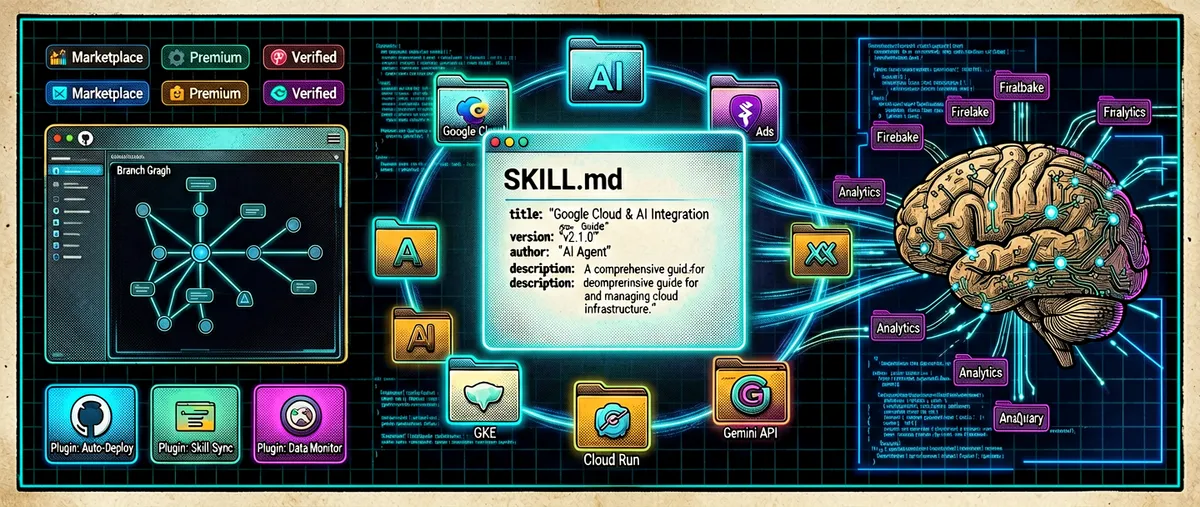
google/skills: Google's official skills for coding agents
google/skills · 20,386★ · 1,678 forks
An “Agent Skills” repository maintained by Google that packages domain knowledge about Google Cloud, Firebase, Google Ads, Analytics, and other technologies into Markdown instructions that coding agents can load on demand.
What it is
google/skills is Google’s official Agent Skills repository for its products and technologies. It’s not an app, a model, or a server: it’s a collection of skills — folders containing a SKILL.md file (metadata plus instructions), optionally accompanied by scripts, references, and templates — that a coding agent can load when a task matches its description.
The README explicitly states the repository is “under active development” and contains skills for Google products, including Google Cloud. The base install documented is npx skills add google/skills, with a selection list to install only the desired skills.
Unlike a traditional plugin that injects a large amount of context, the skills format loads information on demand: the agent reads each skill’s description and only digs deeper when it’s relevant, reducing context bloat.
Origin
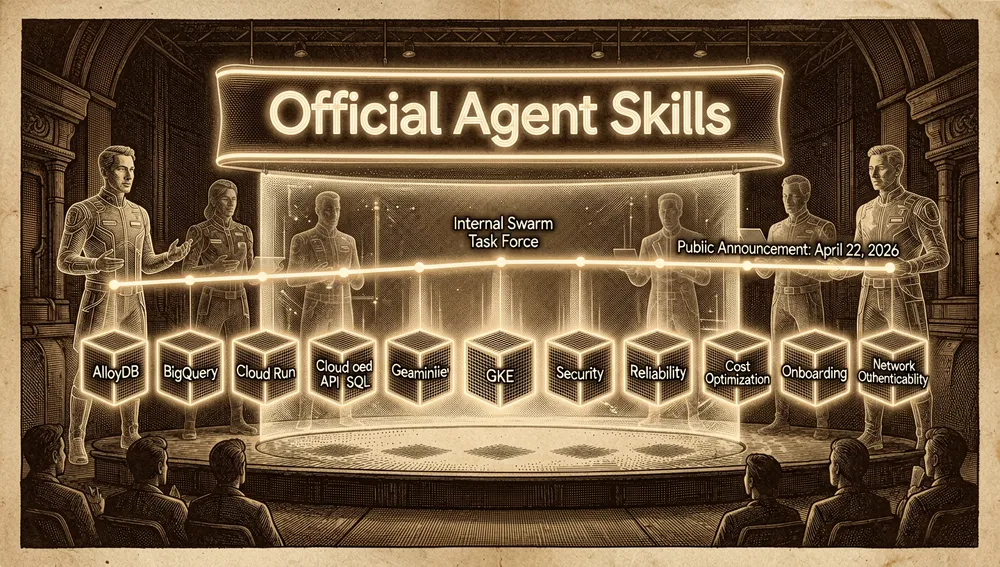
The project started as an internal Google effort called “swarm” (a cross-functional task force of Developer Advocates and Technical Writers) that ramped up ahead of Google Cloud Next 2026, aiming to package Google Cloud domain knowledge into agent-readable instructions.
The public announcement came on April 22, 2026, Day 1 of Google Cloud Next 2026, by Megan O’Keefe (Senior Staff Developer Advocate) on the official Google Cloud blog: “Level Up Your Agents: Announcing Google’s Official Skills Repository.” At that launch, the repository started with thirteen skills, focused on Google Cloud technologies (AlloyDB, BigQuery, Cloud Run, Cloud SQL, Firebase, Gemini API, and GKE), three Well-Architected pillar skills (Security, Reliability, and Cost Optimization), and three “recipes” (onboarding, authentication, and network observability).
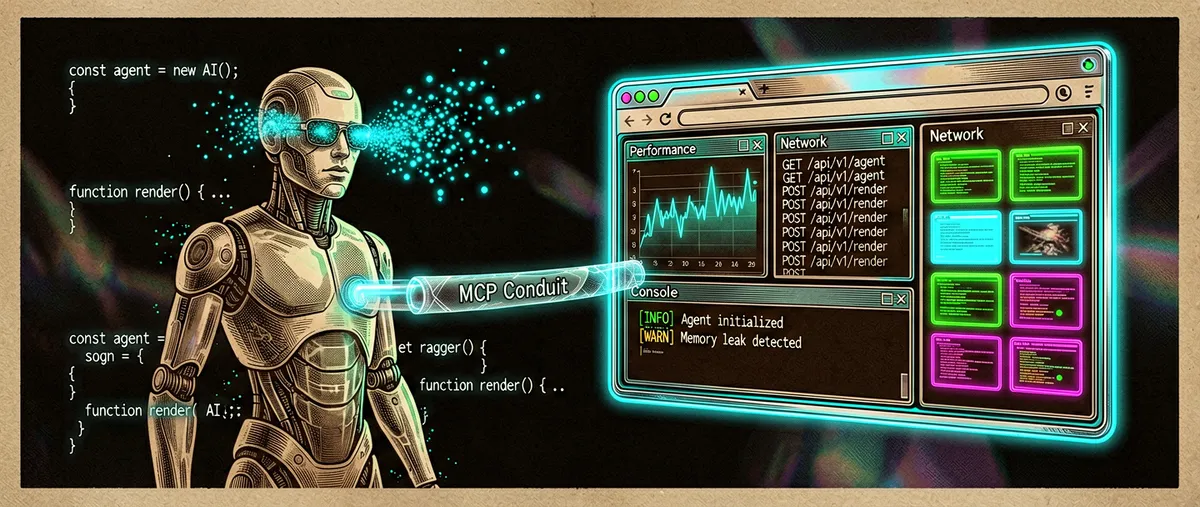
The official account also gives a clear technical motivation: agents can already connect to real-time information sources via MCP servers, but heavy MCP use produces “context bloat” — huge context loads that confuse the model and drive up token cost. Skills are the answer: “compact, agent-oriented documentation for a specific technology or task” that the agent loads only when it needs it.
A second post, “Behind the scenes: How we build, test, and scale Google Agent Skills” (by Remigiusz Samborski, Lead Developer Relations Engineer), describes how the team builds, evaluates, and governs skills: internal validation before publication, automated export to GitHub, CI/CD checks, and continuous evaluations.
Philosophy and principles
The README and blog posts document several verifiable principles:
- Packaged, on-demand knowledge. Each skill is compact procedural documentation the agent loads only when the task matches its description, to reduce context bloat.
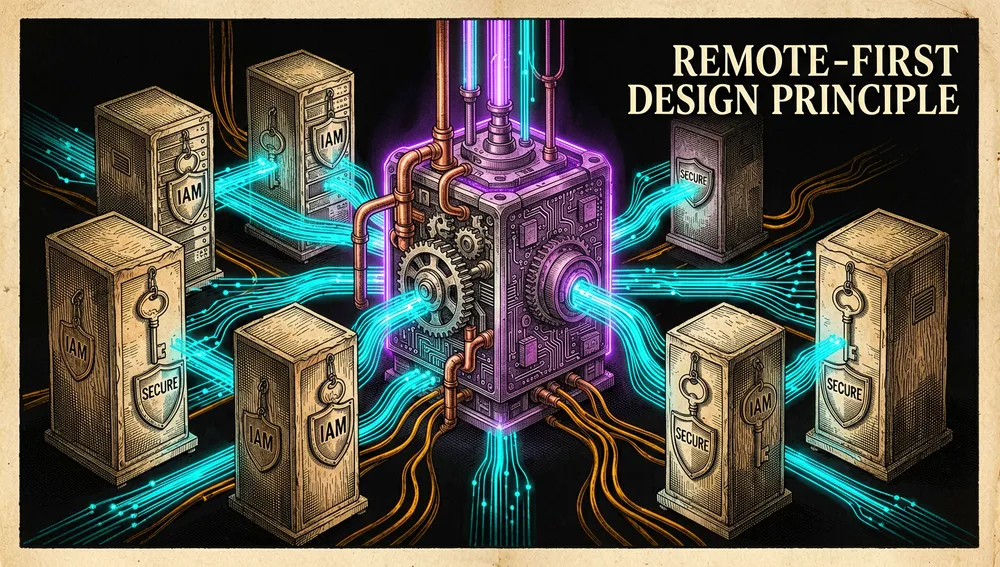
- Preference for remote MCP tools. The stated design principle is: “Reference remote MCP tools whenever possible, falling back to CLI or API calls only when necessary.” Remote MCP servers bring tools, authentication, and IAM governance built in.

- Strict quality and governance. Before a skill enters the repository it must pass a CI/CD pipeline: linters (frontmatter metadata, line count, directory layout, and naming conventions), link checkers (to eliminate 404s and hallucinated links before merge), and AI-assisted checklists.

- Continuous evaluation. Skills are evaluated “on-submit” (authors must provide sets of evaluation prompts and rubrics) and weekly. Agents with and without each skill are compared across two dimensions — accuracy and efficiency (tokens and time) — and run multiple times against different agent frameworks to get statistically significant results.
- Skills are products, not fragments. There are strict ownership rules: repo maintainers oversee the health of the repository and pipelines, and skill owners are responsible for the long-term maintenance of each skill (for example, when a product API changes).
- Governance closed to external contributions. The repository does not accept external pull requests: every skill must pass an internal verification and approval process by Google teams.
How it works
The canonical structure of each skill (per the agentskills.io specification the README points to) is a folder containing:
SKILL.md(required): YAML metadata (minimumnameanddescription) plus Markdown instructions.scripts/,references/,assets/(optional): executable code, reference documentation, and templates or resources.
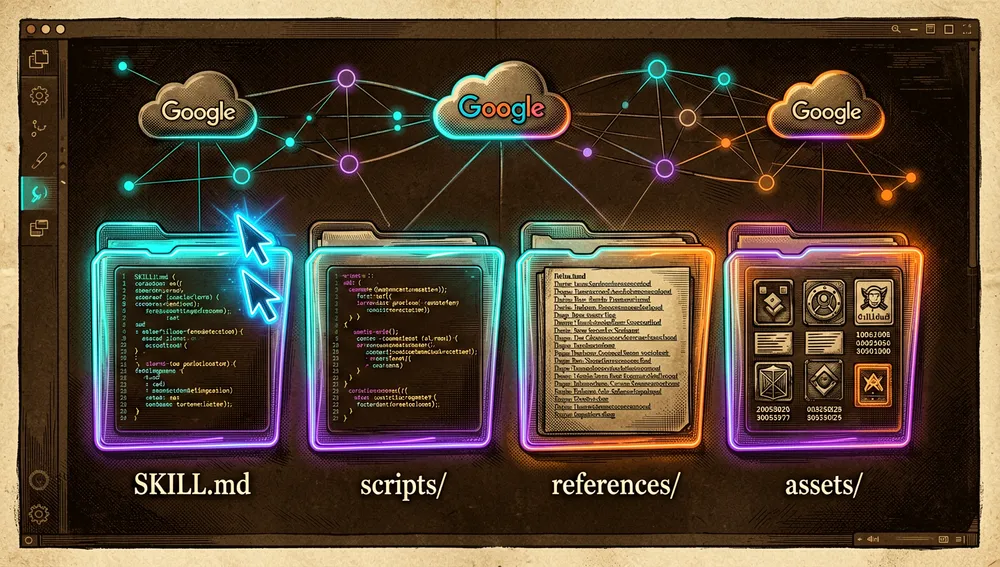
The frontmatter’s description field describes what the skill does and when to use it, and many skills in the repository extend it with a “don’t use for…” clause that steers the agent toward the right skill (for example, gke-basics says “don’t use for specialized networking (use gke-networking)”).
The 114 skills present on the main branch are organized into three top-level categories under skills/: cloud (99), ads (13), and analytics (2). In turn, skills/cloud/ is subdivided into thematic groups visible in the README: getting started and onboarding, multi-product solutions, AI/ML, infrastructure (a large block dedicated to GKE), databases and analytics, developer tools, management tools, the Well-Architected framework, security and identity, and web hosting.
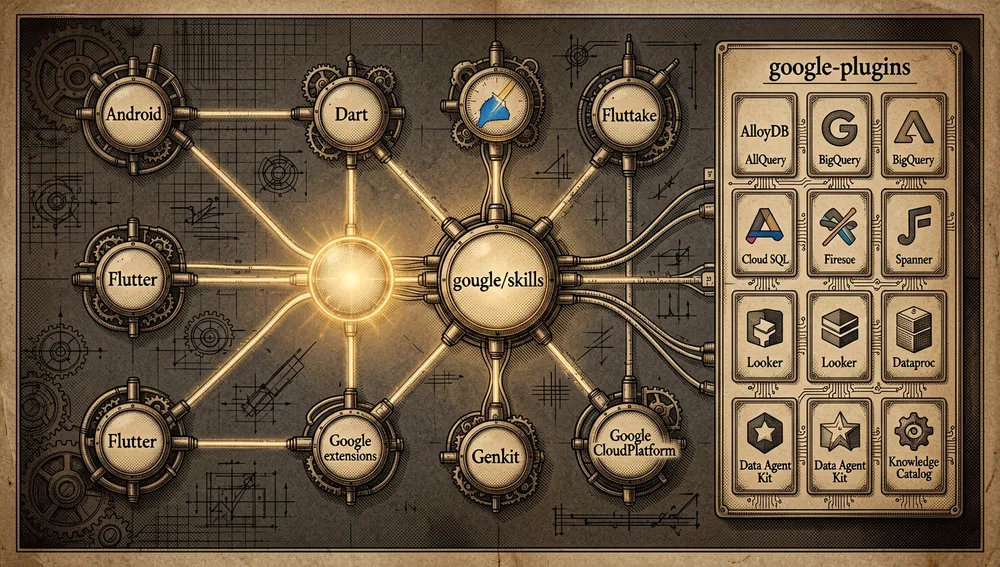
Beyond the skills themselves, the repository groups plugins (skills + MCP servers) for “agent harnesses” in the plugins/ folder and .claude-plugin/marketplace.json. The marketplace.json file defines a marketplace called google-plugins (owner “Google LLC,” version 0.0.1) exposing 16 plugins (AlloyDB, Bigtable, Cloud SQL MySQL/PostgreSQL/SQL Server, Firestore, Data Agent Kit, Google Cloud Storage, Looker, OracleDB, Spanner, Knowledge Catalog, Dataproc, BigQuery, and db-context-engineering), several resolved as git submodules pointing to versioned gemini-cli-extensions/* repositories.
Documented installation varies by harness:
| Harness | Installation |
|---|---|
| Generic (skills.sh) | npx skills add google/skills |
| Claude Code | claude plugin marketplace add google/skills, then claude plugin install <plugin>@google-plugins |
| Codex | codex plugin marketplace add google/skills, then install from the /plugins browser |
| Antigravity CLI | agy plugin install https://github.com/google/skills/<plugin-path> |
The ecosystem
In its “Additional Google skills” section, the repository explicitly links to a family of official Google skill repositories and the ecosystems orbiting them:
gemini-cli-extensions/google-cloud-storage— official Google Cloud Storage skills (bucket and object management, data transfer, MCP, IAM, security, lifecycle, gcsfuse, and Terraform); 23 stars, 2 forks.google/agents-cli— “Agent Development Kit (ADK) Skills,” the CLI and skills that turn any coding assistant into an expert at building, evaluating, and deploying agents on Google Cloud; 5,713 stars, 622 forks.android/skills— Android skills; 6,940 stars, 440 forks.dart-lang/skills— Dart skills; 456 stars, 33 forks.firebase/agent-skills— “Agent Skills for Firebase”; 421 stars, 85 forks.flutter/skills— the README links togithub.com/flutter/skills, which redirects toflutter/agent-plugins; 2,871 stars.genkit-ai/skills— skills that teach agents to build applications with the Genkit framework (JS/TS, Go, Dart); 26 stars, 6 forks.googlemaps/agent-skills— Google Maps Platform skills; 27 stars, 8 forks.
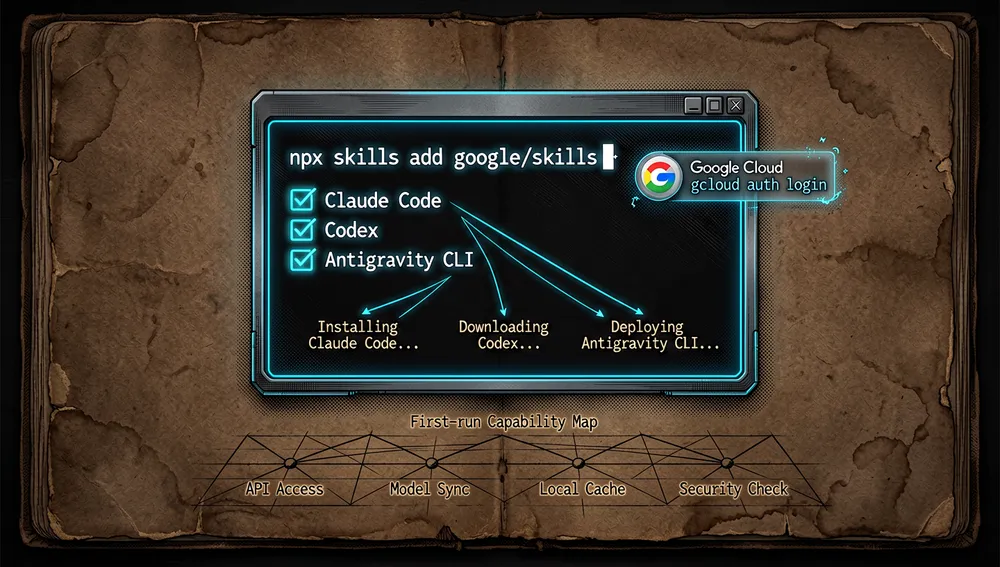
google/skills’s plugins also consume, via submodule, a set of gemini-cli-extensions/* repositories (alloydb, alloydb-omni, bigquery-data-analytics, cloud-sql-*, data-agent-kit-starter-pack, dataproc, firestore-native, google-cloud-storage, knowledge-catalog, looker, oracledb, spanner) and GoogleCloudPlatform/* ones (cloud-bigtable-ecosystem, db-context-enrichment). In practice, google/skills acts as an official aggregation point for Google Cloud skills, while each ecosystem (Android, Dart, Flutter, Firebase, Genkit, Maps) maintains its own.
These figures are what the GitHub API returned during this investigation (August 25, 2026); they don’t constitute a quality or compatibility audit of each derivative.
Official / semi-official status
This repository has directly official status: it’s hosted under Google’s organization on GitHub, was announced as “Google’s official skills repository” by Google Cloud on April 22, 2026 at Google Cloud Next 2026, and the marketplace.json file declares its owner as “Google LLC.”
In practice, this means three verifiable things:
- It’s the official entry point Google offers for giving coding agents domain knowledge of its products — not a community initiative.
- Skills are internally validated and exported in an automated way, giving it the weight of a quality guarantee and updates from Google.
- It acts as the de-facto reference for the “Agent Skills” format within Google’s ecosystem (alongside the skill repositories for Android, Dart, Flutter, Firebase, Genkit, and Maps), and it builds on the open
agentskills.iospecification.
No formal “standard” designation from an external body was found in the sources consulted; its official status is that of a vendor (Google), not a consortium.
Quick-start guide
Installation and first launch
The generic method documented in the README is:
npx skills add google/skills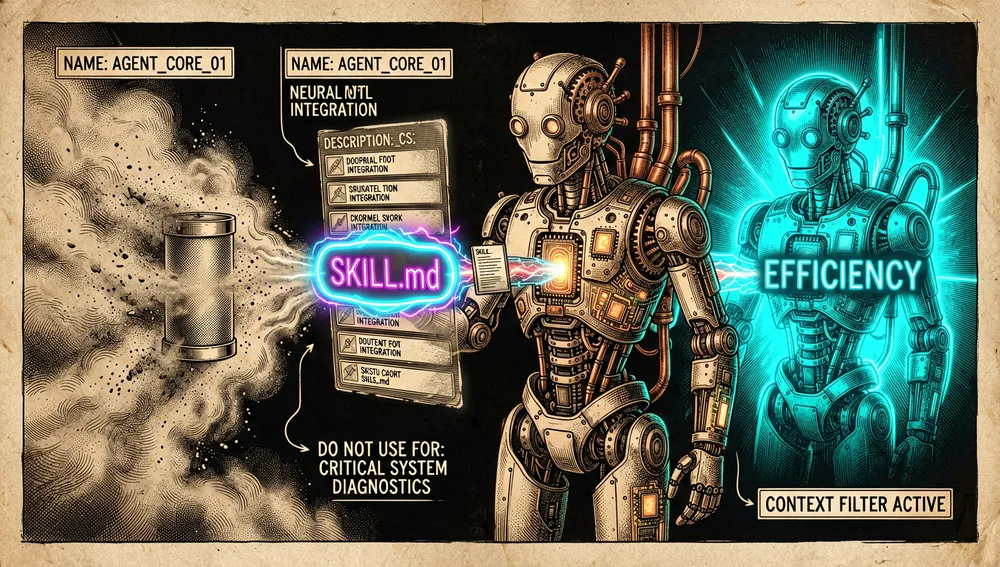
From the install command you can select which specific skills in the repository you want to install instead of all of them. The prerequisites are those of the coding agent itself into which the skills will be loaded (e.g. Claude Code, Codex, or Antigravity CLI), and, for the Google Cloud skills to be useful, an environment authenticated against Google Cloud (gcloud auth login).
For specific agent harnesses:
# Claude Code
claude plugin marketplace add google/skills
claude plugin install <plugin>@google-plugins

# Codex
codex plugin marketplace add google/skills
# then install from the /plugins browser

# Antigravity CLI
agy plugin install https://github.com/google/skills/<plugin-path>
On first launch, the agent gets a set of skills visible in its capability context; from there, activation is automatic based on each skill’s description — there’s no need to invoke a skill by hand.
Common workflows
- To get started with Google Cloud (account, billing, project, and first resource), the agent applies the
google-cloud-recipe-onboardingskill, which documents a non-interactive “happy path”: check the environment, authenticate withgcloud auth login, select or create a project, link the billing account, and deploy the first resource. - To operate
gcloud, thegcloudskill forces the agent to validate subcommand-level syntax withgcloud help <leaf_command>before proposing or running any command, and forbids using web search forgcloudsyntax. The result is a validated command proposal, not an invented one. - To provision a GKE cluster, the
gke-basicsskill drives the Autopilot-vs-Standard decision and applies critical rules (e.g.--enable-private-nodesand--enable-private-endpointfor private clusters, and theiam.gke.io/gcp-service-accountWorkload Identity annotation instead of mounting Service Account JSON keys into pods). - To work with data, skills like
bigquery-basics,bigquery-ai-ml, or thedata-agent-kitplugin let you design pipelines, transform data with dbt, and write Spark/BigQuery SQL notebooks from the agent.
Essential configuration
- Each skill’s
SKILL.md— the central file (name/descriptionmetadata plus instructions). It’s what the agent reads to decide whether the skill applies. - The frontmatter’s
descriptionfield — defines the skill’s trigger (“use when…” / “don’t use for…”). Tuning it is the main lever for controlling when the agent applies or avoids a skill. plugins/and.claude-plugin/marketplace.json— the catalog of plugins (skills + MCP) installed per agent harness.- The chosen agent harness (Claude Code / Codex / Antigravity CLI) — determines the install command and activation mechanism.
- Google Cloud authentication (
gcloud/ IAM) — required for the infrastructure, database, and management skills to actually work.
Common pitfalls and fixes
- External PRs aren’t accepted. If you try to contribute code, the process is to open an issue (bugs, inaccuracies, or anti-pattern security patterns) or request a new skill; direct code contribution isn’t allowed. The open path for experimentation is to fork the repository and remix the skills for your own workflows.
- The repository has no public releases/tags with aggregated release notes (the releases API returns an empty list). Skill “state” is tracked through commits (labeled by the “Cloud IX Team”) and the README’s implicit changelog, not a single semantic tag.
- The
gcloudskills can feel strict. The requirement to validate withgcloud help <leaf>before every command and the ban on web search are intentional (to avoid hallucinated syntax), but they slow down quick flows; it’s documented behavior, not a bug. - Skills change frequently. Weekly evaluations and the “actively under development” nature mean a skill can change between versions; it’s worth pinning the harness and verifying the specific skill if you rely on stable behavior.
Integrations and migration
- MCP. The design principle is to prefer remote MCP tools; skills combine with MCP servers (built-in authentication and IAM). The repository also exposes plugins that bundle skills + MCP.
- Agent harnesses. It integrates with Claude Code, Codex, and Antigravity CLI through their marketplace/plugin mechanisms, and generically via
skills.sh/npx skills. - Migration. Since it’s an instruction repository (not a state one), “migrating” just means installing it on the target agent and letting the Agent Skills format be interpreted by the harness. There’s no user data to port.
Repo numbers
Measured: August 25, 2026, GitHub API.
| Metric | Value |
|---|---|
| Stars | 18,682 |
| Forks | 1,493 |
| Open issues per API | 35 |
| Commits (main branch) | 277 |
| Primary language | Python (also Shell, HCL, Go Template, JavaScript, Dockerfile) |
| License | Apache-2.0 |
| Created | March 31, 2026 |
| Last push | August 24, 2026 |
The top contributors returned by the API, by contribution count, were cloud-ix-copybara (242, an automated sync account for the Cloud IX team), holtskinner (6), martinvarelaj (3), helloeve (1), jsondai (1), and wangauone (1).
Caveats: GitHub’s API uses open_issues_count, which can include open pull requests, so the 35 shouldn’t be read as an issues-only count. The general response’s watchers_count field mirrors star count; no separate subscriber figure is reported. The 277-commit count was obtained from the commits API’s Link pagination header (rel="last" on page 3). The primary language shows as Python, though most of the content is Markdown instruction files.
How to contribute
The process is documented in CONTRIBUTING.md and is notably closed:
- No external pull requests or code contributions are accepted. Every skill must pass a rigorous internal verification and approval process by Google teams to ensure technical accuracy, security, and architectural alignment.
- What you can do:
- Report issues: open an issue if you find a bug, an outdated SDK pattern, or a security anti-pattern in a skill.
- Request new skills: propose Google products or cross-cutting architectural patterns to cover, via the issue tracker.
- Remix and share: forking the repository and remixing the skills for your own specialized workflows is encouraged.
- Internal Google teams: Google team members authoring or updating a skill for their product must consult the internal Agent Skills Program documentation for authoring guidelines and the
SKILL.mdspec.
This constraint explains the repository’s quality-oriented design: instead of an open contributor community, there are skill owners and an internal evaluation pipeline.
How the community received it
The gathered evidence shows adoption boosted by its official origin, but also one concrete criticism about the instructions’ tone:
- Google’s own team states, in the “Behind the scenes” post, that initial community reception exceeded expectations with over 15,000 GitHub stars. That figure is a team claim, not an independent measurement.
- In Hacker News thread 47891283, user v-mdev submitted the launch article (“Google Unveils Agent Skills Repository for Smarter AI Agents”); the submission reached 5 points with 1 comment (the repository link itself).
- In Hacker News thread 48463481, user ulrischa submitted the repository directly (1 point, 1 comment). verdverm’s comment is the most concrete criticism found: “Some of those instructions look like they’re there because gemini is so bad at following instructions. The gemini models are basically unusable for coding right now, they seem to have regressed in capability.” It’s an objection to the need for such detailed instructions, attributed to that user.
- The Agent Skills announcement in Google Antigravity generated Hacker News thread 46613546 (2 points, 0 comments), and the blog.google post “Improve Coding Agents’ Performance with Gemini API Docs MCP and Agent Skills” generated thread 47596867 (2 points, 0 comments).
Taken together, the reception reflects the typical profile of an official vendor resource: adoption driven by Google’s authority, with little extensive critical discussion on Hacker News during the queries performed. No large verifiable Reddit threads were found in this run (Reddit’s JSON endpoint returned an anti-bot page), so no community reactions are inferred beyond what the sources show.
google/skills versus other approaches
| Project | Verifiable overlap | Verifiable difference |
|---|---|---|
obra/superpowers | A skills/instructions library for coding agents that enforces a process. | Superpowers is a single-author initiative focused on development methodology (TDD, planning, review); google/skills is official from Google and focused on domain knowledge of Google products. |
anthropics/skills (and huggingface/skills, MiniMax-AI/skills, slavingia/skills) | “Agent Skills” repositories in the same open format (SKILL.md + instructions) for coding agents. | Each packages its own vendor’s knowledge (Anthropic, Hugging Face, MiniMax); google/skills exclusively covers Google technologies and is internally validated. |
The agentskills.io specification | Defines the open format (folder + SKILL.md with name/description) that all skills repos use. | It’s the specification/format, not a skills repository; google/skills is one implementation of that specification. |
The most useful comparison isn’t by popularity: google/skills stands out when you need domain knowledge of Google products backed by the vendor itself. When you want a cross-cutting development methodology or another vendor’s knowledge, repos like obra/superpowers or the Anthropic/Hugging Face skills are the equivalents for their respective ecosystems.
Use cases
- Engineering teams building on Google Cloud (GKE, BigQuery, Cloud SQL, Spanner, AlloyDB, Cloud Run, Firebase) can load the corresponding skills so their coding agents propose
gcloudcommands, manifests, and architectures that are validated and aligned with Google’s best practices, instead of relying on the model’s (sometimes outdated) knowledge. - Consultants, SREs, and solutions architects designing multi-product solutions (the “solution skills” like solution-architecture, borderless data lakehouse, or n-tier serverless web app) can use the repository as an instruction base so the agent applies the Well-Architected framework (security, reliability, cost, performance, sustainability) when proposing architectures.
- Data and data engineers (BigQuery, BigFrames, Spanner, AlloyDB, Managed Airflow, Data Lineage) can leverage specific skills and the
data-agent-kitplugin to write queries, transform data with dbt, and orchestrate pipelines from the agent. - Ads and Analytics developers (Google Ads API, Data Manager, IMA, Mobile Ads SDK, Analytics Admin/Data API) have dedicated skills for integrations, audience/event ingestion, and migration to the next generation.
- People already using coding agents (Claude Code, Codex, Antigravity) who want to strengthen accuracy on the Google stack without building their own instructions can simply install the skills and, if needed, fork them to adapt to internal workflows.
Resources
- Repository: https://github.com/google/skills
- Documentation / format specification: https://agentskills.io/home · https://agentskills.io/specification
- Official skills / plugins: https://github.com/google/skills/tree/main/skills · the
google-pluginsmarketplace in.claude-plugin/marketplace.json - Installation: https://skills.sh/google/skills (
npx skills add google/skills) - Launch blog post: https://cloud.google.com/blog/topics/developers-practitioners/level-up-your-agents-announcing-googles-official-skills-repository (April 22, 2026)
- “Behind the scenes” blog post: https://cloud.google.com/blog/topics/developers-practitioners/behind-the-scenes-how-we-build-test-and-scale-google-agent-skills
- Agent Skills docs in Antigravity: https://antigravity.google/docs/skills
- Blog post (Gemini API Docs MCP + Agent Skills): https://blog.google/innovation-and-ai/technology/developers-tools/gemini-api-docsmcp-agent-skills/
- Relevant HN threads: 47891283, 48463481, 46613546, 47596867
- Companion repositories (official Google skills):
google/agents-cli,android/skills,dart-lang/skills,firebase/agent-skills,flutter/agent-plugins,genkit-ai/skills,googlemaps/agent-skills,gemini-cli-extensions/google-cloud-storage
This article combines the README, CONTRIBUTING.md, marketplace.json, and .gitmodules of the repository, official Google Cloud blog posts, the agentskills.io specification, and the GitHub API, consulted on August 25, 2026. Star and fork counts for companion repositories and this repo change over time.
Comments