


TradingAgents: a simulated investment desk of language-model agents
TauricResearch/TradingAgents · 108,565★ · 20,803 forks
Everything you need to know about TauricResearch/TradingAgents: a financial research framework that splits analysis, debate, and decision-making across language-model agents.
What TradingAgents is
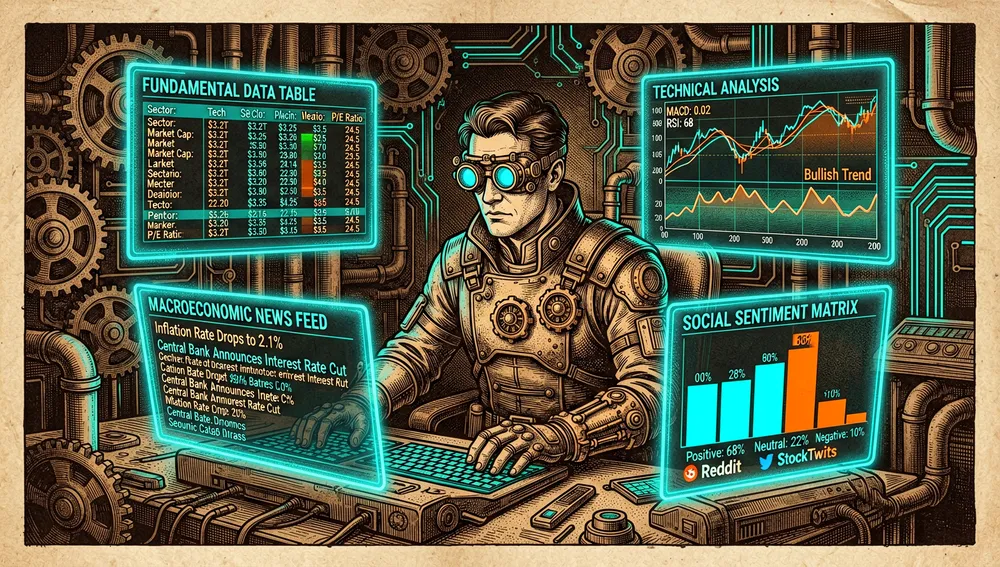
TradingAgents is a multi-agent financial trading framework that tries to reproduce the division of labor of an investment firm. Its technical paper and README describe fundamental, sentiment, news, and technical analysts; bullish and bearish researchers; a trader agent; a risk team; and a portfolio manager who accepts or rejects the final proposal.
The repository presents itself explicitly as a research tool, not financial, investment, or trading advice. The approved decision is sent to a simulated exchange; the documented flow therefore does not justify interpreting its outputs as actionable recommendations or as a guaranteed-return strategy.
The origin: from a 2024 paper to open source
The arXiv paper 2412.20138 was published on December 28, 2024, and credits Yijia Xiao, Edward Sun, Di Luo, and Wei Wang. It argues that language-model financial systems had tended to use either a single agent or several agents gathering data independently, and proposes instead a collaborative dynamic resembling a trading firm.
The Tauric Research organization created the repository on December 28, 2024. The README states that, given the inquiries and enthusiasm the work received, it decided to fully open-source the framework. The API identifies Yijia-Xiao as the lead author by code contributions, but the retrieved sources do not establish a public biography that would support attributing the intellectual creation to him alone; the origin should be understood as the work of the four credited authors and of Tauric Research.
Philosophy and principles
The core idea is not that a single model produces a signal, but that conflicting perspectives are kept separate:
- The analyst team combines fundamental data, technical indicators like MACD and RSI, news, macroeconomic signals, and conversation from StockTwits and Reddit.
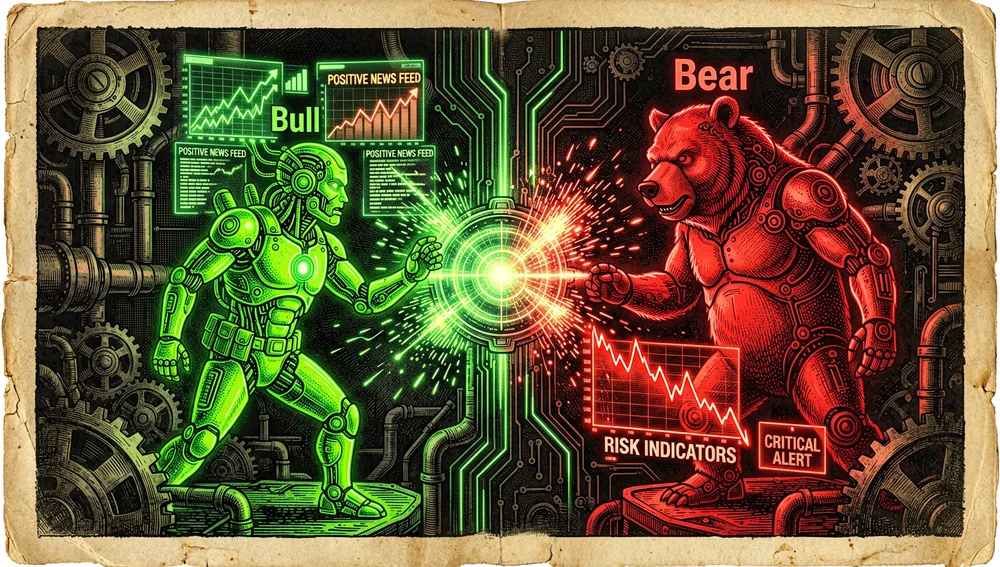
- The bullish and bearish researchers debate the arguments to weigh opportunity against risk before the trade.
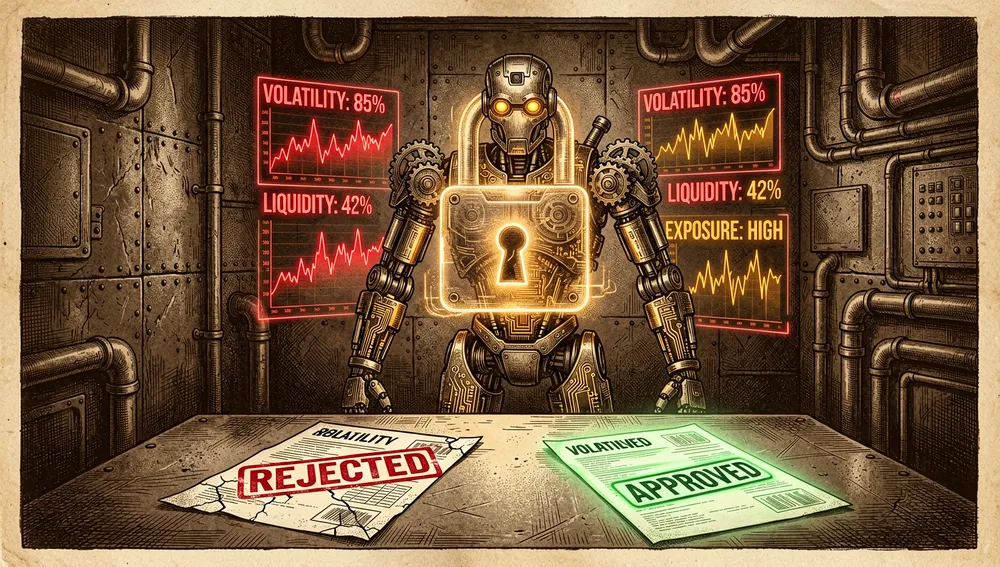
- Risk and portfolio management are the final controls: they evaluate volatility, liquidity, and exposure, and the manager can reject the transaction.
- The paper claims improvements over baseline models in cumulative return, Sharpe ratio, and maximum drawdown; that is a claim made by the authors, not an independent validation retrieved in this research.
The documentation also stresses an important methodological limit: runs are non-deterministic because of model sampling and changing live data. Fixing the date and lowering temperature can reduce variation, but it does not guarantee identical results or necessarily reproduce published outcomes.
How it works
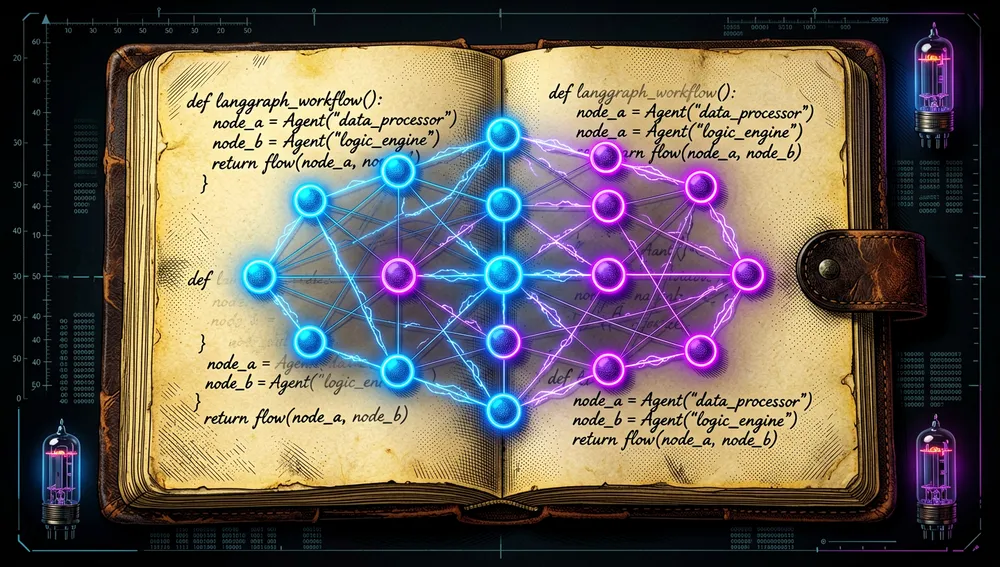
The framework is implemented with LangGraph. Users can launch the interface with tradingagents or python -m cli.main, choosing symbol, analysis date, model provider, and research depth. The Python library exposes TradingAgentsGraph() and its propagate("NVDA", "2026-01-15") method, which returns a decision.
The documented flow is:
- The four specialized analysts prepare their reports.
- The bullish and bearish researchers put those signals through a structured debate.
- The trader agent synthesizes the reports; risk reviews volatility, liquidity, and other factors.
- The portfolio manager approves or rejects the proposal; only an approved proposal reaches the exchange simulator.
It supports OpenAI, Google, Anthropic, xAI, DeepSeek, Qwen, GLM, MiniMax, OpenRouter, Azure OpenAI, AWS Bedrock, and Ollama. It can also connect to an OpenAI-compatible server, such as vLLM, LM Studio, or llama.cpp. The README lists markets covered by Yahoo Finance, including symbols from the US, Hong Kong, Tokyo, London, India, Canada, Australia, Chinese A-shares, and cryptocurrencies.
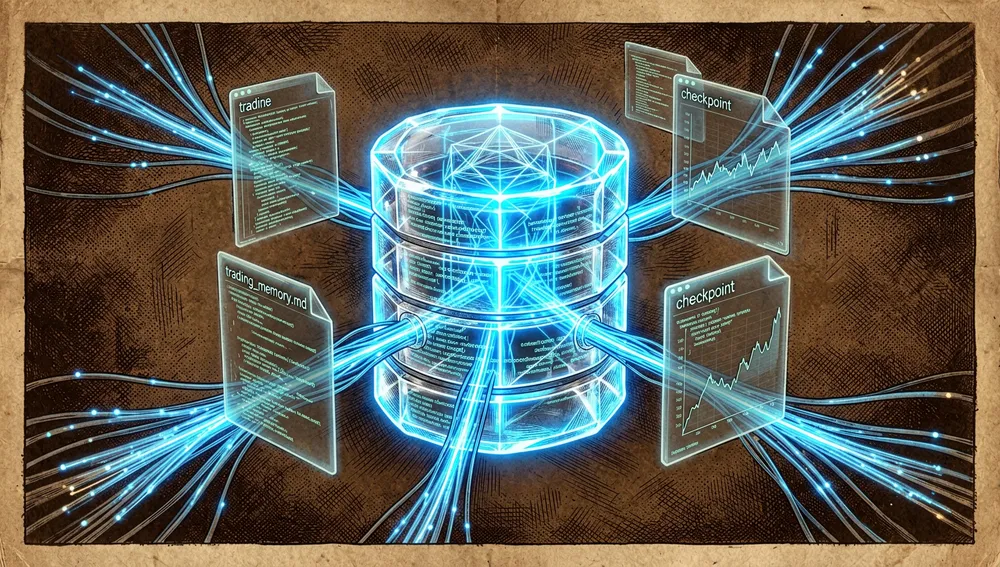
For continuity, it saves decisions to ~/.tradingagents/memory/trading_memory.md; on a later run for the same symbol, it feeds the realized performance and a reflection into the portfolio manager’s message. With tradingagents analyze --checkpoint, LangGraph persists state per node and allows resuming an interrupted run; --clear-checkpoints resets the per-symbol SQLite databases.
Version v0.3.1, released on July 5, 2026, added, among other changes, filtering against improper look-ahead in Alpha Vantage, safe recovery from graph failures, cryptocurrency sentiment sources, configurable retries, and Bedrock API-key authentication.
Official and semi-official status
No evidence was retrieved that TradingAgents has been accepted into a model provider’s official marketplace, nor of a formal endorsement from OpenAI, Anthropic, Google, LangChain/LangGraph, or Yahoo Finance. The README links Discord, X, and Tauric Research’s GitHub community, and states compatibility with providers; that technical compatibility does not equal endorsement by those providers.
Its clearest semi-official standing is academic: the code links directly to its authors’ arXiv paper. Its 95,453 stars and 18,456 forks show adoption on GitHub, but they do not constitute a formal designation as a standard.
The ecosystem
Tauric Research repositories
The organization’s GitHub API returned three public repositories during this measurement:
TauricResearch/Trading-R1— 465 stars; TradingAgents’ README links its January 2026 technical report and announces a future terminal.TauricResearch/TradingAgents— the flagship project, 95,453 stars.TauricResearch/.github— 11 stars; a community configuration repository with no public description in the queried API.

Forks, ports, and community extensions
The repository search and the list of most-starred forks show a community especially active in Chinese markets and alternative interfaces. These are independent projects; no evidence was retrieved that Tauric Research maintains or certifies them.
hsliuping/TradingAgents-CN— a Chinese translation and extension, 30,864 stars.simonlin1212/TradingAgents-astock— an adaptation for Chinese A-shares, with seven analysts and debate; 2,724 stars.KylinMountain/TradingAgents-AShare— an A-share adaptation with 15 agents, visualization, and Docker deployment; 744 stars.guangxiangdebizi/TradingAgents-MCPmode— a variant that claims Model Context Protocol integration; 332 stars.oficcejo/tradingagents— a secondary Chinese development with batch analysis; 127 stars.Tomortec/CryptoTradingAgents— a multi-agent framework for cryptocurrencies; 272 stars.0x0funky/TradingAgents-crypto— a fork focused on cryptocurrencies, 127 stars.TheLocalLab/TradingAgents-GUI— a fork with a local graphical interface for stock analysis, 20 stars.Yung-Chih-Lo/TradingAgents_traditional-chinese— a fork that claims Traditional Chinese responses, 6 stars.lucemia/trading-agents-plugin— a Claude Code extension mentioned on Hacker News; it offers the analysis as a command and claims to avoid an extra API bill by using an existing Claude subscription. It had 13 stars in the queried GitHub search.
The figures in this section come from the GitHub search API and the forks API: they identify visibility, not quality, security, current compatibility, or financial performance.
Repo numbers
Measured: August 3, 2026, GitHub API and page.
| Metric | Value |
|---|---|
| Stars | 95,453 |
| Forks | 18,456 |
| Subscribers | 692 |
| Commits | 257 |
| Open issues reported by the API | 327 |
| Primary language | Python |
| License | Apache-2.0 |
| Created | December 28, 2024 |
| Latest metadata update | August 3, 2026 |
| Latest release | v0.3.1, July 5, 2026 |
The top contributors returned by the API were Yijia-Xiao (201 contributions), EdwardoSunny (13), CadeYu (12), and luohy15 (10). The repository page showed 257 commits. GitHub duplicates the star total in the general watchers_count field; that is why subscribers_count is reported here as the real subscriber figure. Also, open_issues_count may include open pull requests, so 327 does not necessarily equal issues alone.
How to contribute
The README invites contributions of bug fixes, documentation, and feature ideas, and points to the changelog to credit prior contributions. It does not document, in the retrieved text, a mandatory branch, a pull request template, or a specific test suite that contributors must run. The repository structure does include tests/ and a continuous-integration flow visible in .github/workflows, but the consulted sources do not allow turning that into a more detailed contribution procedure.
How the community received it
Verifiable reception on Hacker News is limited and does not support inferring consensus:
- Submission 44249279, posted by
_vaporwave_on June 11, 2025, linked the arXiv paper. When retrieved via Algolia it had 2 points and 0 comments. It shows discovery, not a community assessment. - Submission 45189763, by
mustaphahon September 9, 2025, linked the repository and reached 2 points and 0 comments. It likewise does not provide a verifiable outside opinion. - Submission 47954608, by
rmasonon April 29, 2026, linked the repository and registered 1 point and 0 comments. - In 47987347,
lucemia51introduced a Claude Code extension and called TradingAgents a good multi-agent analysis framework, but objected to the cost of requiring model API keys. His alternative creates seven subagents with the/trading-analysis NVDAcommand and claims to leverage an existing Claude subscription. The thread had 1 point and 1 comment; the only reply, fromvegaxarchitect, suggested trying another service and did not evaluate TradingAgents. It is praise and criticism attributable to the author of an extension, not an independent review.
The project’s own warning about variability and the absence of financial advice comes from the project itself and is not presented here as community criticism.
TradingAgents versus other proposals
| Proposal | Verifiable overlap | Verifiable difference |
|---|---|---|
EthanXiang777/circuit-framework | Described on GitHub as a multi-agent language-model trading research system. | The retrieved description does not allow comparing its internal architecture to TradingAgents’. |
EthanAlgoX/LLM-TradeBot | Presented as a multi-agent, language-model trading system that optimizes strategies and adapts to market conditions. | The retrieved source does not prove it has TradingAgents’ bull/bear debate or portfolio-approval flow. |
Tomortec/CryptoTradingAgents | It is a multi-agent, language-model framework for financial trading. | Its description specializes it in cryptocurrencies; TradingAgents documents international stocks and cryptocurrencies covered by Yahoo Finance. |
huygiatrng/AlpacaTradingAgent | Its description states a multi-agent financial framework based on TradingAgents. | It adds execution through Alpaca, while TradingAgents’ README describes sending the approved proposal to a simulated exchange. |
Use cases and who this repository can help
- Researchers studying coordination among language-model agents in finance can inspect a flow with explicit roles, bull/bear debate, risk control, and an associated technical paper, without mistaking it for investment advice.
- Teams building prototypes that analyze international symbols or cryptocurrencies can use the CLI to set symbol, date, provider, and depth, or integrate
TradingAgentsGraph()in Python; the README documents symbols from multiple exchanges covered by Yahoo Finance. - Those comparing providers or local models can switch between commercial providers, Ollama, or an OpenAI-compatible server while keeping the same agent structure. They will need to measure variation, cost, and quality on their own, since the project states that model responses and live data are not deterministic.
- People running long or interruptible analyses can turn on checkpoints and keep a per-symbol decision log; the feature provides operational recovery and later reflection, not evidence that memory improves profitability on its own.
Resources
- Repository: https://github.com/TauricResearch/TradingAgents
- Documentation and installation: https://github.com/TauricResearch/TradingAgents#installation-and-cli
- Technical paper: https://arxiv.org/abs/2412.20138
- Sibling repository, Trading-R1: https://github.com/TauricResearch/Trading-R1
- Discord community: https://discord.com/invite/hk9PGKShPK
- Discussions: https://news.ycombinator.com/item?id=44249279, https://news.ycombinator.com/item?id=45189763, https://news.ycombinator.com/item?id=47954608, https://news.ycombinator.com/item?id=47987347
Note: this article combines the README and page of TauricResearch/TradingAgents, its arXiv paper, the GitHub API, and Hacker News threads retrieved on August 3, 2026. Figures change over time.
Comments