

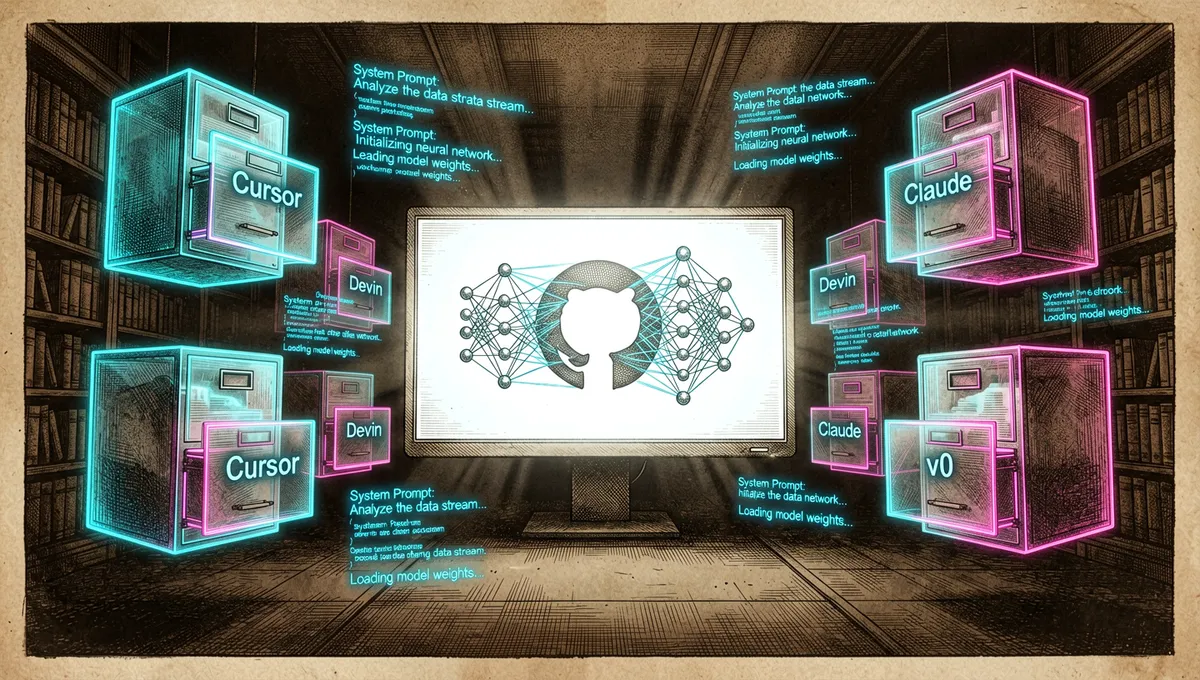
System Prompts and Models of AI Tools: a public archive for examining commercial assistants
x1xhlol/system-prompts-and-models-of-ai-tools · 143,861★ · 34,815 forks
Everything worth knowing about x1xhlol/system-prompts-and-models-of-ai-tools: a community-maintained collection of system texts, tool definitions, and model references for AI assistants.
What System Prompts and Models of AI Tools is
System Prompts and Models of AI Tools is a documentation repository, not a model, an API, or a runnable agent. It gathers files the project presents as system instructions, internal tools, and model data for AI assistants. The repository tree sorts them by product: Amp, Anthropic, Augment Code, Claude Code, Cursor, Devin AI, Google, Kiro, Lovable, Manus, Perplexity, Replit, Trae, Warp, Windsurf, Xcode, and v0, among others.
Its concrete usefulness is for consultation and comparison: it lets readers see how rules, roles, tool schemas, and limits are expressed for an assistant in the included materials. That a file sits in the collection does not by itself prove it remains a provider’s current configuration or that the provider published it. That caveat matters for a collection that also uses the word “leaked” in some of its titles and documents.
The origin: a personal collection that turned collaborative
The GitHub API places the repository’s creation on March 5, 2025. Its creator and main contributor is Lucas Valbuena (x1xhlol): his profile identifies him by that name, lists Spain, and showed 3,763 followers at the time of measurement. The API itself credits the author with 406 contributions, ahead of pricisTrail (28), benja (18), and paulacavero (12).
No independent launch post explaining the founding story was retrieved; therefore, it isn’t verifiable to attribute a narrative beyond the creation date and the public history. The project’s own front page does convey context, though: it opens with a notice to AI companies about the exposure of instructions and models, and links to ZeroLeaks as a service for detecting extraction and injection risks. That framing illustrates the central tension: providers tend to treat these configurations as internal components, while the repository gathers versions the community can inspect and compare.
Philosophy and principles
The observable philosophy is per-file transparency: keeping readable material, sorted by tool, and expandable through contributions. There is no separate technical manifesto or evaluation methodology that guarantees the authenticity, completeness, or currency of each document.
Three practical principles emerge from its own materials:
- Centralize: one folder per assistant avoids scattering texts and schemas across isolated links.
- Preserve operational context: the project includes not only natural-language instructions but also tool definitions and, where available, model references.
- Warn about security: the front page stresses that exposing these configurations can become a target for extraction or injection.
The consequence is that it works better as a source for research, comparative auditing, or historical reference than as an official source of production configuration.
How it works
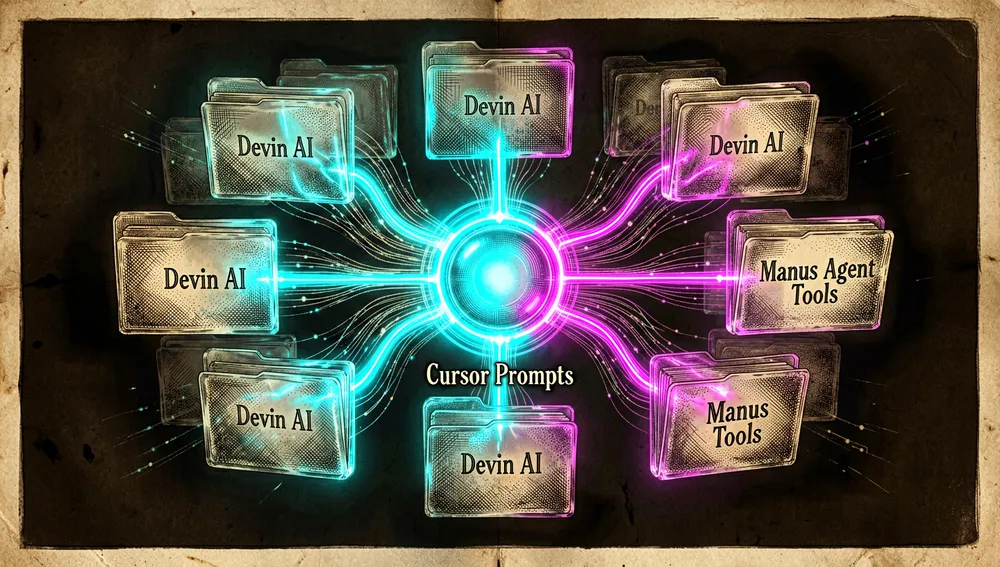
There is no installation, binary, or dedicated command: the documented flow consists of browsing the repository tree, opening the product’s folder, and reading or downloading the corresponding files. The root directory contains, for example, Cursor Prompts, Devin AI, Manus Agent Tools & Prompt, Open Source prompts, Perplexity, and v0 Prompts and Tools.
For a reproducible analysis, a reasonable approach derived from that structure is:
- Select the assistant and the file’s version, if it appears in the filename.
- Separate the system instructions from the tool manifests and any model data.
- Cross-check the text against the provider’s public documentation before concluding it describes current behavior.
- Keep the path and the GitHub revision identifier when citing the material, because the content can change.
The project offers no command pattern and does not promise that an instruction can be literally reused in another product. In fact, issue #55 shows several users asking how to use the texts and build applications from them: the collection preserves the material but does not provide an equivalent implementation guide.
Official and semi-official status
No evidence was found that the repository has been accepted into an official marketplace, endorsed by the providers whose products appear in its folders, or designated a standard by any company. It is a public repository independent of x1xhlol, not an official distribution from Anthropic, Cursor, Cognition, Google, Perplexity, Vercel, or the other names it includes.
Its scale may make it a de facto reference for locating this kind of material, but it does not constitute validation of the origin, license, or currency of any given file. In practice, its status is community-driven: the materials should be treated as references for analysis, not as a provider’s contractual documentation.

The ecosystem
Author’s repositories
Querying x1xhlol’s public repositories identified projects close to the interest in AI tools, though they are not presented as official extensions of this archive:
x1xhlol/better-clawd— a Claude Code fork advertising OpenAI and OpenRouter compatibility, with no telemetry; 431 stars.x1xhlol/zero-calendar— an open-source AI calendar; 363 stars.x1xhlol/awesome-solana-ai— a list of tools for building on Solana; 15 stars.
Forks, translations, and related tools
The forks API shows a broad network of copies. The most visible ones retrieved were shareAI-lab/share-best-prompt (324 stars), WesleyMaik/system-prompts-and-models-of-ai-tools (283), and mhar-andal/system-prompts-and-models-of-ai-tools (148). These are forks or re-editions and should not be confused with independent tools or with endorsements from the author.
The repository search also located two non-English adaptations that are not flagged as forks in the search result:
IsHexx/system-prompts-and-models-of-ai-tools-chinese— a Chinese-language collection of programming-tool instructions; 1,224 stars and 215 forks.InfyEdge/system-prompts-and-models-of-ai-tools-chinese— another Chinese-language collection for tools such as Cursor, Antigravity, and VSCode Agent; 372 stars and 72 forks.
As an access extension, JamesANZ/system-prompts-mcp-server advertises a Model Context Protocol server that exposes system instruction files and summaries; it had 8 stars. The search identifies it as a related tool, but that does not demonstrate an affiliation with x1xhlol.
Inside the repository itself there’s also an attempt at localization: pull request #393, from xu91102, proposes simplified Chinese versions and a migration to Markdown. It’s a pending community contribution, not an officially approved translation.
Repo numbers
Measured: August 5, 2026, via the GitHub API and web page.
| Metric | Value |
|---|---|
| Stars | 142,583 |
| Forks | 34,827 |
| Real subscribers | 1,672 |
| Commits | 514 |
| Open issues shown on the page | 92 |
| Open pull requests shown on the page | 67 |
| License | GPL-3.0 |
| Primary language | Not identified by the API |
| Created | March 5, 2025 |
| Latest push | July 31, 2026 |
| GitHub releases | None |
The total of 514 comes from the final pagination link of the commits API and matches the repository page. x1xhlol, pricisTrail, benja, and paulacavero top the contributor list returned by the API. GitHub’s general response returns watchers_count duplicating the star count; that’s why subscribers_count is reported as the real subscriber figure. The API’s open_issues_count field can mix issues and pull requests together; the web page shows 92 and 67 separately.
The API returned updated_at as August 5, 2026; it’s transcribed here as GitHub metadata. The actual last push (pushed_at) was July 31, 2026.
How to contribute
No CONTRIBUTING.md file, pull request template, or test harness was retrieved. The front page only says to “open an issue” for feedback and roadmap items. As a result, there is no verifiable formal process beyond proposing changes through GitHub’s normal features.
There is evidence of real contribution: xu91102 opened pull request #393 to add simplified Chinese material and convert it to Markdown; pasterpo opened #479 to add Anthropic and xAI model instructions. Anyone contributing should precisely identify the source, version, and redistribution permission of each text, because the repository does not publish an automated authenticity check.
How the community received it
The available reception combines interest in examining internal configurations with criticism of the lack of usage instructions:
- On Hacker News, submission 43718105, posted by Tech_Nomad on April 17, 2025 and linked to the repository, got 3 points and 1 comment. The submitter themself noted it was interesting to observe the internal workings. The figure is small: it evidences specific curiosity, not broad consensus.
- Submission 45252073, by aspaler, linked the pull request that incorporated Poke material; it got 5 points and 4 comments. arturwala replied with a security objection, joking about the lack of need for security among people who code with AI. It’s a criticism attributed to that participant, not an audit of the repository.
- In issue #16, ab-v1 requested the Perplexity material and, after a reply from the author, thanked them for it being “awesome.” That thread had 8 comments; it proves specific demand for product coverage, not the accuracy of the obtained texts.
- In issue #55, with 8 comments, AndrejFrench2025 explained they had reused a collection to adapt it to their own task; by contrast, earcuri criticized that the README didn’t explain what the materials were for or how to use them. The critical comment received 2 upvotes. Both observations are user experiences, not evaluation results.
No large-volume external discussion or independent technical reviews verifying the content of each folder were retrieved. Stars and forks show reach, but they don’t substitute for that validation.
System Prompts and Models of AI Tools versus other proposals
| Proposal | Verifiable overlap | Verifiable difference |
|---|---|---|
IsHexx/system-prompts-and-models-of-ai-tools-chinese | Also gathers AI programming-tool instructions. | Its description explicitly targets Chinese-speaking developers and adds programming rules in Chinese. |
shareAI-lab/share-best-prompt | Is a fork that preserves a collection of assistant instructions. | The API classifies it as a fork and its description focuses on a curated selection of texts; it is not the upstream repository. |
JamesANZ/system-prompts-mcp-server | Part of the same type of instruction files. | It’s presented as an MCP server exposing files and summaries, while the main repository is a browsable archive with no running service. |
The comparison doesn’t establish which is more correct: the retrieved sources don’t provide a common evaluation of coverage, authenticity, or freshness.
Use cases and who this repository can help
- Researchers of assistant behavior can compare the instructions and tool definitions included per folder, saving the path and revision to study differences between products or versions.
- AI product security teams can use the collection as an inventory of examples to discuss disclosure, extraction, and injection risks — precisely the risks the project’s front page highlights. They should not assume that every file is current or authorized.
- Developers designing their own assistant can examine instruction structures, roles, and tool schemas as design references; issue #55 shows there’s interest in that kind of reuse, but the repository doesn’t offer a recipe for turning the texts into a working application.
- Multilingual communities can start from the Chinese adaptations found or from proposal #393 to localize instructions, while keeping each tool’s specific identifiers, markers, and syntax untranslated.
Resources
- Repository: https://github.com/x1xhlol/system-prompts-and-models-of-ai-tools
- Documentation and material archive: https://github.com/x1xhlol/system-prompts-and-models-of-ai-tools#readme
- Metrics API: https://api.github.com/repos/x1xhlol/system-prompts-and-models-of-ai-tools
- Contributions and pull requests: https://github.com/x1xhlol/system-prompts-and-models-of-ai-tools/pulls
- Community and issues: https://github.com/x1xhlol/system-prompts-and-models-of-ai-tools/issues
- Discord community linked by the project: https://discord.gg/NwzrWErdMU
- Conversations and reviews: https://news.ycombinator.com/item?id=43718105, https://news.ycombinator.com/item?id=45252073, https://github.com/x1xhlol/system-prompts-and-models-of-ai-tools/issues/16, https://github.com/x1xhlol/system-prompts-and-models-of-ai-tools/issues/55
Note: this article combines the repository, the GitHub API, its issues and pull requests, and Hacker News, retrieved on August 5, 2026. Figures change over time.



Comments