

Scientific Agent Skills: a library of instructions for agent-assisted scientific research
K-Dense-AI/scientific-agent-skills · 46,632★ · 4,214 forks
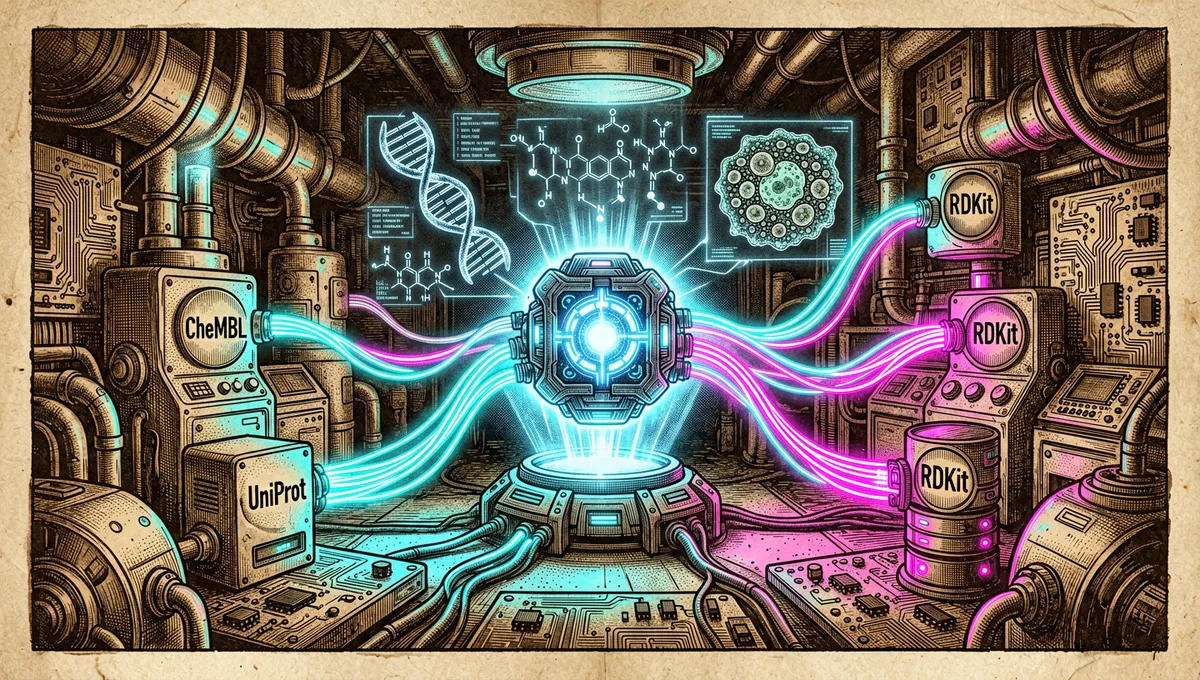
Everything worth knowing about K-Dense-AI/scientific-agent-skills: 158 installable skills documenting workflows, packages, databases, and limits for AI agents used in research.
What Scientific Agent Skills is
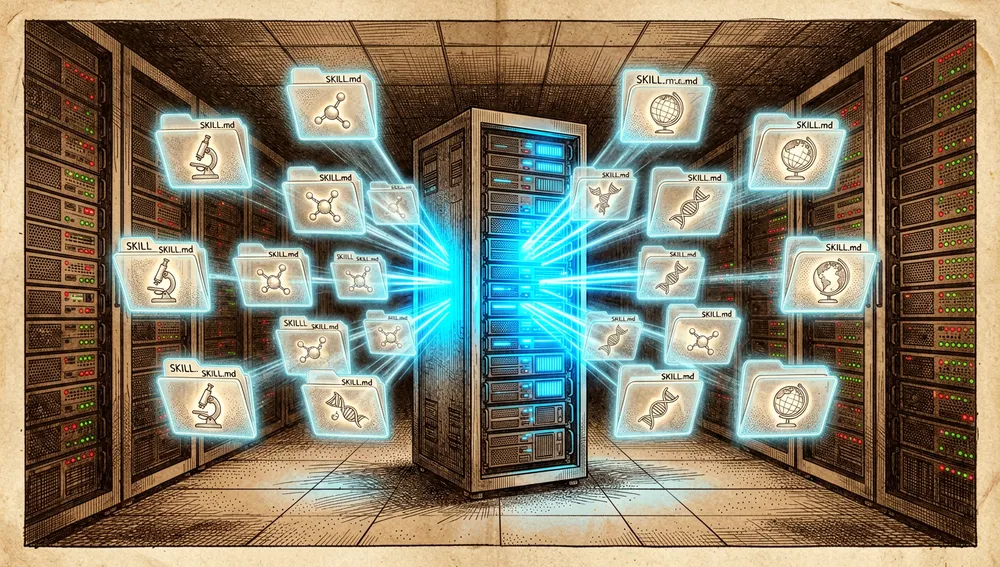
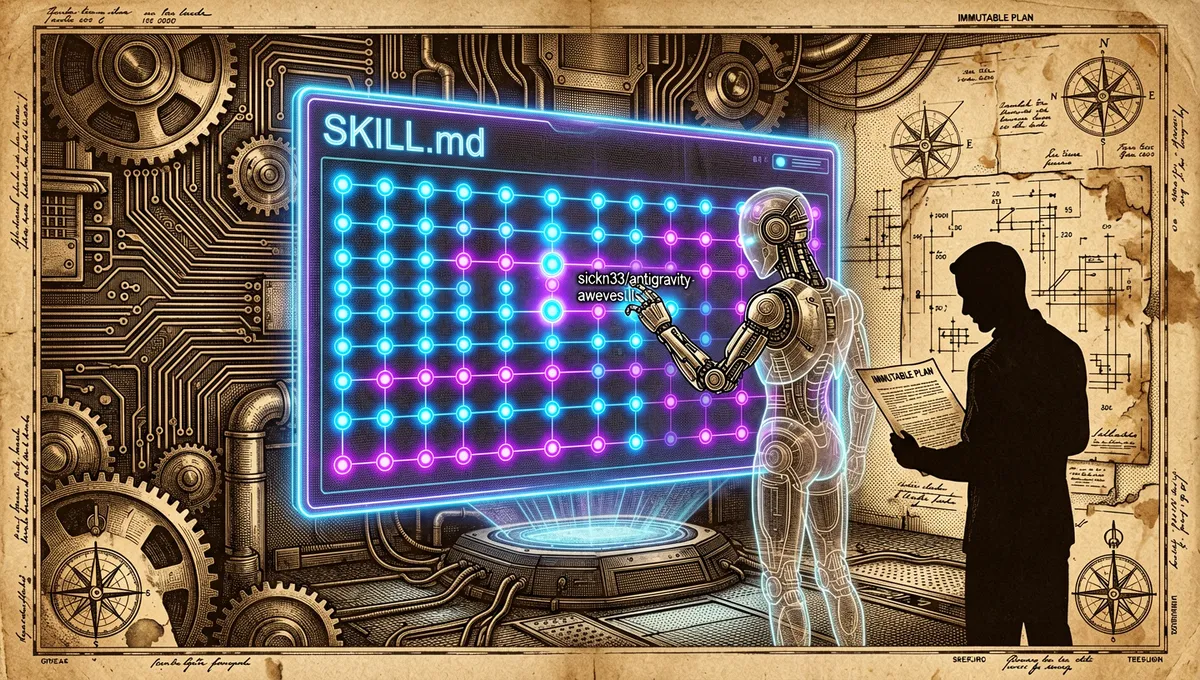
Scientific Agent Skills is an open collection of agent skills, not a scientific model or a compute platform. Each skill ships as a directory with a SKILL.md, documentation, examples, and, where relevant, helper scripts. Its purpose is to give an agent explicit instructions for using libraries, data sources, and specialized research workflows.
The README for version v2.62.0 declares 158 skills and more than a hundred databases or access paths. The scope spans bioinformatics, genomics, computational chemistry and drug discovery, proteomics, medical imaging, materials science, physics, geospatial analysis, lab automation, scientific writing, and data analysis. It also includes explicit limits: for example, clinical materials are presented as research support, authorized or de-identified data, and qualified review — not as diagnosis or therapeutic decision-making.
The project does not stop an agent from using other packages or APIs. Its stated value is offering already-documented paths, with examples, provenance, and checks, for recurring tools such as RDKit, Scanpy, BioPython, PyTorch Lightning, ChEMBL, UniProt, and ClinicalTrials.gov.
The origin: from Claude Scientific Skills to a portable collection
The repository was born on October 19, 2025: the first commit, signed by Timothy Kassis, is titled Initial commit. Kassis’s GitHub profile identifies him as co-founder and CTO of K-Dense; the organization describes itself as a company focused on giving scientists agentic tools. The K-Dense account was created three days earlier, on October 16, 2025.
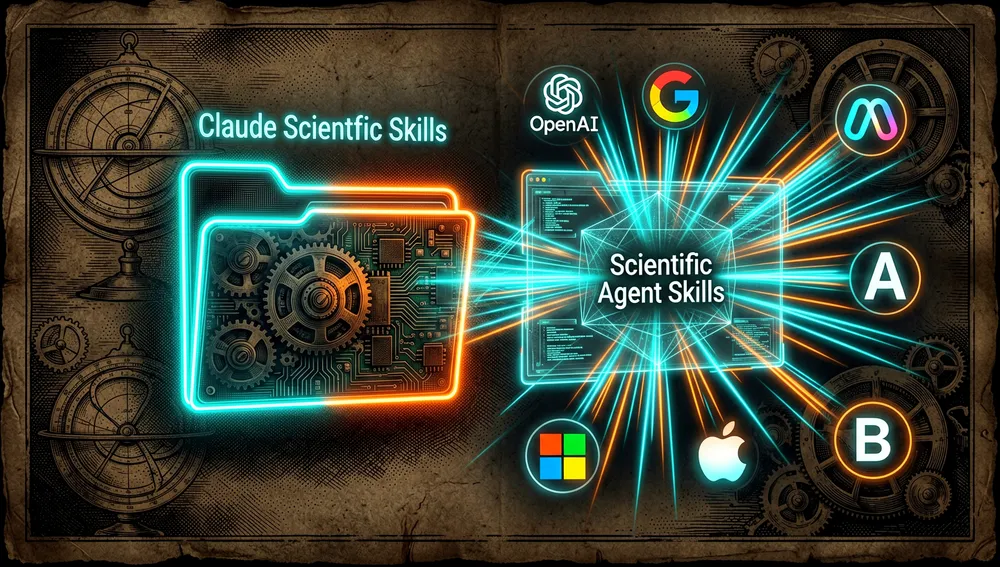
The original name explains the launch context: the README keeps a note that Claude Scientific Skills was renamed to Scientific Agent Skills. The stated reason is to broaden compatibility from Claude to any agent that implements the open Agent Skills standard. The transition reflects a practical tension: a collection organized for one specific client gains reach if it follows a portable structure, but installation directories, skill discovery, and optional fields still vary by client.
No launch blog post with a fuller narrative was retrieved. Therefore, no additional anecdotes or motivations are attributed to Kassis or K-Dense beyond the repository’s timeline, the rename, and the texts published by the project itself.
Philosophy and principles
The philosophy documented in the README and CONTRIBUTING.md can be summarized as follows:
- Explicit instructions instead of tacit knowledge: a skill defines what to use, when to use it, dependencies, examples, references, and best practices so an agent doesn’t have to reconstruct that context from scratch.
- Cross-disciplinarity: K-Dense justifies grouping the skills together because a real workflow can bring together genomics, cheminformatics, clinical data, and machine learning.
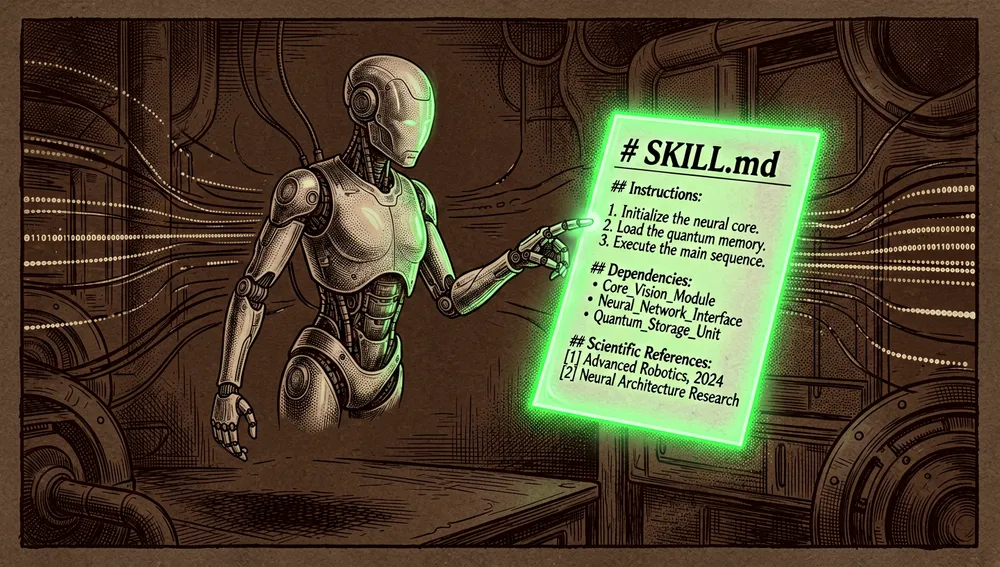
- Portability through a common specification: every skill must use
SKILL.mdwith a YAML header conforming to Agent Skills; the repository additionally requiresmetadata.version. - Validation, traceability, and limits: guides must include scientific and safety checks where relevant; health and lab workflows must stay within research limits and human review.
- Security through inspection, not blind trust: the README warns that a skill can make an agent execute code, install packages, use the network, or modify files. It recommends installing only what’s needed, reading
SKILL.md, reviewing the history, and scanning locally before trusting third-party content.
The practical consequence is that a skill does not equal scientific evidence and does not by itself validate a result. It’s a procedural layer over software, data, and external sources that the user must verify in their own environment.
How it works
Installation can be done through the skills installer or through GitHub CLI:
npx skills add K-Dense-AI/scientific-agent-skills

gh skill install K-Dense-AI/scientific-agent-skills scanpy
The README also suggests cloning it into ~/.agents/skills/scientific-agent-skills or .agents/skills/scientific-agent-skills, and offers a Hermes tap, hermes skills tap add K-Dense-AI/scientific-agent-skills. It states that compatible clients can discover the configured directories and that a specific skill can be invoked by mentioning its name.
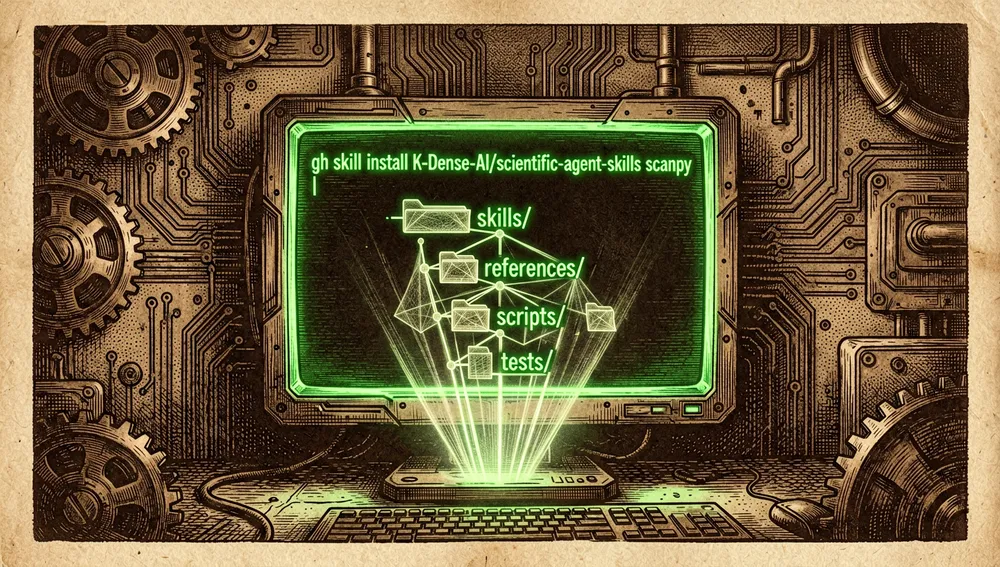
The published structure separates what an agent loads from what gets tested:
skills/<name>/SKILL.md
skills/<name>/references/
skills/<name>/scripts/
skills/<name>/assets/
tests/<name>/
The repository requires Python 3.13+ and uv for its own maintenance work; runtime dependencies depend on each skill. For reproducibility, gh skill install accepts a tag or SHA, for example --pin v2.62.0.
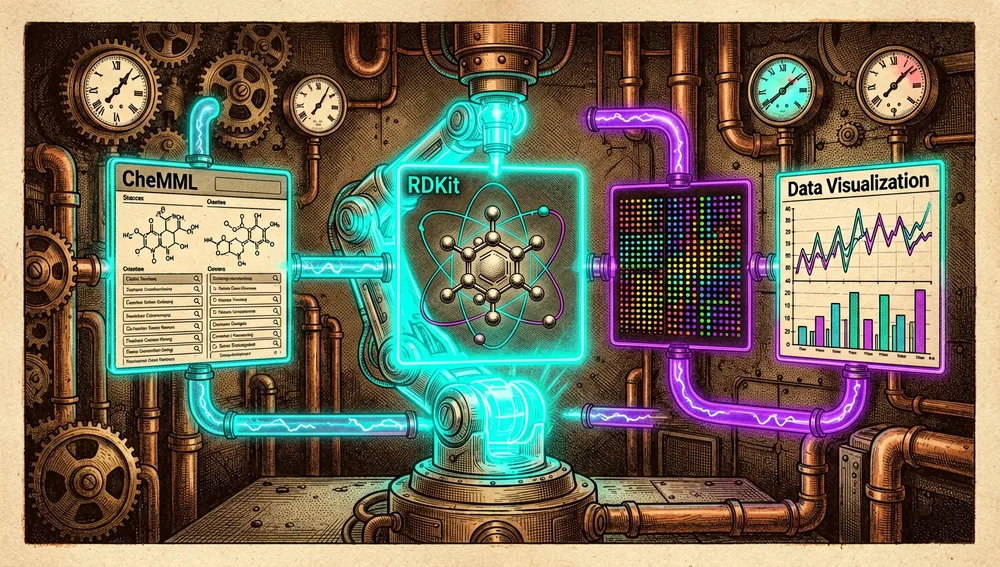
The examples show skill composition: one drug-discovery workflow combines a ChEMBL query, structural analysis with RDKit, virtual screening, literature search, and visualization; another chains Scanpy, Cellxgene Census, PyDESeq2, Arboreto, and Open Targets for single-cell data. These are the project’s own recipes, not clinical results or independent validations.
Official and semi-official status
The verifiable official status is that of an MIT-licensed collection that adopts the open Agent Skills standard and documents gh skill commands for GitHub CLI. The README links to GitHub CLI’s documentation and notes that gh skill places skills in the appropriate directory and records provenance for supply-chain integrity.
The status is semi-official with respect to clients: the README itself declares compatibility with Claude Code, Claude Cowork, Codex, Gemini CLI, Google Antigravity, Cursor, Pi, OpenClaw, NemoClaw, and Hermes, provided the host supports the standard and has its paths configured. No evidence was retrieved that Scientific Agent Skills has been accepted as a plugin in an official marketplace from Anthropic, OpenAI, Google, or Cursor. So the announced compatibility should not be read as certification, vendor endorsement, or a guarantee of uniform behavior.
In practice, using an open format and installation paths for several clients reduces adoption friction; it does not turn the repository into a formal standard nor replace review of the skills that get installed.
The ecosystem
K-Dense repositories
Querying the organization’s GitHub API identified these related public projects, with their star counts at the measurement noted below:
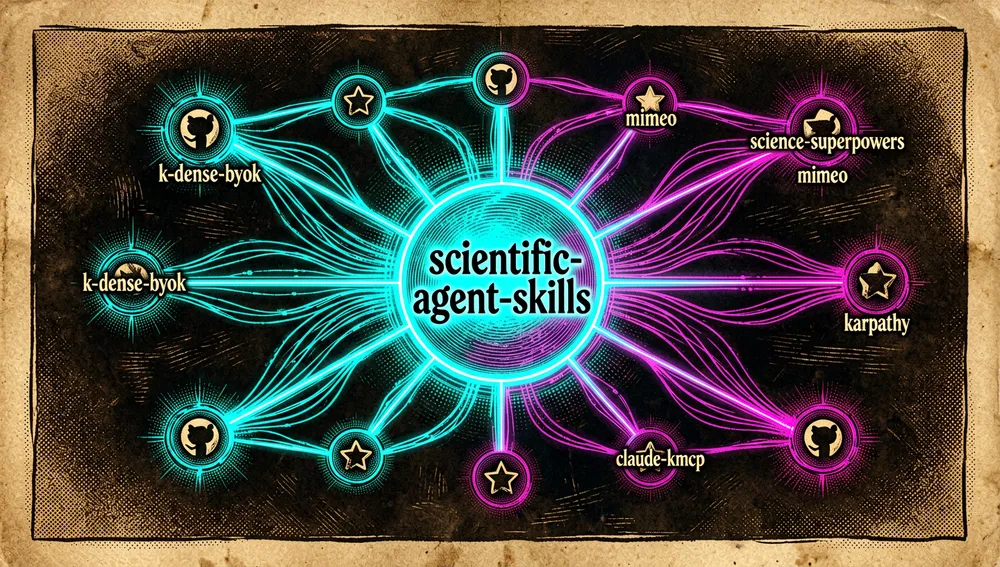
K-Dense-AI/k-dense-byok— 973 stars. A desktop scientific copilot said to be powered by Scientific Agent Skills; it lets you bring your own keys, choose models, and use a local workspace.K-Dense-AI/claude-skills-mcp— 396 stars. An MCP server for searching and retrieving skills via vector search.K-Dense-AI/science-superpowers— 281 stars. A computational-science methodology for agents, described by K-Dense as a scientific reimplementation of Superpowers that prioritizes preregistration over test-driven development.K-Dense-AI/mimeo— 238 stars. A tool for converting a person’s expertise intoSKILL.mdorAGENTS.md.K-Dense-AI/mimeographs— 97 stars. Skills generated withmimeoto approximate the thinking style of founders, philosophers, and scientists.K-Dense-AI/scientific-agents— 121 stars.AGENTS.mdprofiles oriented toward expert reasoning by scientists and engineers.K-Dense-AI/claude-scientific-writer— 2,177 stars andK-Dense-AI/agentic-data-scientist— 679 stars. These are sibling projects for scientific writing and end-to-end data science, respectively.K-Dense-AI/karpathy— 1,525 stars. A project presented as an agentic machine-learning engineer.
The most direct link is k-dense-byok: the collection’s README states that this product uses all 158 skills. claude-skills-mcp is complementary because it adds retrieval, not new scientific skills.
Forks, ports, and community translations
The forks API mostly showed copies with the original description. Among those that change scope or language are:
Dev-moe-kyawaung/scientific-agent-skills— 20 stars; described as a set of skills for research, science, engineering, analysis, finance, and writing.backtrue/claude-scientific-skills— 18 stars; a Claude-oriented fork.kellsaro/k-dense-ai-claude-scientific-skills— 12 stars; a Claude-oriented fork.xianyu110/claude-scientific-skills— 2 stars; its GitHub description states it is a Chinese-language presentation of K-Dense’s scientific skills collection.
These are forks found via the API, not audited extensions or versions recommended by K-Dense. The existence of a translated copy does not demonstrate maintenance, parity with the original, or official support.
Comparable and related projects
A GitHub repository search retrieved google-deepmind/science-skills (2,628 stars), a Google DeepMind collection for accelerating scientific workflows with sources such as AlphaGenome, AFDB, and UniProt; LeonChaoX/qinyan-academic-skills (764), a multilingual library for academic research; and InternScience/Awesome-Scientific-Skills (501), a curated list of scientific skills. They’re described in more detail in the comparison; their presence confirms that this library is part of a wider space of agent skills, not a closed ecosystem.
Repository numbers
Measurement: August 5, 2026, GitHub API.
| Metric | Value |
|---|---|
| Stars | 32,726 |
| Forks | 3,231 |
| Real subscribers | 153 |
| Commits | 668 |
| Open issues reported by the API | 8 |
| Primary language | Python |
| Repository license | MIT |
| Created | October 19, 2025 |
| Latest code push | August 3, 2026 |
| Latest metadata update | August 5, 2026 |
| Latest release | v2.62.0, July 31, 2026 |
The total of 668 commits comes from the API’s last pagination link. The top contributors returned by the API are TKassis (285 contributions), borealBytes (38), github-actions[bot] (23), vin-bio (22), and leipzig (15). The automation account is not a person and is kept here because the API classifies it among the top contributors.
There are two API caveats: open_issues_count can include open pull requests, so it does not necessarily equal issue count; and watchers_count duplicates the star total. That’s why the table reports subscribers_count as real subscribers. The figures change over time.
How to contribute
CONTRIBUTING.md documents a defined contribution flow:
- Create a fork and a branch, for example
add-skill-name. - Create
skills/<name>/SKILL.mdwith a valid YAML header, a lowercase hyphenated name, a description, andmetadata.versionas a quoted numeric string. - Add
references/,scripts/, orassets/only if they add value; put tests intests/<name>/, not inside the skill itself. - Test the commands, examples, and scripts; bump the version when modifying an existing skill.
- Run
uv run skills-ref validate ./skills/<name>and, if the skill includes scripts, its tests withuv run --with pytest python -m pytest tests/<name> -q. - Run the behavioral scanner
skill-scanner scan ./skills/<name> --use-behavioralfor new or substantially modified content, before opening the pull request.
Continuous integration validates formatting, links, script analysis, YAML headers, and the test requirement for skills with scripts/. K-Dense clarifies that a clean scanner result reduces review noise but does not replace manual review.
How the community received it
No direct Hacker News thread was retrieved for the repository’s name or for K-Dense-AI/scientific-agent-skills; therefore no reception in that community is attributed. On GitHub, though, concrete signals do appear, both favorable and critical:
- In issue #126, with four comments,
neseliispanakcalled the project extraordinary and asked for skills covering social sciences, arts, and musicology. Kassis replied that they would broaden the scope if clear capabilities were defined, and later said they would need specialists to validate them. This is one person’s enthusiasm and a design conversation, not proof of scientific effectiveness. - Issue #174, with three comments, records an operational objection:
antoine-mlereported thatgh skill installcouldn’t find the skills;lxhuang2confirmed the same error. Kassis closed the thread saying that GitHub CLI expectedskills/instead ofscientific-skills/and that they had updated the repository to improve compatibility. The README keeps a note about that change as ofv2.43.0. - In issue #127, with three comments,
rottenpenreported that a skill was inserting advertising.yarikopticlocated a recommendation for K-Dense Web, noted it looked like advertising but didn’t consider it malicious, and listed other skills that could still make a similar recommendation. This doesn’t verify that the whole repository is safe, nor that the original accusation was correct; it does explain why the README insists on reading skills and running scans before installing them.
The retrieved reaction combines interest in expanding the catalog and perceived usefulness with installation problems and vigilance over instructions that can influence an agent. It’s pointed evidence from public issues, not a user survey.
Scientific Agent Skills versus other proposals
| Proposal | Verifiable overlap | Verifiable difference |
|---|---|---|
google-deepmind/science-skills | Both are skill collections for scientific workflows citing specialized databases and tools. | DeepMind’s description centers on AlphaGenome, AFDB, UniProt, and more than 30 resources; Scientific Agent Skills declares 158 skills, more than a hundred data paths, and multi-agent compatibility. |
LeonChaoX/qinyan-academic-skills | Both group installable skills for research, literature, writing, and analysis. | qinyan-academic-skills is presented as a multilingual library of 182 skills for academic research; K-Dense’s collection documents an explicit focus on science, Python packages, databases, and limits for clinical research. |
InternScience/Awesome-Scientific-Skills | Both help with discovering scientific research skills. | Awesome-Scientific-Skills is described as a curated list; Scientific Agent Skills publishes the skills themselves, plus scripts, tests, and a contribution process. |
K-Dense-AI/science-superpowers | Both K-Dense repositories use composable skills for research agents. | science-superpowers is presented as a computational-science methodology based on preregistration; Scientific Agent Skills is the catalog of scientific skills and connectors. |
The comparison is not a benchmark. To choose between one collection and another, it’s better to review the SKILL.md for the desired task, its dependencies, individual license, data sources, network policies, and safety limits, rather than inferring quality from star count.
Use cases and who this repository can help
- Computational biology and genomics teams can give an agent documented paths for sequence analysis, single-cell data, variant annotation, and queries to resources like NCBI, UniProt, or Cellxgene Census. Research limits and qualified review matter especially when handling biomedical data.
- Medicinal chemistry and drug-discovery groups can compose ChEMBL, RDKit, DiffDock, structural-source, and literature-search skills to organize virtual screening, structure-activity relationship analysis, and candidate documentation. The results remain research hypotheses, not clinical recommendations.
- Labs and automation teams can use the Opentrons, LIMS, and protocol skills to prepare or simulate workflows, keeping the safety gates and operator review that the README requires for physical execution or remote writes.
- Researchers producing reports, figures, or literature reviews can draw on the full-text retrieval workflows, line-pinned citations, provenance-aware writing, and document creation. The collection also invites citing both the overall set and the specific skills that contributed to the work.
- Administrators of agents in Cursor, Codex, Claude Code, Gemini, Hermes, or other compatible hosts can install just a thematic subset, pin a version, and review the code before expanding it. This partial selection matters because the README itself warns that 158 skills can add a lot of context and that instructions can execute actions on the system.
Resources
- Repository: https://github.com/K-Dense-AI/scientific-agent-skills
- Documentation and installation: https://github.com/K-Dense-AI/scientific-agent-skills#-getting-started
- Skills specification: https://agentskills.io/specification
- Official contribution guide: https://github.com/K-Dense-AI/scientific-agent-skills/blob/main/CONTRIBUTING.md
- Official skills: https://github.com/K-Dense-AI/scientific-agent-skills/tree/main/skills
- Companion BYOK project: https://github.com/K-Dense-AI/k-dense-byok
- Related MCP server: https://github.com/K-Dense-AI/claude-skills-mcp
- Reviews and conversations: https://github.com/K-Dense-AI/scientific-agent-skills/issues/126, https://github.com/K-Dense-AI/scientific-agent-skills/issues/174, https://github.com/K-Dense-AI/scientific-agent-skills/issues/127
- Community and updates: https://www.k-dense.ai/, https://www.youtube.com/@K-Dense-Inc
Note: this article combines the repository’s README and contribution guide, the GitHub API, the cited issue threads, and the K-Dense site, all consulted on August 5, 2026. Metrics and content may change.
Comments