


Academic Research Skills: an academic research copilot with mandatory human oversight
Imbad0202/academic-research-skills · 49,449★ · 3,828 forks
Everything you need to know about Imbad0202/academic-research-skills: a Claude Code skill suite that walks a researcher through the full research → writing → review → revision → finalization flow, with mandatory human checkpoints.
What Academic Research Skills is
Academic Research Skills (ARS) is a Claude Code skills framework aimed at non-commercial academic research. It’s not a model, a server, or an autonomous agent: the core product is a set of instructions and utilities that guide a human through the entire process of producing a publication. Its own POSITIONING.md file defines it as a “source-available academic research copilot” for non-commercial academic use.
The repository bundles four skills, each with its own SKILL.md, and a total of 27 modes per MODE_REGISTRY.md:
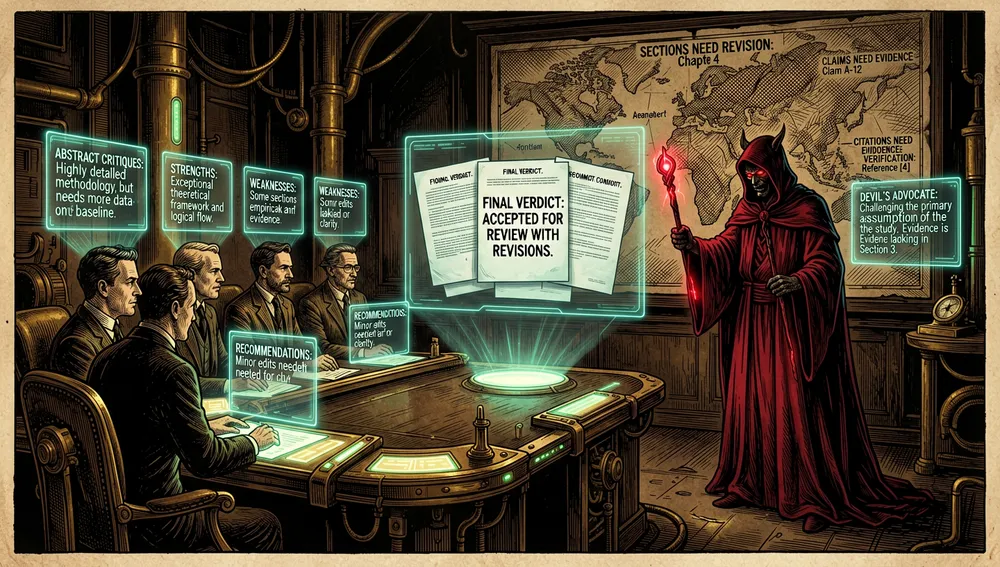
deep-research(version 2.12.1, 8 modes, 13 agents): literature search, PRISMA systematic review, fact-checking, and a Socratic guidance mode.academic-paper(version 3.3.1, 11 modes, 12 agents): planning, drafting, feedback-driven rewriting, citation review, and AI-use disclosure generation.academic-paper-reviewer(version 1.11.1, 6 modes): peer-review simulation with a fixed panel of five reviewers plus a “devil’s advocate” reviewer.academic-pipeline(version 3.21.1): a ten-stage orchestrator that chains the previous three with mandatory checkpoints.
The design is summed up in one line from the positioning doc: “assistive, not deceptive.” ARS helps write better, not hide that AI was used; it doesn’t claim authorship, and its outputs aren’t submission-ready without human review.
Origin: a toolkit for the solo researcher
The repository was created on February 26, 2026 by Edward Cheng-I Wu (Imbad0202), whose GitHub account lists no company or profile description. The first dated commit record corresponds to February 26, 2026, on pipeline version v2.0.
Wu published the original announcement as a Substack newsletter post titled “Academic Writing Shouldn’t Be a Solo Act,” subtitled “An Open-Source AI Toolkit for Researchers,” dated March 8, 2026 and updated April 19, 2026. In it, he describes the pains motivating the tool: the “black hole” of literature review, losing the thread mid-draft, citation anxiety, the absence of an available reviewer, and “formatting hell.” His thesis is that what a researcher needs isn’t an AI that “writes the paper for them,” but a companion that accompanies them from the research question to the final PDF.
The author himself documents a central tension that shapes the design. On April 3, 2026 he shipped v3.0, born from a “four-round dialectical experiment” in which the “devil’s advocate” agent conceded too quickly, the Socratic mentor tried to converge prematurely, and the whole debate got trapped inside the frame the human had set. That finding (that the verifying AI and the generating AI share the same cognitive frame) motivated the anti-sycophancy and dialogue-health improvements. The launch post also documents a v2.7 stress test that revealed a 31% citation error rate: a full web-search audit of the 68 references found 21 problems that had passed three rounds of integrity checks, and that became the justification for mandatory external verification.
Philosophy and principles
POSITIONING.md and the README state verifiable principles:
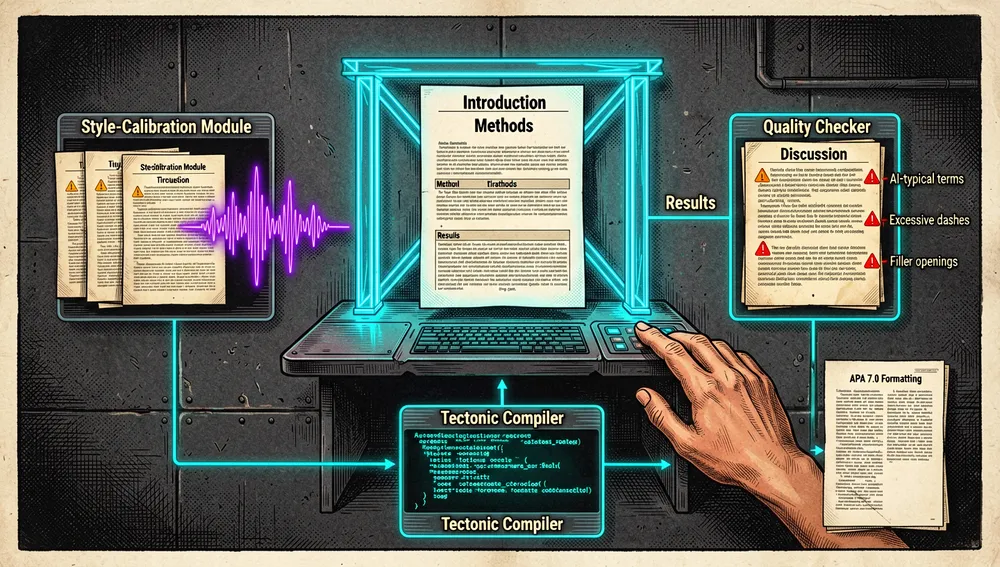
- Assistive, not deceptive: the style-calibration and writing-quality features aim to improve prose, not evade AI detection. The disclosure mode generates AI-use statements per venue or per policy.
- Human oversight, always: FULL checkpoints present every deliverable and require explicit confirmation; MANDATORY checkpoints (integrity gates at stages 2.5 and 4.5, review decisions) can’t be skipped. “Full mode” means running the whole pipeline, not full autonomy. A maximum of two rewrite loops; whatever remains becomes “Acknowledged Limitations.”
- Failure modes are made visible: the list of 7 AI-research failure modes and the reviewer calibration mode exist so the user can see where the AI can fail.
- Boundaries are logged, not improvised:
POSITIONING.mdincludes a “Rejected Mechanisms” section (autonomous-research anti-patterns, mostly cataloged by Kong et al., 2026, arXiv:2605.18661) the project explicitly rejects: end-to-end autonomous research pipelines, idea-generation agents, automatic slide/video generation, autonomous experiment execution, physical lab automation, and simulated ethics committees.
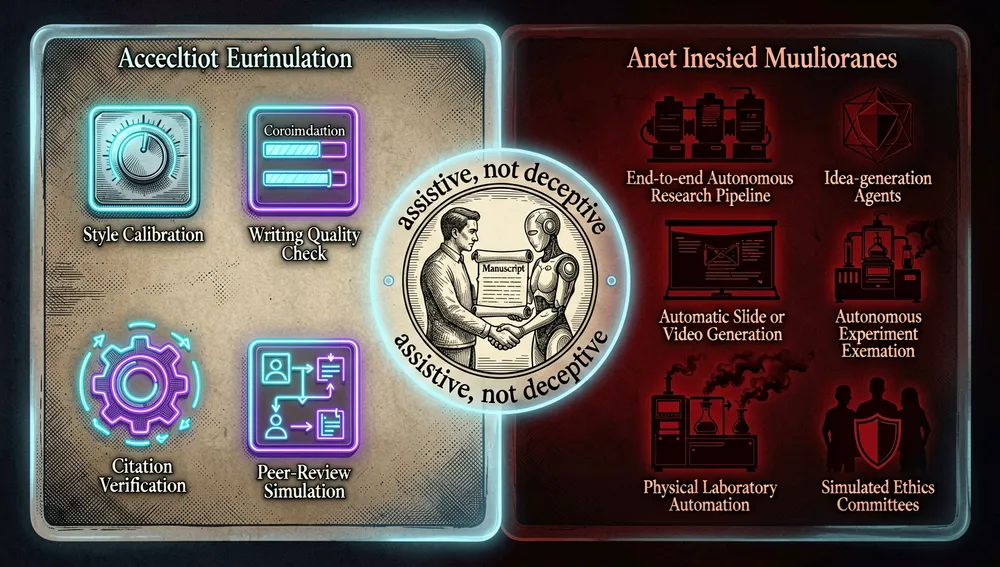
An important positioning clarification: ARS’s checks cover the manuscript and the reported process, not the actual execution. The document says it plainly: “a study built on fabricated data can pass every ARS gate if the fabrication is reported, cited, and packaged coherently.”
How it works
The academic-pipeline orchestrator runs a ten-stage journey with adaptive checkpoints (FULL / SLIM / MANDATORY). A representative slice of the documented flow:
- Research (
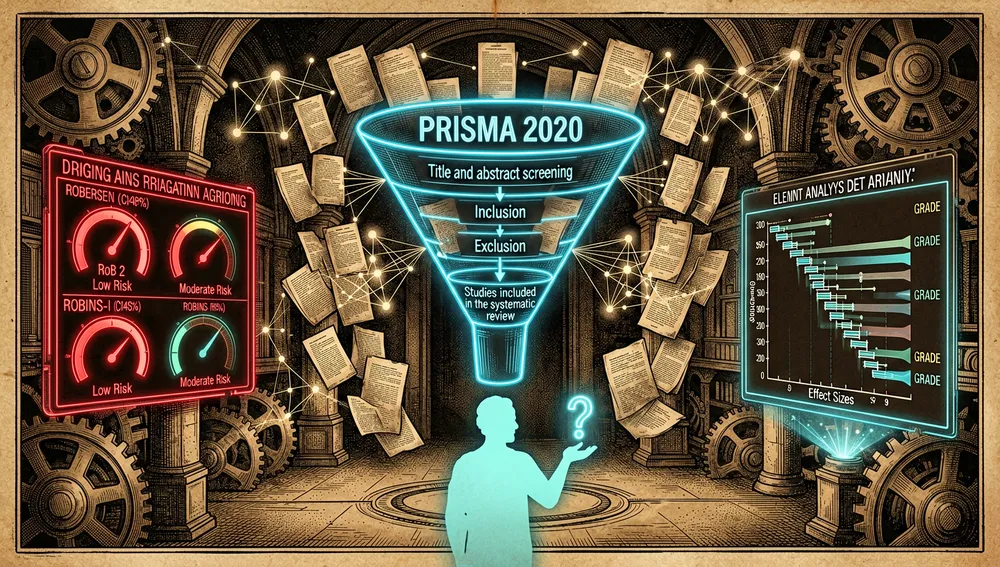
deep-research): convergence on arguments, not just papers. Includes asystematic-reviewmode with PRISMA 2020 templates, a bias-risk agent (RoB 2 + ROBINS-I), and a meta-analysis agent (effect sizes, heterogeneity, forest-plot data, GRADE assessment).
- Write (
academic-paper): an IMRaD draft or one following domain structure, with optional style calibration (learns the author’s “voice” from 3+ past papers) and a writing-quality check that flags 25 typical AI terms, excessive em-dash use (≤3 per paper), and filler openings.
- Review (
academic-paper-reviewer): a fixed panel of five reviewers plus a “devil’s advocate”; produces five review reports, an editorial decision, and a rewrite map.
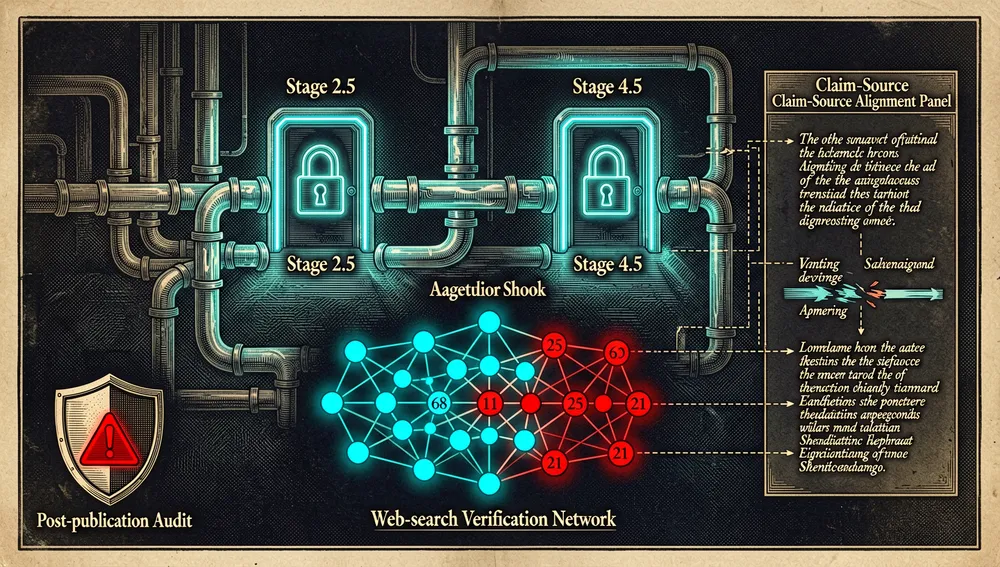
- Integrity checkpoints (stages 2.5 and 4.5): verifying each reference’s existence via web search, claim-source alignment, and reporting-guideline checks.
- Finalize (
academic-pipelineStage 5/6): format conversion (APA 7.0 / Chicago / IEEE), PDF compilation via LaTeX withtectonic, and a final “Process Summary” that includes an assessment of collaboration quality.
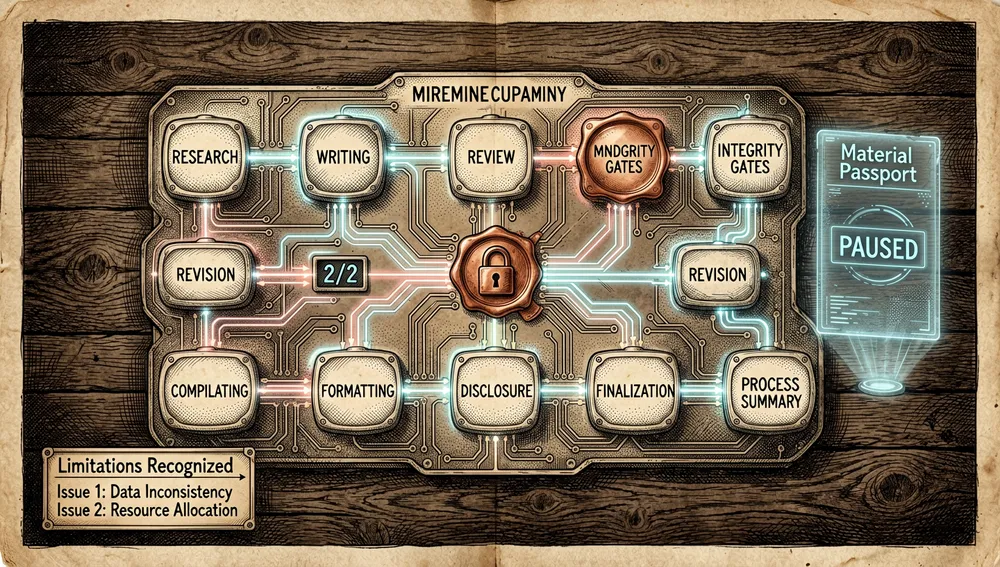
A real use case documented in examples/showcase/ shows the output of a full ten-stage pipeline: a pre-review integrity report that “caught 15 fabricated references + 3 statistical errors,” two rounds of peer review, a point-by-point response to reviewers, and a post-publication audit (2026-03-09) that, verifying all 68 references via web search, found 21 problems the three rounds of checks had missed.
Quick-start guide
Installation and first launch
Prerequisites: Claude Code (a recent version, since the plugin packaging requires current releases) and an exported ANTHROPIC_API_KEY variable (or entered at claude’s first launch). Optional but recommended: Pandoc for DOCX output and tectonic (with the Source Han Serif TC font) for APA 7.0 PDF; without them, Markdown output still works. The core agents are instruction-driven and don’t require Python; a real Python interpreter is only needed for optional features (the PreToolUse write-scope guard, rewrite-patch mode, submission-package verifier).
The recommended method (plugin, v3.7.0 onward):
/plugin marketplace add Imbad0202/academic-research-skills
/plugin install academic-research-skills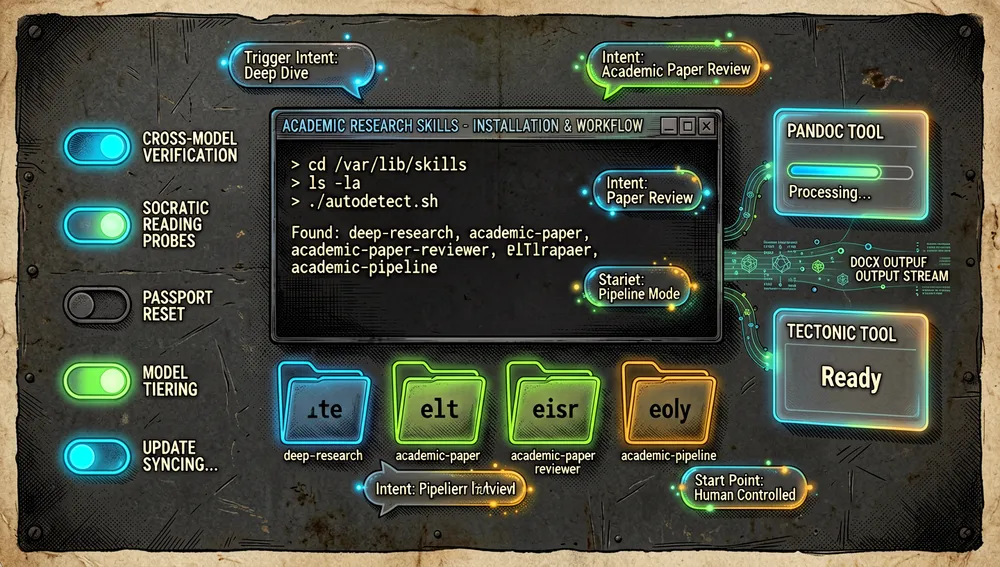
The four SKILL.md files are autodetected from the plugin’s skills/ directory. The README recommends enabling auto-update in the /plugin interface (ARS ships every 1–2 weeks) and disabling the update check with ARS_UPDATE_CHECK=0 if desired.
Other methods documented in docs/SETUP.md: copy the four skill folders into a project’s .claude/skills/ (method 1), clone the repository and open it directly (method 2), upload a zip per skill in Claude Cowork (method 3), use it with claude.ai web (method 4), and import into Claude Science (method 5, v3.14.0 onward). A separate sibling distribution exists for OpenAI Codex (Imbad0202/academic-research-skills-codex).
Common workflows
The README documents natural-language activation:
# Full research pipeline
You: "I want to write a paper about AI's impact on higher-ed QA"

# Socratic guidance
You: "Guide my research on AI in educational assessment"

# Guided paper planning
You: "Walk me step by step through writing a paper on demographic decline"

# Review an existing paper
You: "Review this paper" (and provide the paper)

# Check pipeline status
You: "status"
The Socratic mode and the planning mode use intent-based activation (not keyword-based), so they work in any language; only the skill’s general activation still lists keywords in English and Traditional Chinese.
Essential configuration
The optional environment variables (all OFF by default) a new user will touch first, per docs/SETUP.md:
ARS_CROSS_MODEL: enables cross-model verification (e.g.gpt-5.6-sol,gemini-3.1-pro-preview, orgpt-5.5) to check facts with a model different from the one generating.ARS_SOCRATIC_READING_PROBE=1: triggers a one-time reading probe in the Socratic mentor when the user has cited a specific paper.ARS_PASSPORT_RESET=1: turns every FULL checkpoint into a context-reset boundary and lets you resume in a new session from theMaterial Passport.ARS_CROSS_MODEL_TRANSPORT=codex: uses the ChatGPT subscription transport only for citation-integrity calls.ARS_MODEL_TIERING(economyorquality-boost): optional per-agent-type model assignment.
Fixed content preferences (citation style, whether to include searches) are declared in CLAUDE.md, not environment variables.
Common pitfalls and fixes
- Installing as a single nested folder: the README explicitly warns against copying the whole repository under
.claude/skills/academic-research-skills/, since that buries the fourSKILL.mdfiles one level too deep for Claude to detect. Copy the four skill folders individually. - Cowork doesn’t read
~/.claude/skills/: that directory belongs to Claude Code CLI/IDE; Claude Cowork loads skills uploaded via Settings → Capabilities → Skills, each as its own zip. Symlinking or copying folders there won’t make them appear. - Microsoft Store
python3on Windows: usually a non-functional stub; install real Python from python.org instead. ThePreToolUseguard’s launcher is a POSIX script that needs Git Bash on Windows; without Git Bash, the guard stays inactive (an accepted degradation — it never blocks writes). - Commands don’t show up: in plugin installs, commands are namespaced as
/academic-research-skills:ars-<mode>; the unprefixed/ars-<mode>form only works on Claude Code v2.1.216 or later. - Resuming long sessions: to avoid losing state in long sessions, the
Material Passportis the cross-session resume mechanism;docs/PERFORMANCE.mdoffers token-budget guidance.
Integrations and migration
- Cross-model verification: connect an OpenAI/Google provider with
OPENAI_API_KEY/GOOGLE_AI_API_KEYkeys andARS_CROSS_MODEL. The community lists a compatible gateway (OrcaRouter) as a cross-verification provider. - Literature corpus adapters (v3.6.4 onward):
scripts/adapters/includes three reference Python adapters (folder_scan.pyfor PDFs,zotero.pyfor Better BibTeX exports,obsidian.pyfor frontmatter) that produce apassport.yaml+rejection_log.yamlfrom the user’s library. - Pi wrapper (community-maintained, in-tree):
pi install git:github.com/Imbad0202/academic-research-skills. It documents two performance differences: no agent isolation/orchestration (roles run sequentially, a degradation that must be declared) and Claude’s hooks don’t run under Pi. - An OpenCode port and a Codex distribution exist as independent repositories.
- Experiment companion:
experiment-agentfills the gap between ARS’s stage 1 (RESEARCH) and stage 2 (WRITE), running code experiments and managing human-study protocols. - No migration process from a specific comparable tool is documented; the usual “migration” is between the six documented install methods and between the main repository and its sibling Codex distribution.
Official and semi-official status
ARS is not part of an official Anthropic catalog or any other vendor’s: it installs as a Claude Code plugin from the repository itself via /plugin marketplace add Imbad0202/academic-research-skills, which is a project-self-managed marketplace, not an official one. The THIRD_PARTY.md page clarifies that the third-party project listing there is explicitly not an endorsement, and that those projects belong to independent parties, not reviewed by the maintainer.
What is verifiable as external recognition:
- Zenodo registration: the project has a formal citation
Wu, C.-I. (2026). Academic Research Skills for Claude Code (Version 3.21.1) [Computer software]. Zenodo. https://doi.org/10.5281/zenodo.20696614. Querying the Zenodo API in this investigation returned a live record (current DOI10.5281/zenodo.22080258, dated 2026-08-24), indicating the project is cited and versioned as software. - CC BY-NC 4.0 license: the README and
POSITIONING.mdinsist it is not an open-source license; it deliberately restricts commercial use to keep the tool free for academic communities. A GitHub Discussions thread (“Commercial licensing inquiry for ARS,” byacelsss) shows commercial-license inquiries are real and get routed to the maintainer. - De facto: the presence of dozens of derivatives and ports (see “The ecosystem”), the video tutorials, and the author’s article make it function as a de-facto reference for the “academic research copilot with human oversight” pattern in the Claude Code skills space. No formal standard designation was found, however.
The ecosystem
Repositories by the same author
Per Imbad0202’s public repository list consulted in this investigation:
Imbad0202/academic-research-skills-codex: a native Codex distribution of the same working content; 9,453 stars and 439 forks, created April 25, 2026. It’s the largest sibling piece.Imbad0202/experiment-agent: a companion skill for running, monitoring, and statistically interpreting experiments; 179 stars and 12 forks. ARS’s README links it as the filler between stage 1 and stage 2.Imbad0202/tw-formal-writing: a skill for writing Taiwanese formal documents (official letters, contracts) importable into ChatGPT/Claude/Gemini; 163 stars and 19 forks.Imbad0202/critical-thinking-for-humans: a “critical thinking gym” where the AI is the coach; 32 stars and 2 forks.Imbad0202/cc-user-autopsy: a peer-review skill with traceability for Claude Code users; 11 stars and 2 forks.
Community ports, translations, and extensions
A GitHub repository search for “academic-research-skills” returned 650 results total; the most notable by stars retrieved individually:
HughYau/AcademicForge: a curated skill collection for academic writing; 2,491 stars and 147 forks.aipoch/medical-research-skills: hundreds of medical research skills (protocol design, etc.); 1,771 stars and 164 forks.LeonChaoX/qinyan-academic-skills: a curated, multilingual library of 182 installable skills; 842 stars and 72 forks.hkcanan/katmer-code: a multi-provider sidebar for Obsidian (Claude, Gemini, Codex); 473 stars and 32 forks; it was submitted to Hacker News on March 22, 2026 (“Show HN: KatmerCode – Claude Code in Obsidian with academic research skills,” 2 points, 0 comments).claesbackman/AI-research-feedback: academic research review skills; 471 stars and 83 forks.lingzhi227/agent-research-skills(297 stars and 37 forks),wentorai/research-plugins(280 stars, 350+ skills and MCP configs), andfranklee16/academic-research-skills(211 stars).aspi6246/Claude-Code-Skills-for-Academics(152 stars and 31 forks): the README cites it as the inspiration for v3.1’s anti-context-rot improvements.timpara/opencode-academic-research(49 stars and 11 forks): an OpenCode port (4 skills, 13 commands).kael-odin/awesome-academic-research-skills(52 stars): an automated, daily “ranking” in Chinese of academic research skills on GitHub. It’s the most visible non-English port, as a curated list.YuanyuanMa03/academic-research-skills(54 stars): a variant geared toward searching CNKI (a Chinese academic database).
THIRD_PARTY.md itself also lists ClawMama (by kinhunt, a hosted service offering a trial of the pipeline via Telegram/WhatsApp) and OrcaRouter (an OpenAI/Anthropic-compatible gateway as a cross-verification provider), and acknowledges Yila-AI/sci-ssci-skills (by @MissOrangePeel) as an “upstream” project, the origin of the “claim-strength ladder” mechanism adapted in v3.19.0. On GitHub Discussions, kengo006 announces that the alexandria project cites ARS in its README, and YujxZJCN presents Teaching Skills, a “teaching-side” sibling suite architecturally inspired by ARS.
These figures are what the GitHub API/search returned during this investigation; they aren’t a quality, support, or compatibility audit of each derivative.
Repo numbers
Measured: August 28, 2026, GitHub API.
| Metric | Value |
|---|---|
| Stars | 44,043 |
| Forks | 3,493 |
| Subscribers (watchers) | 120 |
| Commits | 748 |
| Open issues per API | 18 |
| Primary language | Python |
| License | CC BY-NC 4.0 |
| Created | February 26, 2026 |
| Last activity | August 27, 2026 |
| Latest release | v3.21.1, August 24, 2026 |
The 748-commit count was obtained from the final page of the commits API’s pagination link. GitHub’s API uses open_issues_count; that field can include open pull requests, so the 18 “issues” shouldn’t be read as an issues-only count. The subscribers_count field (120) is reported separately because watchers_count usually duplicates star count in the general response.
The top contributors returned by the API, by contribution count, were Imbad0202 (720), 2023Anita (8), ktao732084-arch (3), madtriceps (3), and akshath-raj (2), followed by several with one contribution. The very heavy concentration on the maintainer reflects that, unlike superpowers, this is essentially a single-author project with minor community contributions (typo fixes, journal lists, discipline modules).
How to contribute
CONTRIBUTING.md documents a concrete fork-and-PR process (no direct push):
- Fork the repository on GitHub, clone the fork, create a branch, make changes, push to the fork, and open a PR against
Imbad0202/academic-research-skills. - What’s accepted quickly (fast-track merges): typo and formatting fixes, new pipeline output examples, translation improvements (zh-TW/EN).
- What requires maintainer review: journal and reference-field lists, evaluation sets (gold-standard papers for the calibration mode), new reference files, drift fixes, mode changes.
- What requires approval + prior discussion (open an issue first): changes to agent definitions (
*/agents/*.md), edits to rules marked IRON RULE, ethics and integrity rules, handoff-schema changes (shared/handoff_schemas.md), new skills or modes. - Platform ports (community-maintained only): accepted in two forms — an in-tree wrapper (
<platform>/) or a sibling distribution in a separate repo — and require a named maintainer, end-to-end evidence of a fullacademic-pipelinerun on the platform, claims-evidence alignment, and a model-portability note.
The maintainer’s decision rules are explicit: precision before completeness; human oversight always (contributions that reduce oversight or enable autonomous paper generation are rejected); no detection evasion; and discipline diversity is welcome. PRs must have a single concern per PR, describe the what and why, reference issues, and keep affected-language READMEs in sync. By contributing, the contributor agrees their work will be licensed under CC BY-NC 4.0.
How the community received it
The evidence gathered shows broad adoption (44,000 stars, dozens of ports, video tutorials) alongside concrete criticism. The main source with verifiable anchors is Hacker News thread 48083919, “Academic Research Skills for Claude Code,” submitted by arnon on May 10, 2026, with 82 points and 25 comments (nine top-level comments). Named users and their positions:
evanwolf: “Academic skills are a vector for cite injection” — a security/prompt-injection risk framing.m3kw9: “Research paper slop starting pack.”apwheele: “There needs to be a new name for people creating these with no obvious validation. Skill spam?” —elashrireplies “Skill-slop.”SubiculumCode: flags the contradiction that “the site opens with how it keeps humans in the loop, but reading further it looks almost like a full automation feature.”mmooss: defends the author, citing the dialectical experiment and the “frame-lock” framework;janpeukeragrees it “goes too far” but likes the Socratic State-Challenge-Reflect mode;cyanydeezadds that the training method makes “disagreement halt token generation.”varispeed: a strong technical objection: “These things aren’t going to be reliable if you don’t know when your session will get routed to a lesser model. Stopped using Opus over that… This says it’s not ready for any serious work.”mdxmaker: “Academic skills need proper tooling too, since many papers sit behind paywalls or anti-bot systems.”implexa_founder: “Research skills fail differently from dev skills: research ones need to retain the wrong paths, or the real artifact has been removed.”
On the positive side, the video-tutorial ecosystem is extensive: “How To Use Claude For Academic Research (My Actual AI Stack)” by Prof. David Stuckler (58,031 views), “Claude 4 Just Made Research 10x Faster” by Andy Stapleton (81,337 views), “Master Claude for Researchers | Step-by-step Tutorial” by WiseUp Communications (180,624 views), “Claude Cowork for Academics: Full Setup & Use Cases” by Andy Stapleton (77,873 views), and, in Spanish, “Habilidades de investigación académica: escribe trabajos de investigación 10 veces más rápido” by CLI Stack (666 views) and “Cómo usar Claude Skills para investigación académica (guía paso a paso)” by Muhammad Irfan (2,672 views).
No Reddit threads with substantive content could be retrieved during this investigation (the API returned HTML blocks and the PullPush mirror returned no results), no verifiable X/Twitter announcement (the author’s account doesn’t publish a twitter_username), and no Product Hunt launch page with a verifiable count. No sentiment beyond what’s cited is inferred from those platforms, then; video figures and Hacker News comments are the reception sources that were directly retrieved.
ARS versus other approaches
| Approach | Verifiable overlap | Verifiable difference |
|---|---|---|
aspi6246/Claude-Code-Skills-for-Academics (152 ⭐) | A skill collection for academics on Claude Code. | ARS’s README cites it as the inspiration for v3.1’s anti-context-rot improvements; it’s an earlier, smaller collection, not a ten-stage orchestrator with integrity gates. |
HughYau/AcademicForge (2,491 ⭐) | A curated skill collection for academic writing. | Presents itself as “One Forge, All Skills”: a collection, not the multi-stage pipeline with a five-reviewer panel and cross-model verification that distinguishes ARS. |
aipoch/medical-research-skills (1,771 ⭐) | Academic/medical research skills for agents. | Specializes in medical research (protocol design); ARS is multi-disciplinary by default in higher ed, and ARS itself has received proposals for a clinical module (an issue from ktao732084-arch). |
timpara/opencode-academic-research (49 ⭐) | Same working content (4 skills, 13 commands). | It’s a port of ARS to OpenCode, not an independent competitor; ARS is the reference distribution for Claude Code. |
Imbad0202/academic-research-skills-codex (9,453 ⭐) | Same working content and philosophy. | It’s ARS’s sibling distribution for Codex, not a competitor: same license, same author. |
The most useful comparison isn’t by popularity: ARS stands out when you want to impose a research-to-publication process with integrity verification and human oversight at every gate. A generic skill collection may be preferable when you only need fragments; a domain-specific set (medical, Chinese CNKI) when the domain requires rules the general flow doesn’t contain.
Use cases
- Individual researchers writing a paper without an available reviewer: the
academic-paper+academic-paper-reviewerpipeline simulates a five-reviewer panel plus a “devil’s advocate” and produces an editorial decision and a rewrite map — something the author’s article identifies as their central pain point (“no one to review your work”). - PhD students doing a systematic review or meta-analysis: the
systematic-reviewmode includes PRISMA 2020 templates, a bias-risk agent (RoB 2 + ROBINS-I with traffic-light output), and a meta-analysis agent (effect sizes, heterogeneity, forest plot, GRADE), with citation verification via web search. - Anyone needing to verify reference integrity before submission: the integrity gates at stages 2.5 and 4.5 and the
fact-check/citation-checkmodes directly address the “citation anxiety” the author describes; the documented post-publication audit (21/68 errors) shows the value of external verification. - Students who want to train their own judgment, not just receive a draft: the Socratic mode with the State-Challenge-Reflect protocol forces prediction before seeing evidence — a use the README itself positions as “method training.”
- Research teams or departments with a shared workflow: the CC BY-NC 4.0 license permits shared non-commercial academic use (groups, labs, departments), and style calibration from past papers helps keep teams consistent.
- Authors who want to declare AI use correctly per venue: the
disclosuremode generates AI-use statements for ICLR, NeurIPS, Nature, Science, ACL, EMNLP, and a v2 database with medical and Chinese-language destinations, aligned with the “assistive, not deceptive” principle. - Users on platforms other than Claude Code: the sibling Codex distribution, the OpenCode port, the Pi wrapper, and the community ports extend reach to environments that don’t support Claude Code plugins.
Resources
- Repository: https://github.com/Imbad0202/academic-research-skills
- Documentation and setup: https://github.com/Imbad0202/academic-research-skills/blob/main/docs/SETUP.md
- Architecture (single source of truth): https://github.com/Imbad0202/academic-research-skills/blob/main/docs/ARCHITECTURE.md
- Positioning and philosophy: https://github.com/Imbad0202/academic-research-skills/blob/main/POSITIONING.md
- Mode registry (27 modes): https://github.com/Imbad0202/academic-research-skills/blob/main/MODE_REGISTRY.md
- Official skills (4
SKILL.md): https://github.com/Imbad0202/academic-research-skills/tree/main - Sibling Codex distribution: https://github.com/Imbad0202/academic-research-skills-codex
- Experiment companion: https://github.com/Imbad0202/experiment-agent
- Third-party and upstream projects: https://github.com/Imbad0202/academic-research-skills/blob/main/THIRD_PARTY.md
- Author’s launch announcement: https://edwardwu223235.substack.com/p/academic-writing-shouldnt-be-a-solo
- Zenodo citation: https://doi.org/10.5281/zenodo.20696614
- Hacker News thread (82 points, 25 comments): https://news.ycombinator.com/item?id=48083919
- Video tutorials: Prof. David Stuckler (youtube.com/watch?v=GWtx-d3dALQ), Andy Stapleton (youtube.com/watch?v=YTRxrEKNBx0), WiseUp Communications (youtube.com/watch?v=bANtRh9qIWM); in Spanish, CLI Stack (youtube.com/watch?v=ZLB2CkiuuQ0) and Muhammad Irfan (youtube.com/watch?v=whaKrmfy01s)
- Related npm packages:
academic-research-kit,@wentorai/research-plugins,@portos-wang/academic-research-skills-pi-extension(registry.npmjs.org) - Community: GitHub Discussions enabled on the repository; the maintainer notes their support page (buymeacoffee.com/crucify020v). No official Discord server was found in the sources retrieved.
Note: this article combines the README, POSITIONING.md, CONTRIBUTING.md, THIRD_PARTY.md, docs/SETUP.md, MODE_REGISTRY.md, and ARS’s release notes, the GitHub API, the Zenodo registry, the author’s Substack launch article, and Hacker News and YouTube results consulted on August 28, 2026. Figures change over time; the ports and third-party projects listed aren’t audited or endorsed by ARS’s maintainer.


Comments