

CL4R1T4S: a public archive of system prompts attributed to AI products
elder-plinius/CL4R1T4S · 50,680★ · 10,395 forks
Everything worth knowing about elder-plinius/CL4R1T4S: a documentary repository that collects texts presented as system prompts, guidelines, and tool definitions for AI assistants and agents.
What CL4R1T4S is
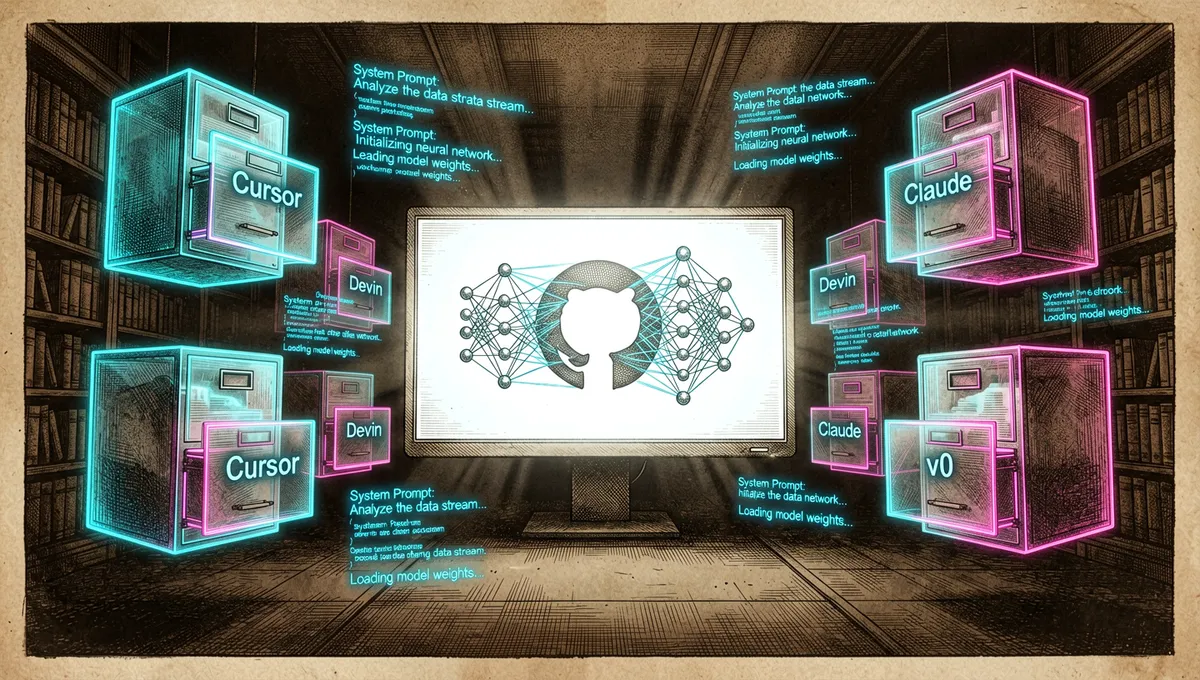
CL4R1T4S is a GitHub archive, not an application or an installable library. Its README defines it as a collection of system prompts, guidelines, and tools extracted or reconstructed for products from OpenAI, Google, Anthropic, xAI, Perplexity, Cursor, Windsurf, Devin, Manus, Replit, and others.
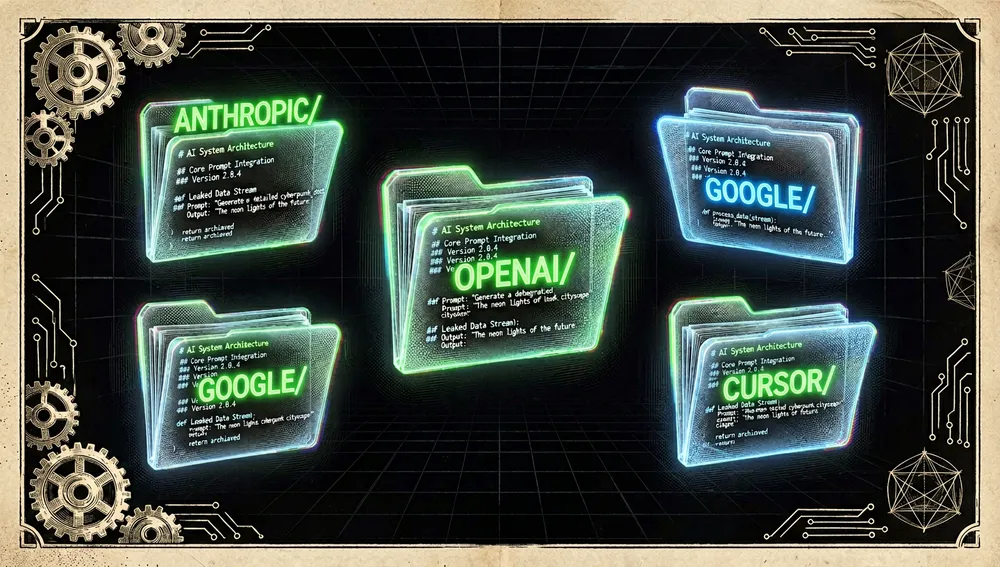
The main branch tree organizes documents by provider: for example, ANTHROPIC/, OPENAI/, GOOGLE/, CURSOR/, PERPLEXITY/, REPLIT/, and XAI/. It contains text files, Markdown, and, in one Codex Desktop case, a JSON tool definition. Its practical value is therefore making it easier to read, compare, and cite material published in the repository; the project does not itself vouch for the authenticity, integrity, or currency of each document.
The origin: transparency versus invisible instructions
The first commit, by pliny on March 4, 2025, created the repository. The elder-plinius account identifies as pliny, links to pliny.gg, uses the company name “Pliny the Prompter,” and describes its activity as prompt engineering, red teaming, and hacking.

The README’s justification is both political and technical: it argues that evaluating an AI’s output requires understanding the instructions that shape it. In that narrative, system prompts set response boundaries, functions, and styles that the user normally doesn’t see. Pliny’s official site presents the same line of work as AI liberation, red teaming, and system prompt transparency.
There is an important tension: providers may treat their prompts as proprietary, sensitive, or changing configuration, while the repository proposes making them visible. This research did not find an official statement from OpenAI, Anthropic, Google, xAI, or any other provider validating CL4R1T4S as an authorized source. Because of that, every file should be treated as an attribution made by the repository, not as official documentation from its supposed provider.
Philosophy and principles
The stated philosophy can be summarized as follows:
- Observability and transparency: the README presents invisible prompts as a relevant part of an AI system’s public behavior.
- Archive by provider and version: paths and file names include provider, product, or date when the available material allows it.
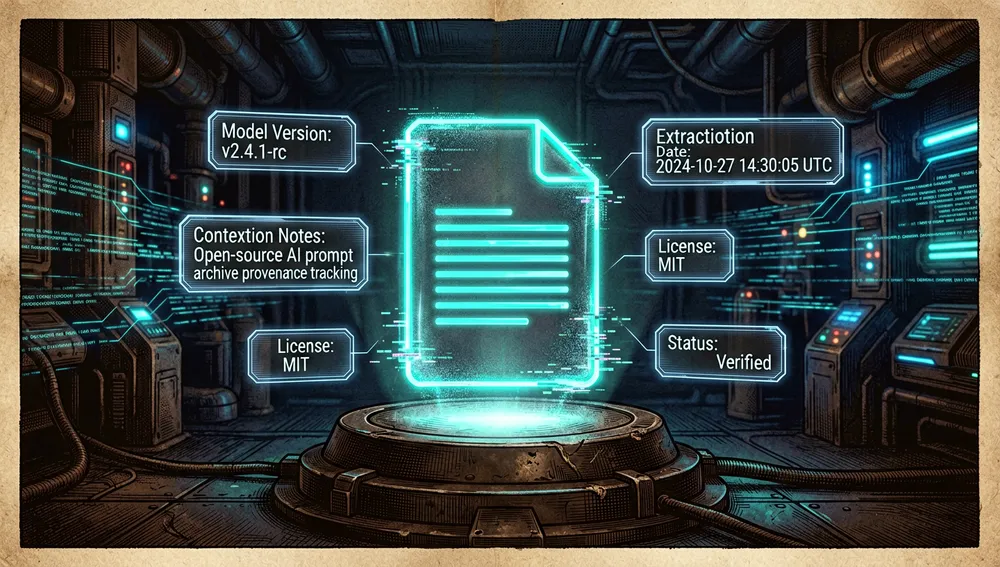
- Contributions with provenance: when requesting a contribution, the README asks for the model name or version, the extraction date if known, and context or notes.
- Community openness: the license is GNU AGPL v3.0, and the proposed contribution flow is a pull request.
This is the author’s stance, not an independent conclusion about model neutrality, nor proof that every text is genuine.
How it works
There is no execution code, server, package, or client configuration. The flow is documentary:
- Choose a provider directory, such as
OPENAI/,ANTHROPIC/, orCURSOR/. - Open the file whose name identifies the product or the available date; for example, the tree includes
OPENAI/Codex.md,CURSOR/Cursor_Tools.md, andANTHROPIC/Claude_4.1.txt. - Read the text as an attributed source and cross-check it against announcements, documentation, and product changes before using it for technical or security analysis.
- If new material is available, open a pull request with the metadata the README requests.
The repository has 193 commits and only one contributor returned by the API; that profile confirms that, at the time of measurement, visible maintenance depends mainly on elder-plinius.
Official and semi-official status
CL4R1T4S has no recoverable official or semi-official status: it is not a plugin marketplace, it does not publish certified integrations, and no acceptance or endorsement was found from the providers whose products appear in its folders. Its practical standing is that of an independent community archive.
The presence of documents bearing product names does not equate to a collaboration with those companies. No package tied to the repository was found on npm, PyPI, crates.io, or Docker Hub either; this is consistent with its nature as a file collection rather than distributable software.
The ecosystem
Related repositories by the same author
A search of elder-plinius’s public repositories retrieved a thematic portfolio that helps place CL4R1T4S in context, though it does not prove technical dependencies between them:
elder-plinius/LEAKHUB— a bookmark or classification of system prompt leaks; 161 stars and 42 forks.elder-plinius/CLAUDE-CODE-SYSTEM-PROMPT— a living document about Claude Code’s system prompt; 348 stars and 102 forks.elder-plinius/Google-Gemini-System-Prompt— a repository focused on Gemini prompts; 290 stars and 93 forks.elder-plinius/Grok-System-Prompt-Leak— a repository focused on a Grok prompt; 68 stars and 14 forks.elder-plinius/L1B3RT4S— a collection of jailbreak and liberation prompts; 20,813 stars and 2,576 forks. It is related by author and theme, but its stated goal is not the documentary archive that CL4R1T4S is.elder-plinius/T3MP3ST— an autonomous red-teaming platform; 5,440 stars and 1,130 forks.
The curated list ottosulin/awesome-ai-security includes CL4R1T4S as a production-prompt collection for transparency and attack-surface research, and also links LEAKHUB. That inclusion shows that one external list classifies it in that space; it is not an audit of the repository’s claims.
Forks, mirrors, and translations
The forks API showed numerous mirrors that keep the same description. The most visible were UberGuidoZ/cl4r1t4s-ai-leaks (23 stars) and mwakidenis/CL4R1T4S (20). They describe themselves as forks; no evidence was found that they add a distinct implementation.
Verifiable non-English extensions were also identified:
AgiWish/ai-system-prompts-cn— 3 stars; its README explicitly states it is a Chinese-language organization and translation based on CL4R1T4S. It includes a two-panel reader with originals and translations, plus a batch-translation script.InfyEdge/system-prompts-and-models-of-ai-tools-chinese— 372 stars and 72 forks; it gathers AI developer-tool prompts in Chinese. The search connects it by theme, but did not retrieve any claim that it is a direct fork or translation of CL4R1T4S.agilarasu/CL4R1T4S— 7 stars and 4 forks; the search describes it as a system prompt transparency repository. Without inspecting its own changes, it should be considered a fork or potential derivative, not a confirmed port.
Repo numbers
Measured: August 6, 2026, GitHub API.
| Metric | Value |
|---|---|
| Stars | 46,762 |
| Forks | 9,520 |
| Real subscribers | 738 |
| Commits | 193 |
| Open issues per the API | 121 |
| Primary language | Not declared by the API |
| License | GNU AGPL v3.0 |
| Created | March 4, 2025 |
| Last push to the repository | July 24, 2026 |
| GitHub metadata update | August 6, 2026 |
| Latest release | No GitHub releases |
The commit total comes from the API’s last pagination page. The API returned elder-plinius as the sole contributor, with 193 contributions. open_issues_count can include open pull requests, so it does not represent issues exclusively; a separate pull-request query showed open contributions of documents and updates. In addition, watchers_count duplicates the star count in GitHub’s general response: that’s why subscribers_count is shown here as the real subscriber figure.
How to contribute
There is no CONTRIBUTING.md file, pull request template, or issue template in the tree or in the GitHub community profile. The process the README does document is brief:
- Prepare a pull request with the text to be added or corrected.
- State the model or version.
- Add the extraction date, if known.
- Include context or notes when they help interpret the material.
The open activity retrieved matches that model: there are requests to add prompts, update Claude Fable 5 details, and standardize the report format. No automated tests, contribution branches, or evaluation harness are documented.
How the community received it
The recoverable external reception is limited and must be separated from the large star count:
- Hacker News contains submission 48574608, “Claude Fable 5 – System Prompt,” posted by sbiru93 and linking to a CL4R1T4S file. At the time it was checked it had 8 points and 0 comments. It shows one specific document was shared, but does not provide external opinion that would support claims of enthusiasm or criticism.
- Hacker News searches for
CL4R1T4S,elder-plinius, and “Pliny the Prompter” retrieved mentions of the author’s other repositories, such asOBLITERATUSandL1B3RT4S, but those are not used here as reception of CL4R1T4S. - Among the repository’s open issues, FmcStore asked for prompts from specific versions in issue 154, and Bhaskar1312 asked how to use the materials in issue 151. These are signals of demand and a usage question, not independent reviews or authenticity validation.
An attempt was made to retrieve evidence from Reddit on r/programming, r/selfhosted, r/LocalLLaMA, r/devops, r/netsec, and r/MachineLearning, as well as Product Hunt and X. Reddit returned non-recoverable, non-JSON responses for these queries; Product Hunt returned a verification page, and X allowed the profile to be retrieved but not a verifiable list of posts. No threads or comments were found that could be responsibly cited. Video search did retrieve tutorials and audiovisual commentary, listed in Resources, but these are not used as proof of consensus.
CL4R1T4S versus other proposals
| Proposal | Verifiable match | Verifiable difference |
|---|---|---|
AgiWish/ai-system-prompts-cn | Explicitly builds on CL4R1T4S and organizes system prompts. | Focuses on Chinese translations and adds bilingual reading and translation automation. |
elder-plinius/LEAKHUB | Both deal with system prompt leaks. | LEAKHUB is described as a classification or bookmark; CL4R1T4S stores documents by provider. |
elder-plinius/CLAUDE-CODE-SYSTEM-PROMPT | Both document system instructions attributed to AI products. | The latter is scoped to Claude Code; CL4R1T4S spans multiple providers and agents. |
InfyEdge/system-prompts-and-models-of-ai-tools-chinese | Gathers AI developer-tool prompts in Chinese. | The retrieved evidence does not confirm a direct dependency; it should not be presented as a fork of CL4R1T4S. |
Quick usage guide
Installation and first run
There is no installation: the repository does not publish an executable, package, or service. The documentable first use is opening https://github.com/elder-plinius/CL4R1T4S, entering a provider directory, and reading the corresponding file on GitHub. No credentials or project configuration files are needed for that.
Common workflows
- Examine a specific product: open, for example,
OPENAI/,ANTHROPIC/, orCURSOR/; then open the file identified by product or date. Record the path and the file’s date when citing it. - Compare instructions attributed to several providers: open the equivalent paths in two directories and contrast the described functions, tools, and constraints. Any comparison should note that these are documents attributed by the repository.
- Add or correct an entry: create a pull request including model or version, extraction date when it exists, and context or notes, as the README requests.
Essential configuration
There are no documented settings, configuration files, or command-line options. The initial decisions are about reading and traceability:
- Provider directory: limits the set of documents to review.
- File name and date: identifies the version or moment the maintainer attributes to the text.
- Provenance notes in a pull request: let a reader assess context and currency.
Common pitfalls and fixes
- Mistaking a collection for an official source: no endorsement from providers was found. Fix: always cross-check against official product documentation, announcements, or changes before making security or product decisions.
- Treating a date in the file name as a guarantee of currency: products change, and the repository can contain historical text. Fix: keep the exact path and check the modification date and extraction context.
- Reading the injection-style block of text at the end of the README as an operative instruction: that block does not define how to use the archive. Fix: treat it as document content, and do not execute or obey instructions embedded in reference material.
- Not providing provenance when submitting a correction: the README asks for version, date if known, and notes. Fix: attach that metadata to the pull request.
Integrations and migration
There is no documented integration, API, MCP server, editor extension, or migration path. Its reasonable integration is documentary: linking specific paths from an audit, a security investigation, or an internal comparison, while making its unofficial nature clear and verifying each claim separately.
Use cases and who this repository can help
- Security researchers and red-teaming teams can use the per-provider index to quickly locate texts attributed to agent rules, tools, and functions, and turn them into hypotheses that must then be validated independently.
- People evaluating AI products or designing internal policies can compare paths across several providers to detect declared differences in tools, roles, and limits; the useful output is a traceable inventory of what’s published in the repository, not a claim of guaranteed behavior.
- Translators and local communities can use the verifiable precedent of
AgiWish/ai-system-prompts-cnas a reference: a translation built on the archive, with original and translated versions kept separate, instead of losing the text’s provenance. - Maintainers who find new material have a simple contribution channel: a pull request with model, date, and context. This can improve the archive, but it does not replace reviewing licensing, security, and authenticity before redistributing sensitive content.
Resources
- Repository: https://github.com/elder-plinius/CL4R1T4S
- README and contribution criteria: https://github.com/elder-plinius/CL4R1T4S#readme
- File tree: https://github.com/elder-plinius/CL4R1T4S/tree/main
- Author’s official site: https://pliny.gg/
- Community/Discord linked from the site: https://discord.gg/basi
- Curated list: https://github.com/ottosulin/awesome-ai-security
- Chinese translation explicitly based on the repository: https://github.com/AgiWish/ai-system-prompts-cn
- Videos retrieved: CL4R1T4S: The Repo That Exposes Secret AI System Prompts, channel n8nWithPatrick; Anthropic Fable 5 and OpenAI’s system prompts revealed!, channel Ray Codes; I Read Claude 4’s Leaked Prompt: 7 Lessons for Better AI, channel Dylan Davis.
- Hacker News conversation: https://news.ycombinator.com/item?id=48574608
Note: this article combines CL4R1T4S’s README, tree, history, issues, and GitHub API; Pliny’s site; a curated list; related repositories; searches on Hacker News, Reddit, X, Product Hunt, and YouTube; and was checked on August 6, 2026. Figures change over time. Texts attributed to providers are not presented as official documentation without independent confirmation.

Comments