

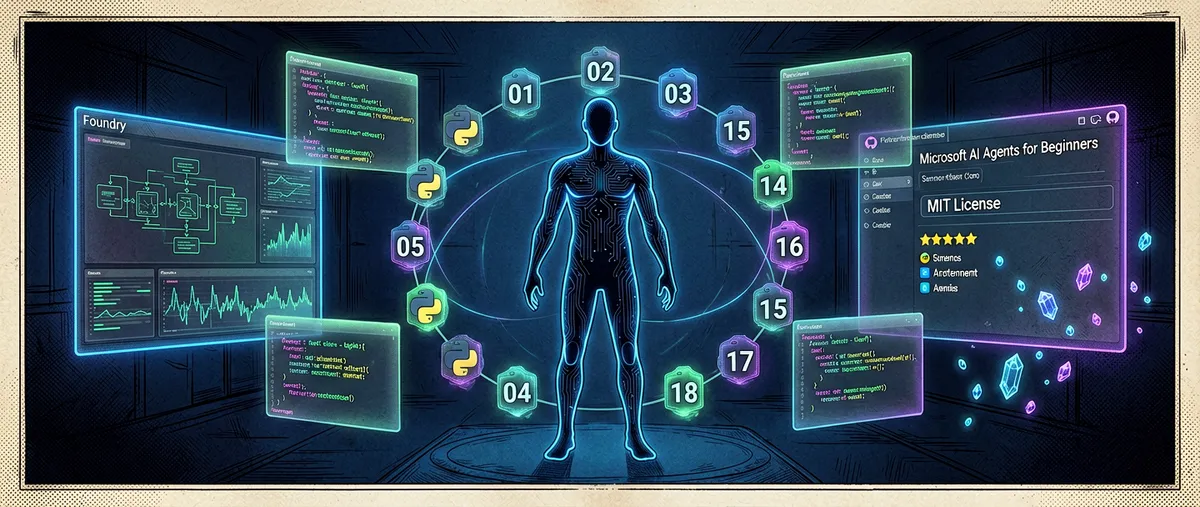
AI Agents for Beginners: Microsoft's official course for building AI agents
microsoft/ai-agents-for-beginners · 75,661★ · 24,888 forks
Everything worth knowing about microsoft/ai-agents-for-beginners: an open-source, MIT-licensed training of 18 lessons with videos and Python/.NET notebooks that teaches how to design and deploy AI agents on Microsoft’s own stack — Microsoft Agent Framework and Microsoft Foundry.
Disambiguation: this report documents the official course from the
microsoftorganization on GitHub. It should not be confused with the various community replicas and handbooks that share keywords (ai-agents,agentic-ai-for-beginners, etc.) that show up in repository search; only Microsoft’s first-party repository is analyzed here.
What AI Agents for Beginners is
AI Agents for Beginners is a self-paced course published by Microsoft, not a library or framework in itself. The product is 18 written lessons (plus a lesson 00 for setup), each with a short video, Python code samples (and, in some, C#), and further-reading links. Its stated goal is to cover “everything you need to know to start building AI agents,” from what an agent is to production deployment.
It doesn’t run anything on its own: it’s teaching material whose code supports two real pieces of Microsoft infrastructure — Microsoft Agent Framework (MAF) for orchestrating agents and Microsoft Foundry Agent Service V2 (the Responses API) as the inference service. In practice the repo works as the documented entry point to Microsoft’s agent stack, following the same format as its “for Beginners” course family (Generative AI, MCP, LangChain, AZD, Edge AI).
The origin
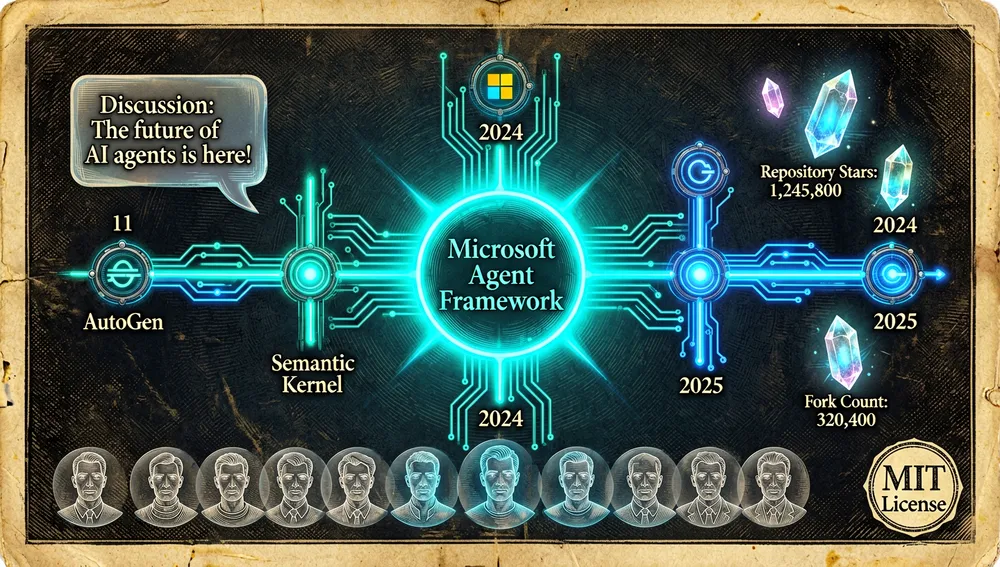
The repository was created on November 28, 2024 under the microsoft organization. Its evolution shows in its own topics, which preserve traces of several eras: autogen, semantic-kernel on one side and foundry, microsoft-foundry, agent-framework on the other.
The technical trajectory is consistent with Microsoft’s agent strategy. In 2024 the company’s agent ecosystem relied on AutoGen and Semantic Kernel, and the course was born in that context: the first verifiable Hacker News submission, by koreyspace on February 14, 2025, titled the course “A 10 Lesson Course.” Since then the course grew to today’s 18 lessons and was rewritten to build on the unified successor: Microsoft Agent Framework, which Microsoft’s official documentation describes as “the direct successor, built by the same teams, that combines AutoGen’s simple abstractions with Semantic Kernel’s enterprise capabilities.” The README and requirements.txt document the transition: the notebooks use MAF with FoundryChatClient, and the dependency file is pinned to agent-framework-core==1.10.0 because 1.11.0 introduced breaking changes.
Maintenance is a Microsoft education effort, not a single author’s project. The README’s links carry the WT.mc_id=academic-105485-koreyspace tracking tag, and the README explicitly thanks Shivam Goyal for the Agentic RAG code samples. The top contributors are leestott, skytin1004, and koreyspace, plus the Copilot bot.
Philosophy and principles
The course doesn’t propose an engineering methodology or an opinion on the state of the art; its “philosophy” is that of adoption material: learn Microsoft’s own stack top to bottom and reach production with the controls that stack offers. A set of recurring, verifiable ideas emerges from the lessons:
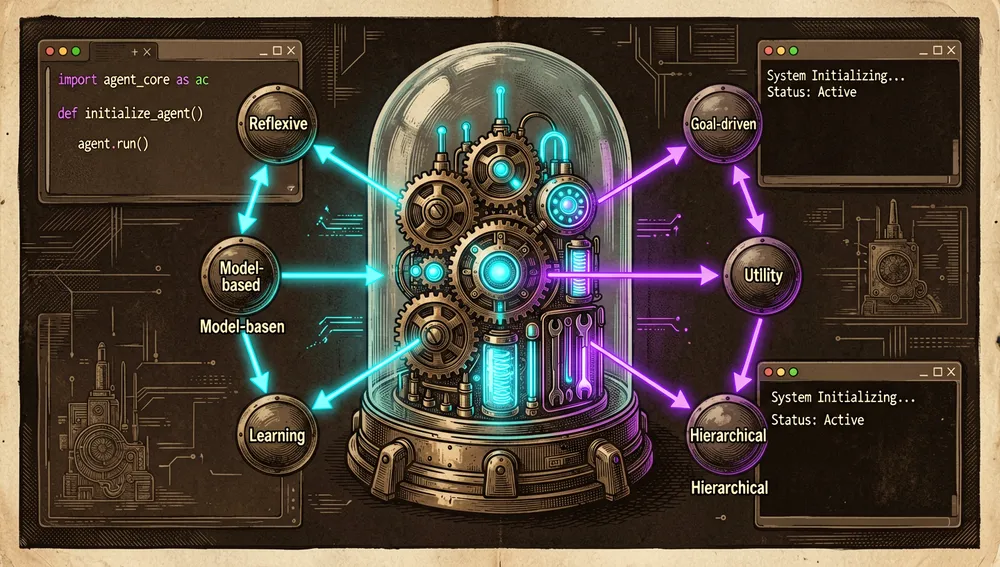
- The agent as a system, not as “chat.” Lesson 1 defines an agent with environment, sensors, and actuators, and distinguishes types (simple reflex, model-based, goal-based, utility-based, learning, hierarchical, and multi-agent). The emphasis is on “doing things” (calling tools, accessing memory), not only generating text.
- Agentic design patterns as the teaching unit. The course is structured around reusable patterns: tool use, planning, multi-agent, metacognition, and agentic RAG, plus context engineering and memory.
- Security and trust as a requirement, not decoration. There are dedicated lessons on building reliable agents (6), running them in production (10), and securing them (18, with cryptographic receipts).
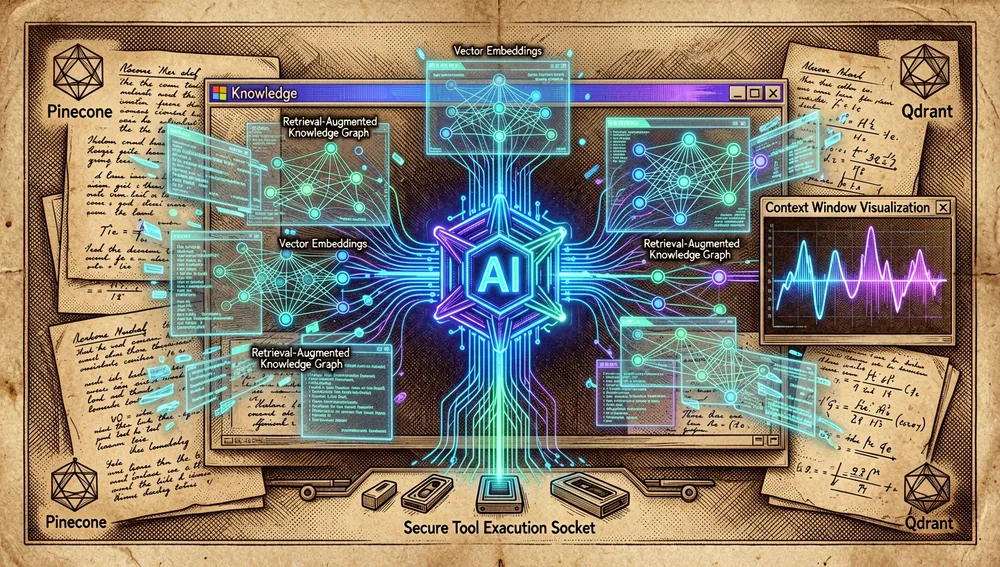
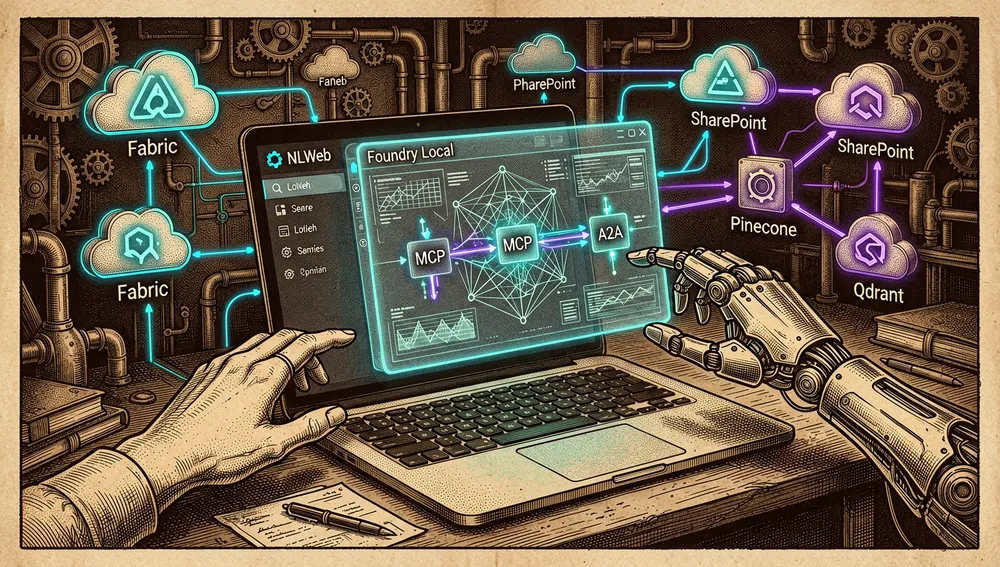
- Interoperability and agnosticism. MAF presents itself as cloud- and vendor-agnostic, integrated with open standards (MCP, A2A) and connectors to Fabric, SharePoint, Pinecone, and Qdrant. Lesson 17 also lets you run agents locally with Foundry Local.
How it works
The course follows an 18-step progression. Each lesson has a text README, a video (lessons 1 through 12), and code notebooks tagged *-python-agent-framework.ipynb (and, where applicable, *-dotnet-agent-framework).
The lessons, per the README’s table: 1. Introduction to AI agents and use cases. 2. Exploring agentic frameworks. 3. Agentic design patterns. 4. Tool Use pattern. 5. Agentic RAG. 6. Building trustworthy AI agents. 7. Planning pattern. 8. Multi-agent pattern. 9. Metacognition pattern. 10. AI agents in production. 11. Agentic protocols (MCP, A2A, and NLWeb). 12. Context engineering for AI agents. 13. AI agent memory management. 14. Exploring Microsoft Agent Framework. 15. Computer-use agents (CUA / browser use). 16. Deploying scalable agents. 17. Building local AI agents. 18. AI agent security.
The central technical flow (lessons 14 onward) relies on MAF. Creating an agent means defining the inference service, some instructions, and a name (for example AzureOpenAIChatClient(...).create_agent(instructions=..., name=...)); the agent runs with .run() or .run_stream(). MAF documents sequential, concurrent, group, handoff, and “magentic” orchestration (a manager agent creates and modifies a task list and coordinates subagents), and adds observability (OpenTelemetry + Foundry dashboards), durability (pause/resume threads), and human-in-the-loop.
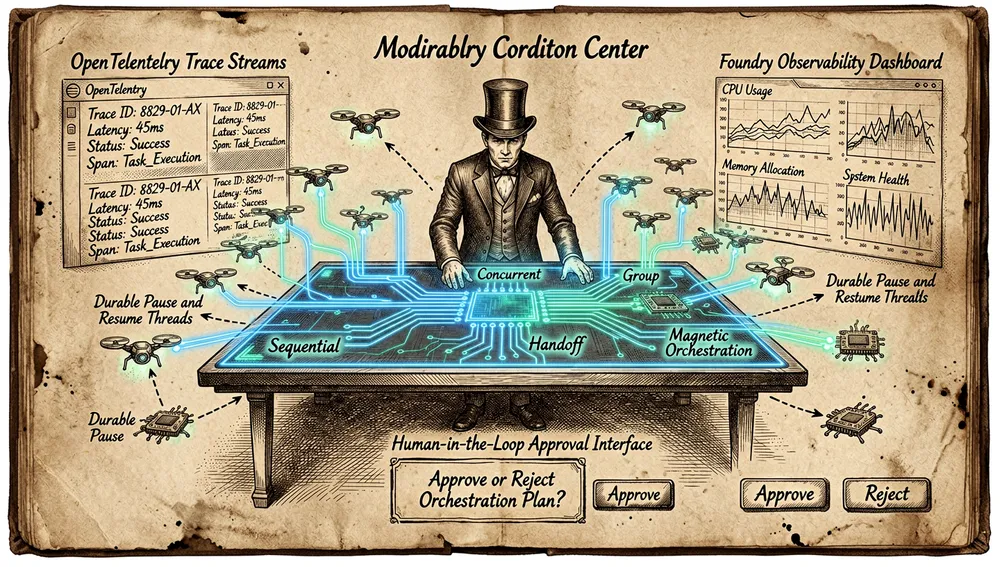
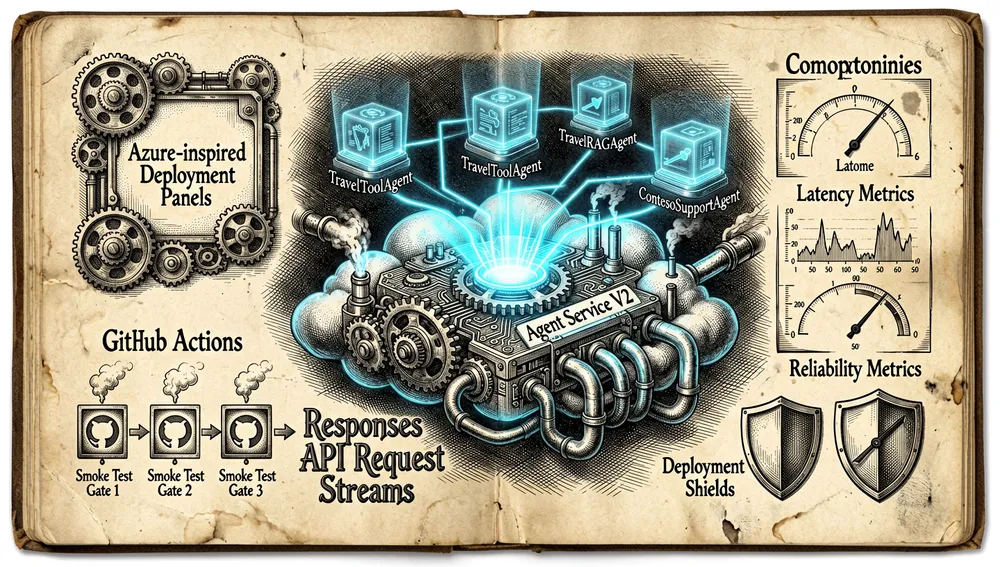
The repo also includes a catalog of smoke tests (tests/lesson-01-smoke-tests.json, lesson-04, lesson-05, lesson-16) for deployable agents (TravelAgent, TravelToolAgent, TravelRAGAgent, ContosoSupportAgent), consumed by the AI Smoke Test GitHub Action via the .github/workflows/smoke-test.yml workflow. They’re a first gate — “the deployed agent responds and meets basic expectations” — not the full evaluation pipeline from lessons 10 and 16.
Security and trust model
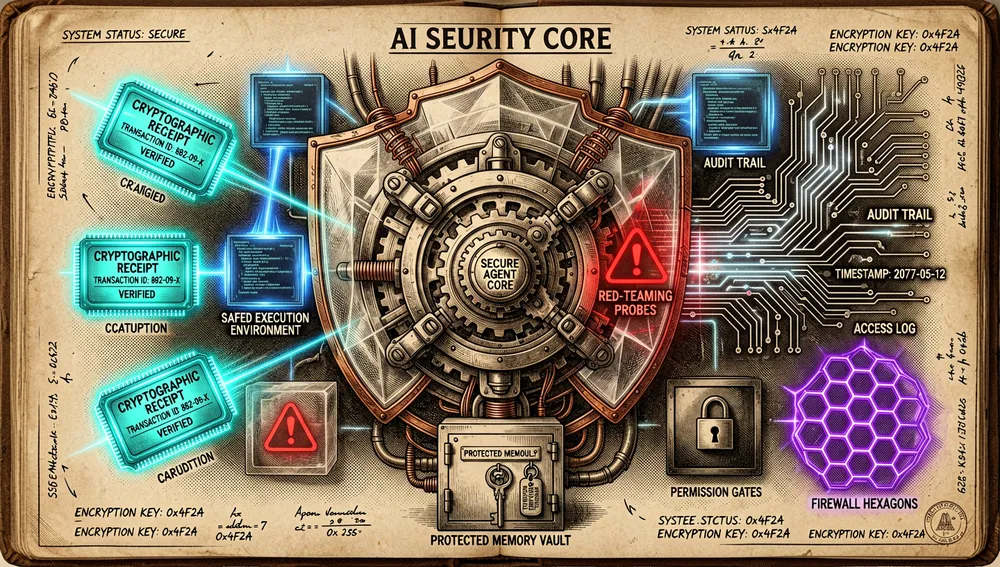
Lessons 6, 10, and 18 form a continuous thread of reliability: build trustworthy agents, run them in production with controls, and secure them with cryptographic receipts. The course doesn’t treat security as an appendix: it positions it as a requirement for reaching production, consistent with the rest of the Foundry stack (observability, human-in-the-loop, durable pauses).
Interoperability is also part of that same trust principle: MAF connects with MCP and A2A as open protocols, with NLWeb, with computer-use agents (browser/computer use), and with Foundry Local for running agents without depending on the cloud, alongside connectors to Fabric, SharePoint, Pinecone, and Qdrant.
Official and semi-official status
This repository is Microsoft first-party: it lives in the microsoft organization, is MIT-licensed, uses official aka.ms short links (e.g. https://aka.ms/ai-agents-beginners), and is the official educational resource for learning Microsoft’s agent stack (MAF + Foundry). There’s no “marketplace” or certification in the sense of plugins; its official status shows up in practice:
- Part of Microsoft’s “for Beginners” family, which includes Generative AI for Beginners, MCP for Beginners, LangChain for Beginners, AZD for Beginners, Edge AI for Beginners, among others, all linked from the README.
- Microsoft academic/developer channel: the
WT.mc_idtracking links and theaka.mspage place it within official adoption materials. - Backed community: the course funnels learners to the Microsoft Foundry Discord and the Foundry developer forum.
- De facto standard: as the official training for MAF/Foundry, it functions as the de facto reference for anyone wanting to learn that specific stack. This doesn’t imply a formal “standard” designation outside Microsoft.
The ecosystem
Microsoft frameworks and services (the course’s “ground”): microsoft/agent-framework — the framework the course relies on; “framework for building, orchestrating, and deploying AI agents and multi-agent workflows in Python and .NET”; 13,048 stars, 2,214 forks. Official documentation defines it as the direct successor to Semantic Kernel and AutoGen, with migration guides from both. microsoft/autogen — “a programming framework for agentic AI”; 60,570 stars. Predecessor that contributed agent abstractions. microsoft/semantic-kernel — “integrate LLM technology quickly and easily into your apps”; 28,478 stars. Predecessor that contributed enterprise capabilities.
Sibling Microsoft courses (same format): microsoft/generative-ai-for-beginners — “21 lessons, get started building with Generative AI”; 118,336 stars, 62,384 forks. The largest sibling course, and the entry point the README recommends before this one. microsoft/mcp-for-beginners — a Model Context Protocol curriculum in .NET, Java, TypeScript, JavaScript, Rust, and Python; 17,043 stars. The README also links LangChain for Beginners, LangChain.js for Beginners, LangChain4j for Beginners, AZD for Beginners, Edge AI for Beginners, and the full “Core” course series (ML, Data Science, AI, Cybersecurity, Web Dev, IoT, XR) and Copilot.
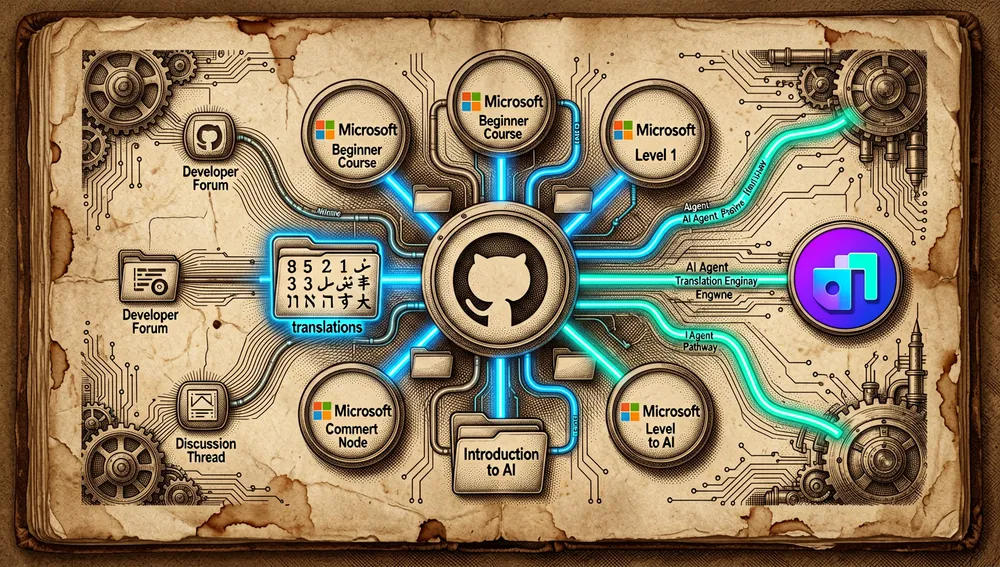
Community translations and derivatives: official translations (50+ languages), listed in the README as maintained “via a GitHub Action (automated and always up to date)” by Azure/co-op-translator. They live in translations/<language>/ inside the repo itself, not as separate repos. Among verified community derivatives: Microsoft-Stores/microsoft-ai-agents-for-beginners (59 stars, an 11-lesson replica geared toward Azure AI Foundry and Semantic Kernel), DTiapan/ai-agents-handbook (87 stars, a comprehensive agent-building handbook), UnfoldDataScience/Agentic_Ai_For_Beginner (33 stars, code from a Udemy course), and Yash-Kavaiya/Agentic-AI-for-Beginners (21 stars).
A repo search for “ai-agents-for-beginners” returns 362 matches, but many are noise that only shares keywords and aren’t derivatives of this course; only the ones listed here are verifiably related.
Repo numbers
Measured: August 22, 2026, GitHub API.
| Metric | Value |
|---|---|
| Stars | 73,007 |
| Forks | 24,133 |
| Real subscribers | 563 |
| Commits | 1,983 |
| Open issues + PRs | 9 |
| Primary language | Jupyter Notebook |
| License | MIT |
| Created | November 28, 2024 |
| Last push | August 18, 2026 |
| Number of lessons | 18 (plus setup lesson 00) |
watchers_count mirrors the star count, so subscribers_count is reported as the real subscriber figure. The releases API returned an empty list: the course doesn’t publish formal GitHub releases; the reference “version” is marked by the requirements.txt pins (agent-framework-core==1.10.0) and the set of 18 lessons. A full clone weighs ~3 GB due to the 50+ translations; the guide recommends a sparse/shallow clone to lighten it.
Top contributors by contributions: leestott (570), skytin1004 (509), koreyspace (285), hyoshioka0128 (114), Copilot (bot, 60), ShivamGoyal03 (56), marietta-a (46). The presence of the Copilot bot and several Microsoft collaborators reflects a project maintained by the company’s education team.
Quick-start guide
Installation and first run
The “start” isn’t running an app — it’s cloning the course and being able to run its notebooks. Prerequisites documented in lesson 00: Python 3.12+ (create the virtual environment with python3.12), .NET 10+ only for the C# samples, Azure CLI, and an Azure subscription with a Microsoft Foundry project (a hub + project with a deployed model, e.g. gpt-5-mini).
# Full clone (or use --depth 1 / --sparse to save the ~3 GB)
git clone https://github.com/microsoft/ai-agents-for-beginners.git
cd ai-agents-for-beginners

python -m venv venv
source venv/bin/activate        # Windows: venv\Scripts\activate

pip install -r requirements.txt
Then authenticate with the Azure CLI and create the .env:
az login                         # or: az login --use-device-code (no browser)
az account show                  # verify
cp .env.example .env             # Windows: Copy-Item .env.example .env
In .env, at minimum fill in AZURE_AI_PROJECT_ENDPOINT and AZURE_AI_MODEL_DEPLOYMENT_NAME. On first run, the notebooks authenticate via az login, so no API keys are needed for most lessons.
Common workflows
- Follow the course in order (or by topic). Open
00-course-setup/README.md; then each lesson’sNN-.../README.mdcontains text + video + notebook. The result is an agent running locally against your Foundry project. - Build and verify a deployable agent. For lesson 16, deploy the agent as a hosted agent in Foundry; then run the Smoke-test hosted agents workflow choosing
tests_file,agent_name, and theproject_endpoint. - Run a local agent with no cloud (lesson 17). Install Foundry Local (
winget install Microsoft.FoundryLocalorbrew install foundrylocal), runfoundry model run phi-4-mini, andpip install foundry-local-sdk. - Migrate to an alternative provider (MiniMax). By setting
MINIMAX_API_KEY,MINIMAX_BASE_URL, andMINIMAX_MODEL_IDin.env, samples usingOpenAIChatClientdetect that configuration and use it as a replacement.
Essential configuration
The files and settings a new user will touch first: .env (connection variables; at minimum AZURE_AI_PROJECT_ENDPOINT and AZURE_AI_MODEL_DEPLOYMENT_NAME), requirements.txt (deliberately pinned to agent-framework-core==1.10.0), the Foundry project setup (ai.azure.com), the Python interpreter in VSCode (must be the 3.12+ venv one), and the lesson folders (NN-.../code_samples/).
Common pitfalls and fixes
agent-framework1.11 breaks the notebooks. Therequirements.txtcomment states it: 1.11.0 removedChatMessageandHostedWebSearchTool, changed theMessageconstructor, and dropped themodel=argument fromAgent.run(). Fix: stay on the pinnedagent-framework-core==1.10.0.- ~3 GB clone. Fix: shallow clone (
git clone --depth 1 ...) or sparse, or use GitHub Codespaces. - SSL error on macOS. Documented fixes, in order: run
Install Certificates.command; install and importtruststore; or, only temporarily in development, disable verification (reduces security, don’t use in production). - Lesson 16 uses key-based authentication for Azure AI Search. Unlike the rest of the course (which goes through
az login), the notebook only switches to Azure AI Search if bothAZURE_SEARCH_SERVICE_ENDPOINTandAZURE_SEARCH_API_KEYare set. - Lessons 6 and 8 call Azure OpenAI directly (via the Responses API) and need
AZURE_OPENAI_ENDPOINT/AZURE_OPENAI_DEPLOYMENT(the GitHub Models API is deprecated and doesn’t support the Responses API). - Not everything can be tested with smoke tests. Lesson 17 (local) and the theoretical lessons (2, 3, 6, 7, 9, 12) are deliberately excluded; they’re validated by running the notebook locally.
Integrations and migration
- With Microsoft Foundry / Azure: the entire course runs against a Foundry project; hosted agent deployment (lesson 16) is the bridge to production.
- With CI (GitHub Actions): the
.github/workflows/smoke-test.ymlworkflow consumes the AI Smoke Test GitHub Action over thetests/*.jsoncatalogs; it requires theAZURE_CLIENT_ID,AZURE_TENANT_ID,AZURE_SUBSCRIPTION_IDsecrets with the Azure AI User role. - With open standards: MAF integrates with MCP (
mcp[cli]) and A2A (a2a-sdk), plus connectors to Microsoft Fabric, SharePoint, Pinecone, and Qdrant. - With alternative providers: MAF’s
OpenAIChatClientworks with any OpenAI-compatible endpoint, enabling MiniMax and Foundry Local as drop-in substitutes. - Migration within the Microsoft stack: MAF’s official documentation includes migration guides from Semantic Kernel and from AutoGen.
Contributing
There’s no CONTRIBUTING.md; the process is documented in the README: open an issue for suggestions or errors; create a pull request; accept Microsoft’s CLA (cla.opensource.microsoft.com, a bot checks whether it’s needed); and adopt the Microsoft Open Source Code of Conduct. Each lesson lives in its own folder with its README, images/, and code_samples/; smoke tests are in tests/; translations are coordinated by Azure/co-op-translator.
How the community received it
The recovered evidence shows something clear: being a corporate Microsoft adoption course, it doesn’t generate the viral discussion other tools do. Hacker News threads are few, low-scoring, and comment-free, and Reddit is dominated by course-aggregator mentions.
On Hacker News, the highest-traction submission found is “Lessons to Get Started Building AI Agents,” by thunderbong (July 4, 2025, 10 points, 0 comments). It’s followed by “AI Agents for Beginners” by aymenfurter (April 14, 2025, 2 points, 0 comments) and “AI Agents for Beginners – A 10 Lesson Course” by koreyspace (one of the repo’s main contributors, February 14, 2025, 2 points, 0 comments) — the latter also serving as dated proof of the move from 10 to 18 lessons. No Hacker News thread with verifiable broad discussion was found; all three submissions are really presentations without debate.
On Reddit, r/learnmachinelearning and r/AgentsOfAI each have a single-digit-point posting (1 point, 0 comments), and r/Udemy lists the course among free-course aggregations with no student ratings. Overall: the repository is heavily used as curriculum and adoption material (73,007 stars, 24,133 forks, 563 subscribers), but its forum footprint is reference-mention rather than technical debate.
AI Agents for Beginners versus other proposals
| Proposal | Verifiable overlap | Verifiable difference |
|---|---|---|
microsoft/generative-ai-for-beginners (118,336 ⭐) | Same Microsoft “for Beginners” format: lessons + video + notebooks. | Focuses on generative AI in general (21 lessons), not specifically agents; the README recommends it as a prior step. |
microsoft/mcp-for-beginners (17,043 ⭐) | Same format and organization; multi-language (.NET, Java, TS, JS, Rust, Python). | Covers only the Model Context Protocol; this course covers the full agent lifecycle (MCP appears as one lesson, #11). |
DTiapan/ai-agents-handbook (87 ⭐) | An AI agents handbook, basic to advanced, with code and tutorials. | Independent community project, not official Microsoft nor tied to Foundry/MAF. |
UnfoldDataScience/Agentic_Ai_For_Beginner (33 ⭐) | Agentic AI course for beginners with code. | Accompanies a Udemy course, not Microsoft material. |
The most useful comparison isn’t by popularity: this repository stands out when you want to learn Microsoft’s specific stack (MAF + Foundry) from start to production, with free, official, multilingual material. For a vendor-agnostic path, a course like LangChain’s may be more suitable; for MCP protocols only, mcp-for-beginners is the entry point.
Use cases and who this repository can help
- Developers and teams adopting Microsoft’s agent stack can use the 18 lessons as a full path: understand what an agent is, choose patterns (tool use, planning, multi-agent), implement with MAF, and deploy with Foundry.
- Data/AI engineers who need agentic RAG can start from lesson 5 and its sample (
TravelRAGAgent), with the documented option of moving from an in-memory knowledge base to a real Azure AI Search index. - Teams deploying agents to production can reuse the smoke-test catalogs (
tests/*.json) with the AI Smoke Test GitHub Action to verify, in CI, that a hosted agent in Foundry responds before each deployment. - Those who don’t want to depend on the cloud can follow lesson 17 and use Foundry Local (or
OpenAIChatClientpointed at a compatible provider like MiniMax). - Teachers, trainers, and learning communities can leverage the 50+ official translations to teach the course in their language.
Resources
- Repository: https://github.com/microsoft/ai-agents-for-beginners
- Official page: https://aka.ms/ai-agents-beginners
- Installation / lesson 00: https://github.com/microsoft/ai-agents-for-beginners/blob/main/00-course-setup/README.md
- Course framework (MAF): https://github.com/microsoft/agent-framework
- Sibling courses: https://github.com/microsoft/generative-ai-for-beginners · https://github.com/microsoft/mcp-for-beginners
- Community / Discord: https://aka.ms/ai-agents/discord
Note: this article combines the README, installation lesson 00, requirements.txt, the tests/ folder, the GitHub API, and Microsoft Agent Framework’s official documentation, alongside Hacker News and Reddit results consulted on August 22, 2026. Star, fork, contribution, and commit figures change over time.
Comments