

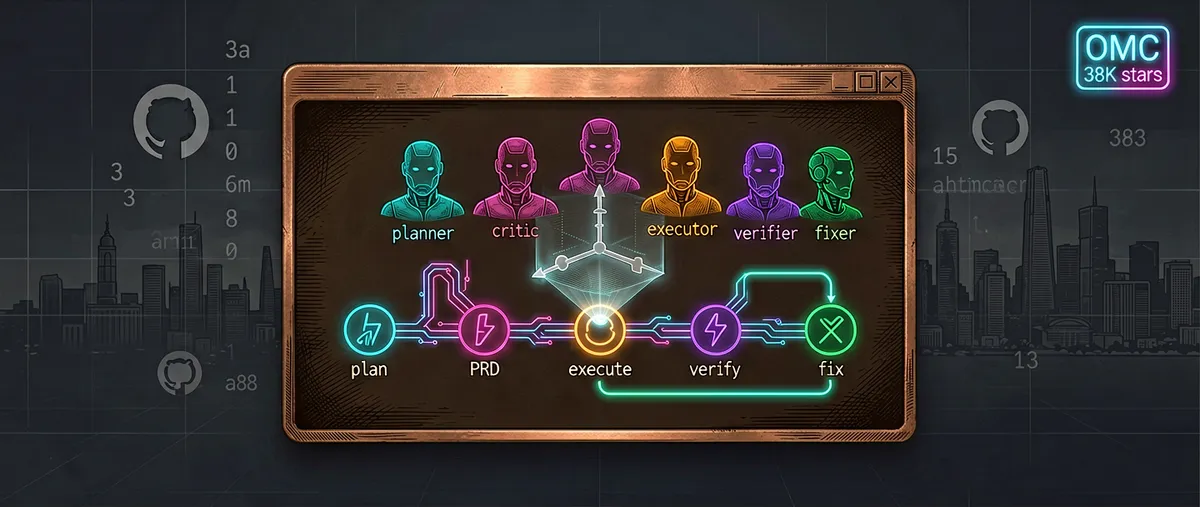
oh-my-claudecode: teams-first multi-agent orchestration for Claude Code, installed as an official plugin
Yeachan-Heo/oh-my-claudecode · 39,354★ · 3,514 forks
oh-my-claudecode (OMC) installs a “teams-first” orchestration layer on top of Claude Code: it turns a single agent session into a team of specialized agents that plans, executes, verifies, and fixes, without the user having to learn new commands. It installs from Claude Code’s own plugin system or from npm, is MIT-licensed, and as of August 22, 2026 has accumulated over 38,000 stars.
Origin
The repository was created on January 9, 2026 by Yeachan Heo (Yeachan-Heo), an algorithmic trader and leader of the Korean quant community Quant.start(), linked to Layoff-Labs and based in Seoul. OMC is by far his largest repository: it tops a list of 67 public repositories with 4,731 followers.
The creation date matters for context: that same day, January 9, 2026, Hacker News discussed Anthropic blocking third-party use of Claude Code subscriptions (a thread with 625 points). OMC was born right after that restriction, explicitly building on oh-my-opencode as its cited inspiration. The author’s companion website describes itself with the phrase “They banned us. We came back.” The consistent reading across recovered sources is that OMC reframes “inside the official system” a tradition of orchestration that used to live in third-party clients: instead of working around Claude Code, it installs on top of it via its own plugin system.
A detail the README clarifies: the project is branded oh-my-claudecode (repository, plugin, and commands), but the npm package is published as oh-my-claude-sisyphus; installing or updating via npm requires that second name.
Philosophy and principles
The README’s tagline is “Multi-agent orchestration for Claude Code. Zero learning curve” and “Don’t learn Claude Code. Just use OMC.” The principles verifiable in the documentation:
- Zero configuration: smart defaults; the user describes what they want in natural language.
- Teams-first orchestration: the
Teammode is the canonical multi-agent surface; the legacyswarmkeyword was removed as of v4.1.7. - Automatic parallelization: complex tasks are split across specialized agents.
- Persistent execution: it doesn’t “give up” until the task is verified complete (Ralph mode).
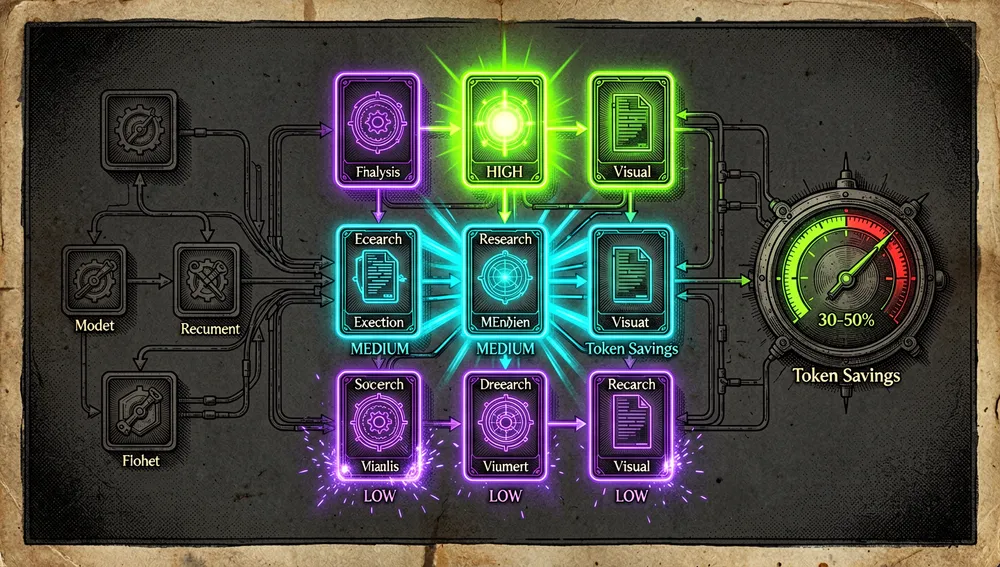
- Cost optimization: smart model routing (Haiku for simple tasks, Opus for complex reasoning); the README claims 30–50% token savings.
- Learning from experience: extracts problem-solving patterns and reuses them as skills.
- Real-time visibility: a status line (HUD) shows what’s happening underneath.
The core idea versus the competition: it’s not a single agent calling subagents “as tools,” but a pipeline stage where each role (planner, critic, executor, verifier) is an agent with its own context that validates the others.
How it works
OMC exposes two surfaces: terminal CLI commands (omc ...), after installing the npm/runtime package, and in-session skills (/...), inside a Claude Code session after the plugin/setup flow.
The canonical Team pipeline is:
team-plan → team-prd → team-exec → team-verify → team-fix (loop)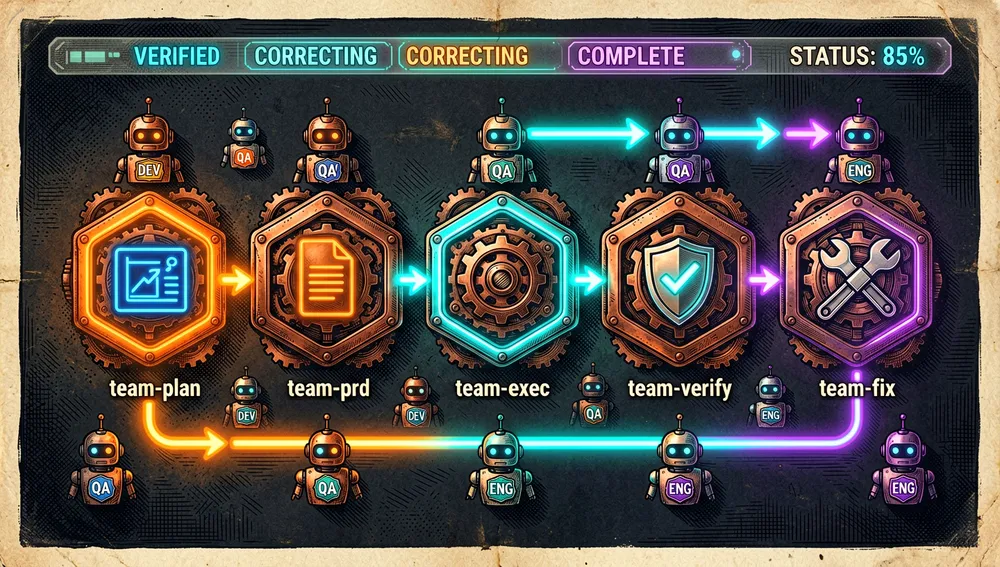
Autopilot mode is a five-stage autonomous pipeline: (1) Expansion — the analyst and architect agents clarify requirements and produce a spec; (2) Planning — planner creates the plan and critic reviews it; (3) Execution — executor writes the code, in parallel when needed; (4) QA — verifies build and tests, fixes and re-verifies; (5) Validation — specialists review functionality, security, and quality.
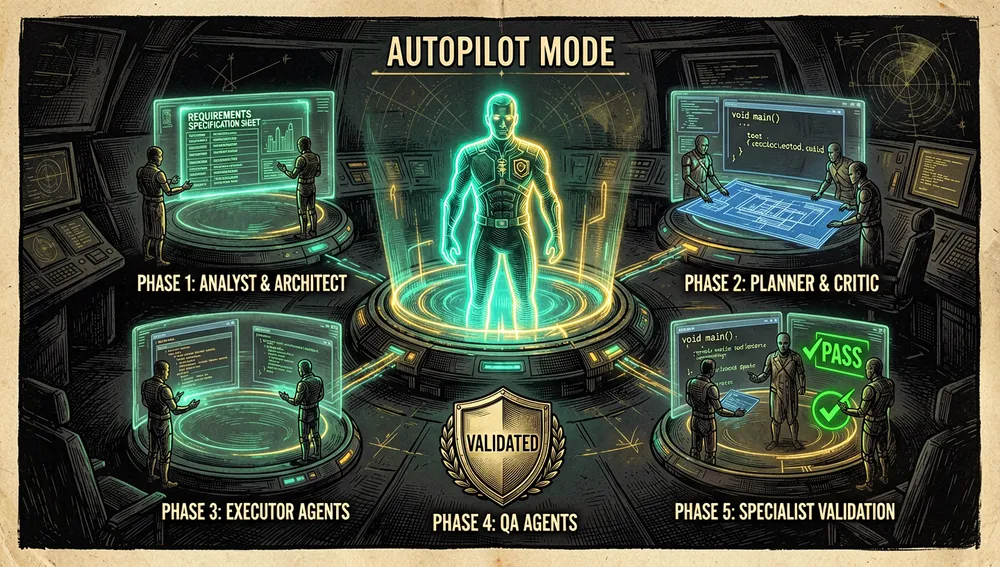
The documented orchestration modes are: Team (canonical), omc team (CLI) (real tmux workers for claude/codex/gemini/antigravity/grok/cursor-agent), ccg (three-model advisors), Autopilot (single leader agent), Ultrawork (maximum non-team parallelization), Ralph (persistent verify/fix loops), UltraQA, Pipeline (sequential), and Ultrapilot (legacy).
The project documents 19 specialized agents in the README, while docs/REFERENCE.md counts them as “29 total” once level variants (LOW/Haiku, MEDIUM/Sonnet, HIGH/Opus) are included. Skills are counted as 38 in REFERENCE.md.
Magic keywords trigger skills without an explicit command: ralph, ulw (ultrawork), ralplan, deepsearch, ultrathink, and stopomc/cancelomc to stop. The README also documents /deep-interview (Socratic questions before writing code), custom skills under .omc/skills/, and a lifecycle-event hooks system.
The ecosystem
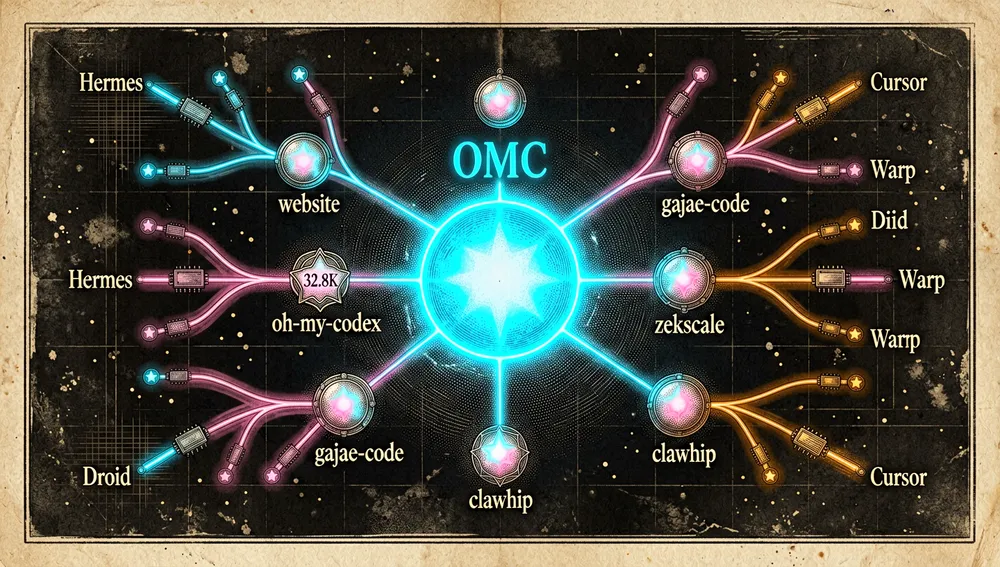
The author maintains an “oh-my-*” family and adjacent tooling. GitHub API figures, August 22, 2026: Yeachan-Heo/oh-my-codex — the same orchestration for the OpenAI Codex CLI, 32,800 stars; Yeachan-Heo/gajae-code — “Gajae Code MVP,” 2,551 stars; Yeachan-Heo/clawhip — a notification router, 929 stars; Yeachan-Heo/claw-code — 39 stars; Yeachan-Heo/rusty-claude-code — a Rust reimplementation, 26 stars.
Searching GitHub for “oh-my-claudecode” repositories returns about 91 results. The most notable non-mirror ones: witt3rd/oh-my-hermes — “Oh My Hermes (OMH),” multi-agent orchestration skills for Hermes Agent, “Inspired by oh-my-…”; 273 stars, the most visible unofficial port outside Claude/Codex; MeroZemory/oh-my-droid — orchestration for the Factory AI Droid CLI, 28 stars; dasomel/oh-my-cursor — orchestration rules for Cursor, 2 stars.
The README’s footer cites five inspirations: code-yeongyu/oh-my-opencode (today code-yeongyu/oh-my-openagent, 68,246 stars), affaan-m/everything-claude-code (today affaan-m/ECC, 242,166 stars), obra/superpowers (276,177 stars), jarrodwatts/claude-hud (27,560 stars), and Q00/ouroboros (5,623 stars). These are the author’s inspirations, not technical dependencies or affiliations.
Official / semi-official status
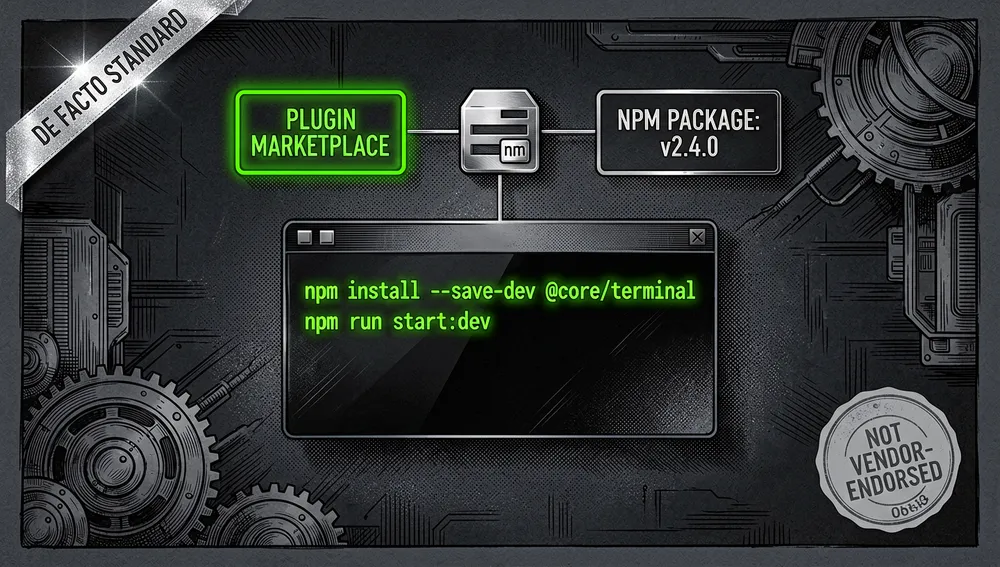
OMC has no vendor backing in the recovered sources: there is no “standard” designation from Anthropic or any other provider. Its real status is:
- A plugin distributed through Claude Code’s own plugin system, installed from a self-hosted marketplace in the repository itself. It’s installable from Anthropic’s official CLI plugin catalog, but the catalog is maintained by the project itself, not Anthropic.
- A package published on npm (
oh-my-claude-sisyphus), with automatic updates every 24 hours. - A de facto standard within a specific niche: teams-first multi-agent orchestration for Claude Code. How fast it grew (over 38,000 stars in ~7 months) and the appearance of ports to Hermes, Droid, Cursor, and Warp position it as the de facto reference for that pattern, though without any formal certification.
In practice, “official” here means installable from Claude Code’s plugin system, not endorsed by Anthropic.
Repo numbers
Measured: August 22, 2026, 23:59 UTC, GitHub API.
| Metric | Value |
|---|---|
| Stars | 38,737 |
| Forks | 3,476 |
| Real subscribers | 128 |
| Open issues | 7 |
| Commits (last pagination page) | ≈ 3,559 |
| Primary language | TypeScript |
| License | MIT |
| Created | January 9, 2026 |
| Last push | August 22, 2026 |
| Latest release | v4.15.10, August 10, 2026 |
| npm downloads (last month) | 23,867 |
watchers_count mirrors the star count, so subscribers_count (128) is reported separately as real viewers. Top contributors: Yeachan-Heo (2,619), shaun0927 (71), devseunggwan (22), hakilee (20), junhoyeo (15).
Quick-start guide
Installation and first run
Prerequisites: the Claude Code CLI installed and a Claude Max/Pro subscription or an Anthropic API key. Team workers also require tmux (macOS/Linux) or psmux (native Windows).
Via marketplace/plugin (recommended; the commands go one at a time):
/plugin marketplace add https://github.com/Yeachan-Heo/oh-my-claudecode/plugin install oh-my-claudecodeVia npm:
npm i -g oh-my-claude-sisyphus@latestThen setup: /setup, /omc-setup, or from the terminal omc setup.
Common workflows
- Build something end-to-end:
/autopilot "build a REST API for managing tasks"; the 5-stage pipeline runs on its own. - Vague requirement:
/deep-interview "I want to build a task management app"launches the Socratic interrogation before writing code. - Real parallel team:
omc team 2:codex "review auth module for security issues"opens two tmux panes with Codex. - Advice from another model:
omc ask codex "review this patch"runs the provider’s local CLI and saves the artifact under.omc/artifacts/ask/.
Essential configuration
| File / setting | What it is |
|---|---|
~/.config/claude-omc/config.jsonc | User (global) config, JSONC format |
.claude/omc.jsonc | Project config; takes priority over the user one |
.omc/ | Runtime state root (sessions, plans, logs) |
CLAUDE_CODE_EXPERIMENTAL_AGENT_TEAMS | Env var to enable native teams |
OMC_STATE_DIR | So state survives worktree deletion |
Common pitfalls and fixes
- Installing both routes at once: the plugin and the npm CLI are separate paths; if you have both, update both.
- MCP server name conflict (
t): using--plugin-dirmakes the plugin register its owntand collide; fix:{"disabledMcpjsonServers": ["t"]}in~/.claude/settings.json. swarmno longer exists: the keyword was removed; migrate old prompts to/team.- Native Windows: experimental; team workers need psmux or WSL2.
Integrations and migration
Optional external providers: Codex CLI, Gemini CLI, Antigravity (agy), Grok Build. Notifications via Telegram, Discord, Slack, and OpenClaw. docs/MIGRATION.md documents the v2.x → v3.0 and v3.x → v4.0 paths.
Contributing
CONTRIBUTING.md documents: prerequisites (Node.js ≥ 20, npm, git, Claude Code); forking and cloning with upstream; two main branches (dev for features, main for release); npm install && npm run build; linking the checkout as an active plugin via omc --plugin-dir "$PWD" setup --plugin-dir-mode; opening a PR with the template.
How the community received it
Hacker News — “Sisyphus Now Lives in Oh My Claude” (52 points, 38 comments, January 11, 2026) shows the full spectrum: gluszak asks whether these orchestrators “do anything besides burning more tokens”; CubsFan1060 says “the README seems more interested in being angry at Anthropic than telling me what this is”; John23832 warns against installing prompts from an account with no history and “silent auto-update”; LaurensBER points to a real speed advantage; undeveloper criticizes that “this removes the main advantage of opencode, easy access to many models.”
An independent article from ZHC Institute (April 1, 2026) reports that OMC reached 19,754 stars “in what looks like a week” and frames it as “the engineering arm of a Zero-Human Company,” noting that it doesn’t make business decisions or manage financial transactions.
oh-my-claudecode versus other proposals
| Project | Verifiable overlap | Verifiable difference |
|---|---|---|
code-yeongyu/oh-my-openagent (68,246 ★) | Agent orchestration for a coding CLI; the directly cited inspiration. | Aimed at OpenCode, not official Claude Code. |
affaan-m/ECC (242,166 ★) | A “harness” optimization system for Claude agents. | Presents itself as performance optimization; OMC as teams-first multi-agent orchestration. |
obra/superpowers (276,177 ★) | A skills framework and development methodology for coding agents. | Superpowers imposes a process; OMC orchestrates several agents in parallel with roles. |
jarrodwatts/claude-hud (27,560 ★) | Shows what’s happening in the statusbar. | It’s just the HUD; OMC integrates that kind of visualization and adds full orchestration. |
Yeachan-Heo/oh-my-codex (32,800 ★) | Same orchestration, same author. | For the OpenAI Codex CLI; OMC is the equivalent for Claude Code. |
The most useful comparison isn’t by popularity: OMC stands out when you want teams-first multi-agent orchestration over official Claude Code, without deeply learning the CLI.
Use cases and who this repository can help
- Developers already using Claude Code who want multi-agent orchestration without learning the CLI: the plugin +
/autopilotflow gives a plan → prd → exec → verify → fix pipeline with a single command. - Teams wanting real parallelization with several models:
omc team 2:codex ...+omc team 1:claude ...mixes Codex and Claude at once. - People with vague requirements:
/deep-interviewforces a Socratic interrogation before coding. - Multi-provider users: the same author offers
oh-my-codexfor Codex; tmux workers let you mix Claude, Codex, Gemini, Antigravity, Grok, and Cursor in a single team command. - Integration with broader agent pipelines: the OpenClaw integration positions it as “the engineering arm” inside a system coordinated by a higher-level agent.
Resources
- Repository: https://github.com/Yeachan-Heo/oh-my-claudecode
- Official site: https://oh-my-claudecode.dev
- Documentation: https://yeachan-heo.github.io/oh-my-claudecode-website
- npm package: https://www.npmjs.com/package/oh-my-claude-sisyphus
- Codex sibling: https://github.com/Yeachan-Heo/oh-my-codex
- Community / Discord: https://discord.gg/jq6jnSGABY
Note: this article combines oh-my-claudecode’s README and official documentation, the GitHub API, the npm registry, repository searches, and Hacker News discussions, consulted on August 22, 2026. Figures change over time.
Comments