


ai-engineering-from-scratch: a 20-phase, 500+ lesson AI engineering course
rohitg00/ai-engineering-from-scratch · 57,188★ · 9,996 forks
“Learn it. Build it. Ship it for others.” — the repository’s slogan. An AI engineering manual that teaches every concept by building it from scratch, then uses it with real frameworks, and ends by shipping a reusable artifact (prompt, skill, agent, or MCP server).
What ai-engineering-from-scratch is
rohitg00/ai-engineering-from-scratch is a complete AI engineering course in repository form: each lesson lives under phases/<phase>/<number>-<name>/ with four pieces — code/ (from-scratch executable implementation), notebook/ (optional experimentation), docs/en.md (lesson documentation), and outputs/ (the final artifact: prompt, skill, agent, or MCP server). The course covers the full spectrum of AI engineering, from math to production:
- Phases 00-03: setup and tooling, math foundations, ML foundations, core deep learning.
- Phases 04-06: computer vision, NLP from basics to advanced, speech and audio.
- Phases 07-09: transformers deep dive, generative AI, reinforcement learning.
- Phases 10-12: LLMs from scratch, LLM engineering, multimodal AI.
- Phases 13-16: tools and protocols (MCP), agent engineering, autonomous systems, multi-agent and swarms.
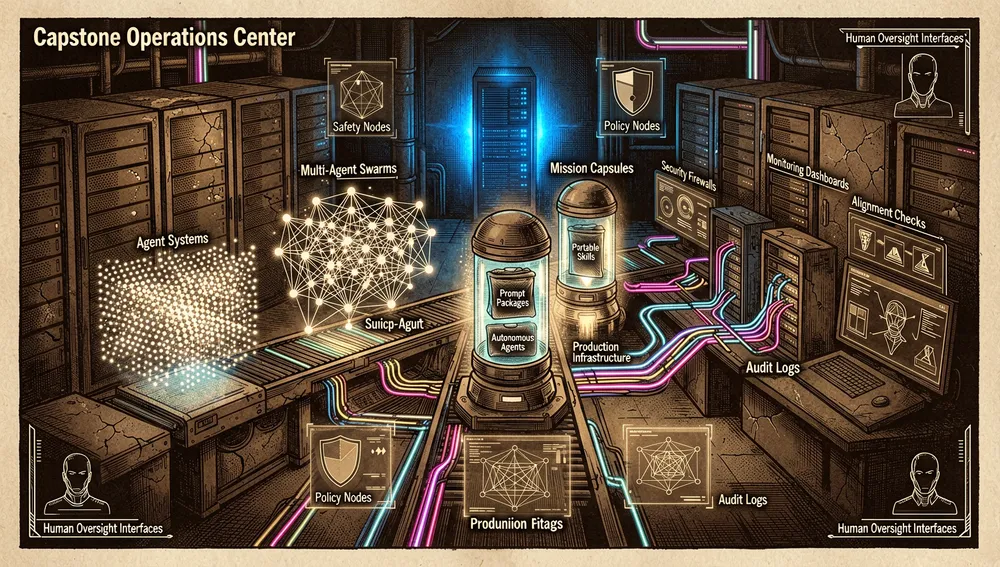
- Phases 17-19: infrastructure and production, ethics/safety/alignment, and capstone projects.
The repository comes with a companion website (aiengineeringfromscratch.com) featuring an interactive roadmap as a dependency graph, a 243-term glossary, lessons translated into several languages, diagram-aware text-to-speech, and book editions (six EPUB and PDF volumes) attached to each release.
As of August 30, 2026 the README badge announces 511 lessons across 20 phases (the August edition’s release note cites 503), written primarily in Python with a notable volume of JavaScript, TypeScript, HTML, Julia, CSS, Rust, and Shell, and licensed under MIT.
Origin
The repository was created on March 18, 2026 by Rohit Ghumare (rohitg00, also known on X as @ghumare64 and on Hacker News as rohitghumare), an engineer, DevRel, and GDE with a background at Solo.io, Cerbos, Oracle, and Reliance Jio. It didn’t start as a blog or a book — it’s a “living edition”: the August edition’s own release note sums it up as “the book is the snapshot; the repository is the living edition.”
The public launch happened in late May 2026: the author himself posted a Show HN (“AI Engineering AI-native Self-learning course repo,” HN item 47591661, posted 2026-05-20), and the next day (2026-05-21) the community resubmitted it as an independent story (“AI Engineering from Scratch,” item 48219853, 58 points and 15 comments), which is where all the discussion concentrated.
The project is funded through GitHub Sponsors with a public rate card (Backer $25/month up to Platinum $5,000/month). In SPONSORS.md the author publishes reach figures verified in his analytics on 2026-05-14: 33,569 visits and 53,917 page views over 7 days; 55,593 visits and 90,709 views over 30 days; the #1 acquisition channel is X/Twitter (18,000 referrals in 30 days), followed by Google (7,100) and GitHub (5,300). The file also includes an explicit clause that the project has no relation to any crypto project (“no token, no coin, no NFT”).
Philosophy and principles
The course’s philosophy is codified in its CONTRIBUTING.md and repeats in every lesson (which always follows the same skeleton: The Problem → The Concept → Build It → Use It → Ship It → Exercises):
- Build from scratch first. “Build from scratch first, framework second”: implement the concept from first principles before showing the framework version.
- Code has to run. Every code file must run error-free with the dependencies declared in the lesson.
- No comments in code. Code should be self-explanatory; explanations belong in the documentation.
- The best language for the job. Don’t force Python where TypeScript or Rust is the better fit (hence the volume of TypeScript, Rust, and Julia in the repository).
- Theory serves practice, not the other way around.
- No AI “slop.” “Write like a human. Be direct. Cut filler.” — an explicit editorial rule that turns out to be especially relevant given the course’s origin (see How the community received it).

The slogan’s core — learn it, build it, ship it for others — turns every lesson into a product: what’s learned gets packaged as a prompt, a portable skill (SKILL.md), an agent, or an MCP server in each lesson’s outputs/ folder, with a top-level index grouping them.
How it works
Lesson format. Every lesson is a mini-project with mandatory documentation in docs/en.md, at least one executable implementation in code/, an optional notebook, and, where applicable, the final artifact in outputs/. Prompts and skills use YAML frontmatter (name, description, phase, lesson, version, tags).
The course is “AI-native.” The 2026-08 edition integrated five learning skills that install into any agent compatible with the SKILL.md format:
/start-learning: a personalized study plan based on a placement test./learn: teaches the next lesson interactively and tracks progress./course-guide: routes any topic or bug to the exact lesson.- Placement test and per-phase checks (
/check-understanding <phase>). /claude-certification: prep for the four Claude credentials.
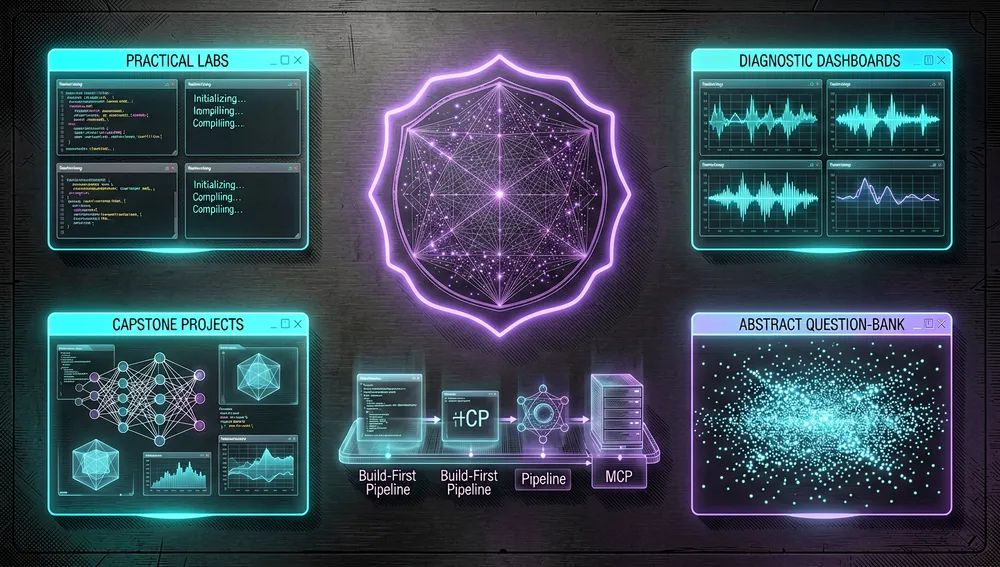
Certification (free prep). The August edition added a “build-first” certification prep program: 33 lessons, executable labs, diagnostics, capstones, and 295 original assessment questions for the four Claude credentials from the July 2026 exam guides (CCAO-F: 9 lessons; CCDV-F: 15; CCAR-F: 21; CCAR-P: 25).

Languages. Lessons are auto-translated (an NLLB-200 pipeline running free in CI, byte-protecting code, formulas, tables, and diagrams) into Simplified Chinese, Hindi, Spanish, Arabic (with RTL rendering), and Turkish, with automatic English fallback while the rollout continues phase by phase. Language is selected in the site header or via ?lang=zh|hi|es|ar|tr in the lesson URL. Separately, the README’s cover text is hand-translated into 12 languages.
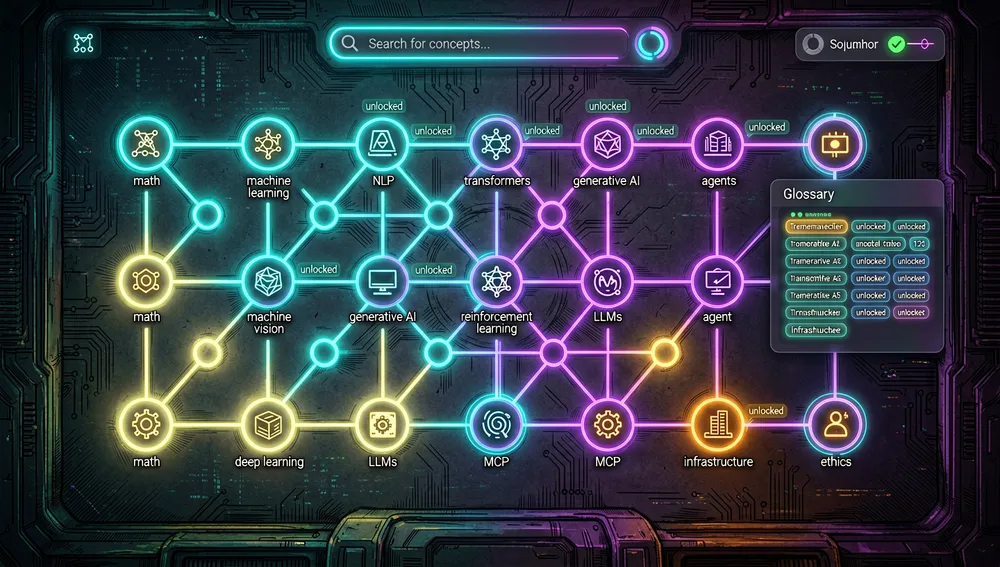
Site. site/build.js parses README.md, ROADMAP.md, and glossary/terms.md to generate site/data.js; the roadmap is an interactive dependency graph (“what unlocks what”) and the glossary holds 243 terms across 12 learning areas.
The ecosystem
Sibling repositories from the same author (GitHub API data, 2026-08-30):
| Repository | Stars | Description |
|---|---|---|
rohitg00/agentmemory | 27,745 | “#1 Persistent memory for AI coding agents based on real-world benchmarks” — persistent memory for coding agents |
rohitg00/pro-workflow | 2,792 | “Claude Code learns from your corrections: self-correcting memory that compounds” |
rohitg00/skillkit | 1,476 | “Supercharge AI coding agents with portable skills. Install, translate & share skills” |
rohitg00/awesome-openclaw | 561 | An awesome list for the OpenClaw community |
skillkit and agentmemory share the course’s thesis (portable skills in SKILL.md format and memory that improves with use), so the course can be read as the “manual” for a toolset the author is building in parallel.
Community forks and translations (GitHub API search by name; 436 matching repos):
| Repository | Stars | Description |
|---|---|---|
fancyboi999/ai-engineering-from-scratch-zh | 1,004 | Full Chinese translation: 20 phases, 503 lessons, its own site, accompanying animated videos |
cluster1900/ai-engineering-from-scratch-zh | 13 | Chinese-language AI-from-scratch course (Python/TS/Rust/Julia) |
yymhai/ai-engineering-from-scratch-zh | 6 | Chinese version of the course |
Rubonal4649/ai-engineering-from-scratch | 16 | A fork with 260+ lessons and 20 phases |
tingfeng007/ai-engineering-from-scratch | 15 | A direct fork |
The Chinese fork fancyboi999/ai-engineering-from-scratch-zh is the most relevant community node: a complete Chinese translation with its own site and audiovisual material, consistent with the original’s #2 acquisition channel (X/Twitter, followed by Google) and with the August edition’s official multi-language rollout.
Distribution through Vercel’s official skills ecosystem. The course installs via npx skills add rohitg00/ai-engineering-from-scratch, the CLI for the npm skills package maintained by vercel-labs/skills (29,977 stars). The skills package logged 38,716,982 downloads the prior month and 9,226,716 during the week of August 22-28, 2026 (npm download API, checked 2026-08-30). In other words, the course distributes through Vercel Labs’ portable-skills tool, which is the de facto standard for the SKILL.md format.
Awesome lists. This research checked aipengineer/awesome-opensource-ai-engineering, boxabirds/awesome-ai-engineering, dontriskit/awesome-ai-software-engineering, and dave-nachman/awesome-ai-engineering: none include the repository. Its inclusion in any other list couldn’t be verified in this research.
Official and semi-official status
- No corporate endorsement, and explicitly so. The course’s certification prep covers Anthropic credentials, but the documentation itself (announcement #402) states: “This program is not affiliated with, endorsed by, sponsored by, or authorized by Anthropic. It contains no live exam questions and makes no pass guarantees.” It’s independent community material.
- Semi-official distribution via Vercel Labs. There’s no acceptance into an Anthropic, OpenAI, or Microsoft “marketplace,” but the course lives inside Vercel Labs’
npx skillsecosystem (the industry’s de factoSKILL.mdformat), which gives it reach across any compatible agent (Claude Code, Codex, Cursor, and similar). - De facto reference in its niche. With ~51,000 stars in under 5 months and a full 1,000-star Chinese fork, it’s the most-starred “from scratch” AI engineering course on GitHub found in this research, ahead of competitors with a much longer track record (see comparison).
- Translation documentation status: the Chinese/Hindi/Spanish/Arabic/Turkish translations are continuous machine translations; the README advertises 12 languages on the cover (hand-translated) and 5 in the lessons.
Quick-start guide
Installation and first boot
Prerequisites: an agent compatible with the SKILL.md format (Claude Code, Codex, Cursor, or similar) and Node.js for the skills CLI.
# Option A: clone the manual (local reading and code)
git clone https://github.com/rohitg00/ai-engineering-from-scratch
cd ai-engineering-from-scratch

# Option B: install the course as skills in your agent
npx skills add rohitg00/ai-engineering-from-scratch
First boot: inside the agent, invoke the placement skill. In Claude Code: /start-learning. On other compatible hosts: ask the agent “Use start-learning to begin the course.” (invocation syntax depends on the host, not the SKILL.md format). The skill runs a placement test and builds a tailored study plan; the site also has https://aiengineeringfromscratch.com/prereqs.html as a prerequisites guide.
Common workflows
- Learn the next lesson: in Claude Code,
/learn; on other hosts, ask by skill name. The agent teaches the lesson interactively and saves progress. - Find the lesson for a specific topic (or bug):
/course-guide+ the topic; the skill routes to the exact lesson in the catalog. - Check understanding of a phase:
/check-understanding 13(in Claude Code); the result is a per-phase diagnostic. - Prep for a Claude certification:
npx skills add rohitg00/ai-engineering-from-scratchthen/claude-certification; the agent teaches the track, runs the labs, quizzes, and resumes progress. - Read a lesson on the site: any lesson URL accepts
?lang=es(orzh,hi,ar,tr); untranslated content automatically falls back to English.
Essential configuration
SKILL.mdfor each installed skill (underskills/start-learning/,skills/learn/, etc.): defines what the agent can do; editable if the repo is cloned.- Site language selector (header) or
?lang=parameter: Chinese, Hindi, Spanish, Arabic (RTL), Turkish, English. README.mdandROADMAP.md: these are the site’s source; their format (| # | Lesson | Type | Lang |tables,✅ 🚧 ⬚glyphs) is the “configuration” a contributor must respect.site/build.js→site/data.js: regenerate after touching the README/ROADMAP/glossary.glossary/terms.md: 243 terms across 12 areas; feeds the glossary page.
Common pitfalls and fixes
- Translations are partial by design. If a lesson isn’t in your language yet, the site automatically falls back to English; the rollout is phase-by-phase and continuous (announcement #403). Nothing needs “fixing.”
- The README/ROADMAP feed the site through a rigid parser. Changing the lesson table format or swapping out the status glyphs breaks
site/build.js; the documented fix is runningnode site/build.jsand verifying thesite/data.jsdiff is only the timestamp change (CONTRIBUTING.md). - Position bias in quizzes (already fixed). The August edition fixed a bias where correct answers across 2,026 questions clustered at the same position; the distribution is now uniform with a CI guard. If you’re working with earlier editions (v2026.07 or before), quiz statistics aren’t reliable.
- Statistical errors fixed in Phase 1. T-test p-values with too many degrees of freedom, and a chi-squared p-value that came out 7.5× too large, were fixed in the August edition; earlier editions contain incorrect values.
- Mind the scope of “certified.” Certification prep is independent community material: no affiliation, endorsement, or authorization from Anthropic; no real exam questions and no pass guarantees (announcement #402).
- The course is large by design. 500+ lessons; the recommended flow is to start with
/start-learning(orprereqs.html) so you don’t study what you already know.
Integrations and migration
- With any
SKILL.mdagent:npx skills add rohitg00/ai-engineering-from-scratchinstalls the learning skills into Claude Code, Codex, Cursor, or another compatible host; each skill keeps its frontmatter (phase,lesson,tags), which lets you inspect and modify it. - With MCP: phase 13 lessons (Tools and Protocols) build MCP servers from scratch; the course documents MCP invocations per host.
- With the author’s ecosystem: the course’s skills share a format with
rohitg00/skillkit(portable skill management), and the agent-phase outputs are compatible with the format used byrohitg00/agentmemory(persistent memory for agents). - With the site: the catalog (
catalog.html), the graph roadmap (roadmap.html), and the glossary (glossary.html) are the reading interface parallel to the agent. - Migrating from reading courses (mlabonne/llm-course, microsoft/generative-ai-for-beginners): the practical equivalent is using
/course-guideto map each already-known topic to its lesson and skip ahead with the/start-learningplan; there’s no state migration, because progress lives in the skill, not the course.
Repo numbers
GitHub API data, checked on August 30, 2026 (the date matters: growth is +450%/week per the author’s own published analytics):
| Metric | Value |
|---|---|
| Stars | 51,007 |
| Forks | 8,826 |
| Watchers | 326 |
Commits on main | 1,762 (counted via the API’s Link pagination header, which returns them paginated) |
| Open issues + PRs | 100 (the GitHub API combines issues and PRs in the same counter; not broken down in this research) |
| Latest release | v2026.08 (2026-08-10); only 2 formal releases (v2026.07 from 2026-07-25 and v2026.08) |
| Created | March 18, 2026 |
| Last push | August 30, 2026 (the day of the check) |
Contributors (API top, 2026-08-30): rohitg00 1,641 contributions, github-actions[bot] 80 (translation and CI pipeline), abhinav-m22 13, thereisnotime 6, thejesh23 5, ismet 4, divya0795 2, sivanaikk 2, CooperSheroy 1, Philippe-Laval 1. The project is, by a wide margin, the work of a single author.
Growth trajectory (anchored in the repo’s own sources): 7,500+ stars verified on 2026-05-14 (reach table in SPONSORS.md) → 51,007 stars on 2026-08-30.
Code volume by language (GitHub languages API, bytes): Python 5.69 M; JavaScript 3.23 M (site); TypeScript 496 K; HTML 470 K; Julia 167 K; CSS 91 K; Rust 89 K; Shell 13 K; TeX 3 K; Dockerfile 2 K.
How to contribute
The process documented in CONTRIBUTING.md (text checked directly):
- One contribution per PR — “keeps reviews fast and lets contributor counts and credit work correctly.”
- Add a lesson under
phases/XX-phase-name/NN-lesson-name/with the exact structure (code/, optionalnotebook/, mandatorydocs/en.md, optionaloutputs/) and the documentation skeleton (motto, The Problem, The Concept, Build It, Use It, Ship It, Exercises). - Add a translation by creating
docs/<language>.mdalongsideen.md(examples in the file:zh.md,ja.md,es.md,hi.md), keeping the structure and translating content, not code. - Add an output (a prompt or skill with YAML frontmatter) under the lesson’s
outputs/and reference it in the top-level index. - Fix bugs or improve existing lessons; more exercises are welcome, especially ones that connect multiple phases.
- PR flow: fork → feature branch (
git checkout -b add-lesson-phase3-gradient-descent) → changes → verify all code runs → PR with a clear description. - Style rules: code runs error-free; no comments in code; the best language for the job; build-from-scratch first; direct prose; no decorative emoji in titles (exception: the emoji flags in the
Langcolumn, since the parser maps them). - Watch the site.
site/build.jsparsesREADME.md,ROADMAP.md, andglossary/terms.md; phase headers and lesson tables must keep their exact shape, and status glyphs (✅,🚧,⬚) can’t be swapped for text. After editing, runnode site/build.jsand thesite/data.jsdiff should show only the timestamp change. - Code of conduct in
CODE_OF_CONDUCT.md: “Be kind, be helpful, be constructive.”
How the community received it
Hacker News. The main thread is “AI Engineering from Scratch” (item 48219853, submitted by rippeltippel on 2026-05-21, 58 points, 15 comments). The discussion is notably polarized, and the polarization centers on the content’s provenance (or lack thereof):
Concrete criticism:
michimagdesign: “These AI-generated websites often lack margins on the left and right of the text, which looks bad on smaller screens. It seems creators don’t care about testing on smaller devices.” — echoed byrightbyte(“fancy responsive design. But with no margins”) andeikenberry(“Looks bad on bigger screens as well”).ulcer: “Love how all the docs around ai tooling are also written by ai. Making it all hyper verbose, repetitive, and unclear.”jatins: flagged it as AI-generated content (“Flagged for being AI generated garbage”), citing HN’s norms on generated comments.bomewish: “I really think people should learn first and primarily from books written by people… the LLMs are trained on that data. So they cannot actually be better than the best original texts.”HlessClaudesman: “Couldn’t find the about section. If you want users to invest their time just be honest about yourself, your goals for making the site and your tech stack.”pinkmuffinere(a control engineer’s technical take): “it seems crazy neither ‘Autonomous Systems’ nor ‘Multi-Agent and Swarms’ appear to mention any control theory content! :’(”
Concrete defense and enthusiasm:
fredcallagan: “Actually the ultimate combo would be to learn this with the learning mode tools provided by AI providers. I must say that it really is a super interesting and efficient way to learn.”meeton: “I don’t trust a vibe-generated course to be great yet, but some day I will and learning will be never the same again.”pinkmuffinere(replying tojatins): argued submissions shouldn’t be flagged as spam for incorporating AI: “Many engineering projects incorporate AI (sometimes very heavily), and many of them are still interesting and useful.”
The author’s original Show HN (item 47591661, rohitghumare, 2026-05-20, URL aiengineeringfromscratch.com) got no traction of its own; all the conversation is in the resubmitted thread.
YouTube. A search for the repository name (checked 2026-08-30) turns up a 4:59 video titled “GitHub - rohitg00/ai-engineering-from-scratch: Learn it. Build it. Ship it for others.,” uploaded by the channel “GitHub Daily Trend AI Podcast” (@githubtrendfeed) about 3 months ago, with 104 views. Also present: derivative summaries and roadmaps in Spanish and English (“The $300K AI Engineer Roadmap,” “AI Engineering in 76 Minutes”), with no confirmed official authorship. No verifiable conference talks were found in this research.
Reddit, Product Hunt, dev.to, podcasts. No verifiable results in this research: Reddit’s search API returned redirects (302) and no thread could be confirmed; Product Hunt’s search returned no launch page for the project; no dev.to/Hashnode articles or Changelog/TLDR mentions with a retrievable source were found. All of the above is explicitly flagged as “not verified in this research” rather than asserted.
ai-engineering-from-scratch vs. other approaches
All star figures verified against the GitHub API on 2026-08-30:
| Project | Stars | Focus | Key difference |
|---|---|---|---|
rasbt/LLMs-from-scratch | 104,022 | Implementing a ChatGPT-style LLM in PyTorch from scratch, step by step | A single concept (LLM) with mathematical depth; not a general course |
microsoft/generative-ai-for-beginners | 118,764 | 21 lessons to get started with generative AI | Short, beginner-oriented, Azure-linked; no build-from-scratch |
datawhalechina/hello-agents | 75,503 | “从零开始构建智能体” — agents from scratch, in Chinese | Agent-only focus; Ghumare’s course covers 20 cross-cutting phases |
mlabonne/llm-course | 82,096 | LLM course with roadmaps and Colab notebooks | LLMs only; reading material, not a per-lesson executable-code repository |
karpathy/nanochat | 57,645 | “The best ChatGPT that $100 can buy” | A single complete system (nano-ChatGPT) as an exercise; not a curriculum |
rohitg00/ai-engineering-from-scratch | 51,007 | 20 phases, 500+ lessons, from math to production | The broadest in scope; the only one that packages every lesson as an installable skill/prompt/MCP |
None of these projects compete in the same format: it’s the only one combining (a) curriculum breadth, (b) from-scratch implementation per lesson, and (c) portable artifacts (SKILL.md) installable via npx skills.
Use cases
- Software engineers transitioning into AI engineering. The full path (math → LLMs → agents → production) with build-from-scratch gives them the conceptual base missing after 21-lesson courses; the
/start-learning+/course-guideflow lets them skip phases they already know. - Teams building agents who need portable skills. Every lesson ends in a
SKILL.md/prompt/MCP server artifact underoutputs/: teams can directly pull and reuse the outputs of phases 13-16 (MCP, agents, multi-agent) without “reinventing” the patterns. - People prepping for Claude certifications. The free certification track (33 lessons, 295 original questions, executable labs) is, in this research, the only public build-first program for the four July 2026 Claude credentials found, with the explicit caveat that it’s Anthropic-independent material.
- Spanish-, Chinese-, Hindi-, Arabic-, and Turkish-speaking learners. The translated lessons (es, zh, hi, ar, tr) with English fallback, plus the 12-language README, make the course the reference multilingual AI engineering manual; the Chinese fork
fancyboi999/ai-engineering-from-scratch-zh(1,004 stars) adds its own audiovisual material for the Chinese market. - Training teams (DevRel, academia, bootcamps). With an MIT license and a standardized lesson structure (
docs/en.md+code/+outputs/), the curriculum can be adapted as internal training material; the contribution process (one contribution per PR, code that must run, no comments) is strict enough to maintain quality at scale. - Engineers who want to understand the agent stack from the inside. Phases 10-16 (LLMs from scratch, LLM engineering, MCP, agents, autonomous systems, swarms), implemented from scratch before framework, are the counterpoint to “black box” use of Claude Code/Codex; the HN criticism about missing control theory (
pinkmuffinere) also marks an honest boundary of the scope.
Resources
- Repository: https://github.com/rohitg00/ai-engineering-from-scratch
- Documentation / official site: https://aiengineeringfromscratch.com (roadmap:
/roadmap, glossary:/glossary, prerequisites:/prereqs.html, catalog:/catalog.html, certifications:/certifications.html) - Official skills:
npx skills add rohitg00/ai-engineering-from-scratch(skills CLI fromvercel-labs/skills; skills:start-learning,learn,course-guide,check-understanding,claude-certification) - Official announcements (GitHub Discussions):
- Certification prep: https://github.com/rohitg00/ai-engineering-from-scratch/discussions/402
- Multilingual course: https://github.com/rohitg00/ai-engineering-from-scratch/discussions/403
- Releases (edition notes): https://github.com/rohitg00/ai-engineering-from-scratch/releases (v2026.08, v2026.07)
- Hacker News: main thread “AI Engineering from Scratch” (item 48219853, 58 points, 15 comments): https://news.ycombinator.com/item?id=48219853 · author’s Show HN (item 47591661): https://news.ycombinator.com/item?id=47591661
- YouTube: “GitHub - rohitg00/ai-engineering-from-scratch: Learn it. Build it. Ship it for others.” — GitHub Daily Trend AI Podcast channel (@githubtrendfeed, 4:59, 104 views): https://www.youtube.com/watch?v=FIkAfMj1eeo
- Sponsorship: https://github.com/sponsors/rohitg00 (rate card and reach figures in
SPONSORS.md) - Community / author’s X: @ghumare64 (Rohit Ghumare)
- Reddit / Product Hunt / podcasts: no verifiable sources found in this research (see How the community received it).
Note: this article combines the repository’s README, CONTRIBUTING.md, SPONSORS.md, and release notes, the GitHub and npm APIs, the Hacker News Algolia API, the official site, and YouTube results checked on August 30, 2026. Figures change over time; the project’s own claims (for example, the +450%/week growth or the reach figures in SPONSORS.md) are flagged as such and not as independent verification.


Comments