


Skills for Real Engineers: small skills to steer code agents
mattpocock/skills · 269,486★ · 22,714 forks
Everything you need to know about mattpocock/skills: an open collection of composable instructions for turning conversations with agents into more deliberate engineering work.
What is Skills for Real Engineers
Skills for Real Engineers is Matt Pocock’s personal collection of agent skills. The repository distributes instruction files for coding assistants, not a model or runtime environment. Its stated goal is to capture practices the author uses for everyday engineering and avoid ad-hoc programming guided solely by vague requests.
The README poses a specific tension with code agents: a tool can write changes quickly, but it doesn’t necessarily share the team’s intent, domain vocabulary, testing criteria, or architectural boundaries. The collection proposes solving this with small, modifiable, and composable skills instead of adopting a framework that controls the entire process. The README itself contrasts this decision with GSD, BMAD, and Spec-Kit: according to the author, those approaches can solve the complete process but reduce local control and make it harder to isolate their own failures.
Origin: a personal folder made public
The GitHub API records the repository and its first commit, both by Matt Pocock, on February 3, 2026. The initial description and README present it as an extraction of his directory of instructions for agents. No independent launch announcement was found, so no additional unverified history is attributed.
Pocock appears on GitHub as the creator of Total TypeScript, previously associated with Vercel and Stately. That background helps explain the repository’s bias: it condenses design practices, types, tests, and review into files that the agent can load when a task warrants it.
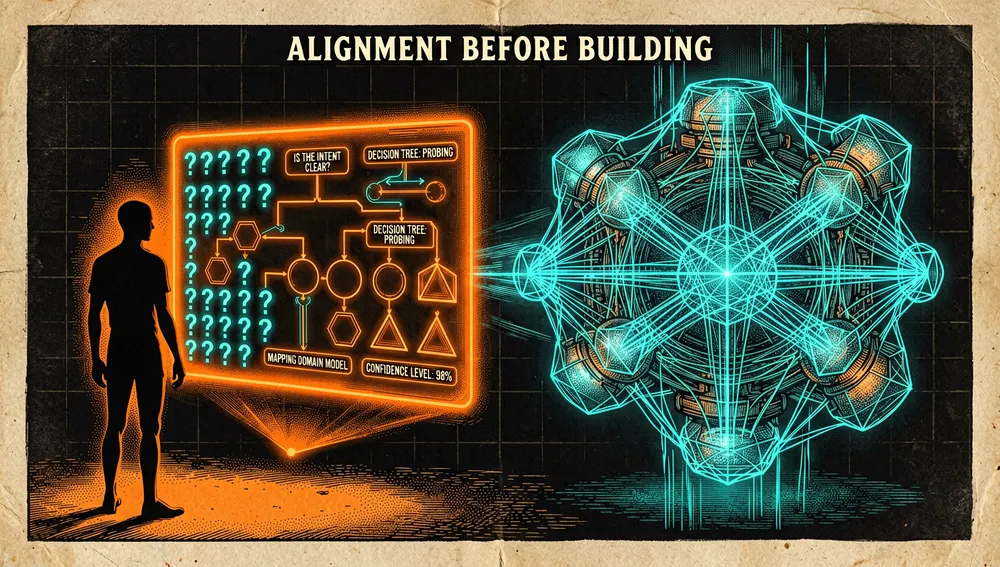
The README narrative is also a response to specific agent failures: misalignment with what the user wanted, excessively long explanations due to not knowing the domain language, changes without sufficient feedback, and accumulation of architectural complexity. Instead of asking for an end result from the start, grill-me and grill-with-docs force a clarification interview; afterward, other skills turn that conversation into specifications, tasks, implementation, and review.
Philosophy and principles
The proposal relies on four ideas that the README and the skills make operational:
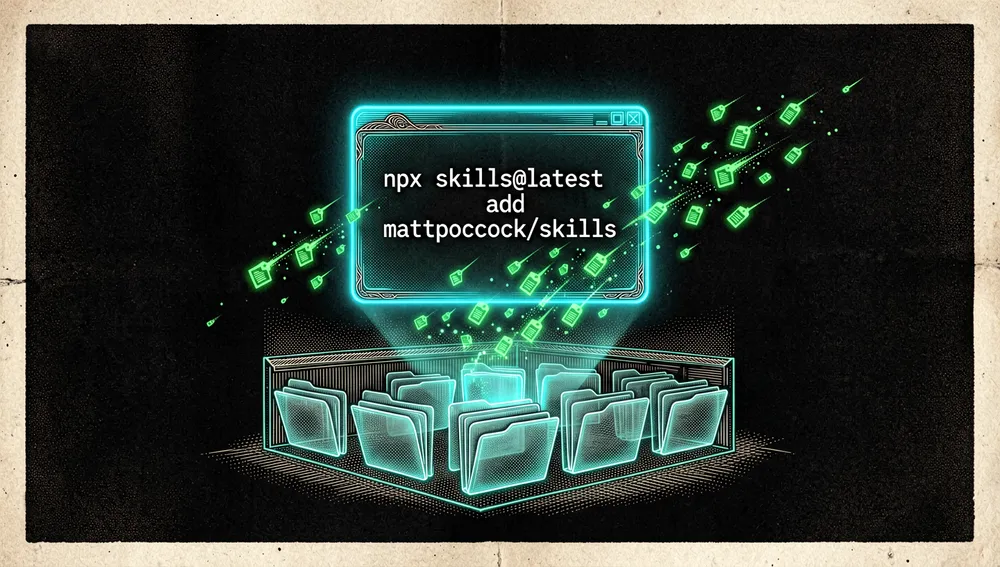
- Local control and adaptation. Skills should be small, editable, and combinable. Installation via
npx skills@latest add mattpocock/skillscopies files to the project for the team to modify; the Claude Code plugin, in contrast, is a managed, read-only subscription. - Alignment before building. A thorough interview aims to transform an ambiguous intent into explicit decisions.
grill-with-docsadds a shared domain model,CONTEXT.md, and architecture decision records. - Short feedback loops. Tests, static checks, and observation of the result are the speed limit. The
tddskill works in vertical slices: one test, one implementation, and repetition. - Design as ongoing work. The collection doesn’t treat architecture as a single phase.
codebase-design,domain-modeling,to-spec,code-review, andimprove-codebase-architectureseek to preserve small interfaces, consistent language, and changes that can be reviewed.
They are not guarantees of automatic quality: they are instructions that must be executed correctly by an agent and reviewed by people. The community discussion itself shows that some users find the discipline useful, while others warn that the value depends on the context and customization.
How it works
Installation offers two routes:
claude plugins install mattpocock-skills
npx skills@latest add mattpocock/skills
The first installs the complete package from the official Claude Code marketplace and receives updates. The second allows choosing skills and installation destinations; the README recommends including setup-matt-pocock-skills. That command runs once per repository to choose GitHub, Linear, or local files as a tracker, define triage labels, and decide where to store documentation.
The catalog distinguishes person-invoked skills, which are executed with an order like /grill-me, from skills that the model can also choose when it detects the appropriate case. The current main flow can be summarized as follows:
/ask-mattorients toward a skill or flow./grill-meor/grill-with-docsasks questions until relevant branches of a decision are resolved./to-specturns the conversation into a specification;/to-ticketsdivides it into vertical slices with dependencies./implementexecutes the work, relying on/tddat agreed-upon test points and ending with/code-review.- For an initiative that exceeds one session,
/wayfindercreates a shared map of issues and tasks in the tracker.
In engineering, it also includes diagnosing-bugs to reproduce, reduce, hypothesize, instrument, fix, and add a regression test; research delegates research based on primary sources and leaves a cited Markdown document; and resolving-merge-conflicts resolves Git conflicts according to the intent of both sides. In productivity, handoff compacts a conversation for another session, teach maintains a learning space, and writing-great-skills helps write new skills.
The latest version, v1.1.0, was published on July 8, 2026. Its notes include updating ask-matt, incorporating research, promoting code-review, and changes in the to-spec and to-tickets flows. These are changes to the project itself, not an independent evaluation of results.
Official and semi-official status
The verifiable official status is limited but clear: the README states that mattpocock-skills is in the official Claude Code plugin marketplace, so claude plugins install mattpocock-skills does not require adding an external market. The CLAUDE.md file confirms that the repository publishes a single plugin and that its manifest is validated with claude plugin validate . --strict.
For Codex and other agents, there was, in the retrieved sources, no equivalent native plugin: the README explicitly states that the native Codex plugin is planned for the future and offers skills.sh as the current path. Therefore, skills.sh is a semi-official or ecosystem distribution for editable files, not an acceptance by OpenAI. Presence in the Claude marketplace simplifies installation and updates; it does not imply that Anthropic certifies the content, security, or effectiveness of each skill.
The dissemination is significant but does not equal a formal standard. The collection can be considered a de facto reference within the pattern of skills for agents due to its adoption, its 197,773 stars, and the amount of forks and adaptations found, not because an entity has declared a standard.
The ecosystem
Related repositories by the author
Querying public repositories of mattpocock retrieved projects close to the work with agents. They share an author, but the sources do not establish that they are required components of skills:
mattpocock/sandcastle: orchestration of isolated code agents in TypeScript viasandcastle.run(); 7,134 stars and 727 forks.mattpocock/dictionary-of-ai-coding: glossary of AI programming jargon; 3,314 stars and 397 forks.mattpocock/agent-rules-books: rules and instructions for agents inspired by engineering books; 359 stars and 50 forks.
These repositories form a useful context: the first addresses isolated execution, the second vocabulary, and the third rules. However, no technical integration is claimed that the source does not document.
Community translations, forks, and extensions
A GitHub search detected 156 repositories that mention mattpocock/skills, and a search including forks returned 2,450 results. Not all are functional derivatives; several are mirrors or tests. Among the derivatives that do declare a translation, port, or extension are:
vinvcn/mattpocock-skills-zh-CN: community localization to simplified Chinese; 2,723 stars and 225 forks.amazingloft999-droid/mattpocock-skills: fork that preserves the original description; 344 stars and 58 forks.devcxl/mattpocock-skills-zh: translation to Chinese; 122 stars and 12 forks.bbylw/mattpocock-skills-cn: agent skills set based on the project; 38 stars and 6 forks.tt-a1i/matt-skills-with-to-goal: extension that adds verifiable goals and implementation in new sessions; 20 stars and 3 forks.uwvwko-zzz/mattpocock-skills-openclaw: declared conversion to the format compatible with OpenClaw; 6 stars and 2 forks.KroxiDev/codex-dev-skills: development skills in neutral Spanish based on Pocock’s; 2 stars.PathGao/mattpocock-skills-codex-plugin: community adaptation as a Codex plugin; 1 star.Boom-Vitt/skills-thai: Thai translation; 4 stars.
Extensions with defined objectives were also found: cswfww123/mattpocock-skills-extras adds complementary skills; nilox94/gh-agentic-workflow overlays GitHub Projects and pull request flow; and AppleCG/devflow combines this repository with obra/superpowers and OpenSpec. These are community works, not official distributions by Matt Pocock or the agent providers.

Repository numbers
Measurement: July 31, 2026, GitHub API.
| Metric | Value |
|---|---|
| Stars | 197,773 |
| Forks | 17,023 |
| Subscribers | 1,159 |
| Commits | 316 |
| Open issues indicated by the API | 258 |
| Primary language | Shell |
| License | MIT |
| Creation | February 3, 2026 |
| Last metadata update | July 31, 2026 |
| Latest published version | v1.1.0, July 8, 2026 |
The main contributors returned by the API are mattpocock with 305 contributions, TESTPERSONAL with 8, and github-actions[bot] with 3. The count of 316 commits was obtained from the last pagination link of the commits API. open_issues_count may include open pull requests, so it does not exclusively represent issues. Also, watchers_count replicates the stars in the general GitHub response; therefore, subscribers_count is reported as the actual number of subscribers.
How to contribute
No public CONTRIBUTING.md file was found: the queried path returns 404. There is maintenance documentation in CLAUDE.md. For a promoted skill, that guide requires updating its link in the main README, including it in .claude-plugin/plugin.json, and synchronizing its documentation page. It also requires that ask-matt be updated when person-invocable skills change so that the router does not point to an obsolete flow.
For plugin version changes, the file indicates keeping the versions of .claude-plugin/plugin.json and package.json synchronized and running claude plugin validate . --strict. This describes the retrieved internal process; in the absence of a public contribution guide, no acceptance policy for pull requests is inferred.

How the community received it
The available evidence mixes enthusiastic use with reservations about how much to delegate:
- The direct submission to Hacker News 48443601, posted by thunderbong, presented the repository with its old description. It reached 2 points and 0 comments. It is a signal of visibility, not broad discussion.
- In the discussion 48037128, about agentic engineering, layoric wrote in comment 48043433 that
grill-mewas most useful for formulating and exploring an idea with more consistency. He also clarified that he saw the models as a reflection interlocutor, not as evidence of understanding. The parent thread is a concrete source of praise and conceptual limit; the retrieved query does not provide a verifiable count of points or comments for that thread, so one is not invented. - In 48130679, the discussion about a deliberate development skill, posted by cdrnsf, reached 253 points and 15 comments. There, esalman cited
grill-meas an example for developing product requirements but warned in comment 48138861 that skills iterated by one person may not transfer well to another due to different interaction habits. It is a concrete criticism of portability, not of the license or the repository itself. - The GitHub tracker offers operational signals of friction. Issue #692, by codymikol, reports that the new installation instructions did not work for Claude and had 3 comments when consulted. #685, by labithiotis, questions dependencies that prevent installing skills independently; it had 1 comment. And #683, by Michael-Colditz, warns that
wayfindercould auto-authorize execution through an exception in the notes; it had 2 comments. These are implementation and design flow objections, not proof that they affect all installations.
Skills for Real Engineers versus other proposals
| Proposal | Verifiable match | Verifiable difference |
|---|---|---|
bmad-code-org/BMAD-METHOD | BMAD is presented as a method for AI-driven agile development. | The README of Skills cites it among the frameworks that assume the complete process; Skills defines itself as a collection of editable and composable pieces. BMAD had 51,337 stars and 5,888 forks in the same API query. |
github/spec-kit | Spec-Kit is a set of tools to start specification-driven development. | Skills uses to-spec and to-tickets, but does not claim to replace the complete Spec-Kit flow; its explicit position is to maintain control through separate skills. Spec-Kit had 124,799 stars and 11,147 forks. |
awesome-skills/code-review-skill | Both distribute a skill for code review and appear in the search of repositories about skills for Claude Code. | The Awesome Skills project concentrates its description on review for specific technologies, while mattpocock/skills integrates review with interview, specification, tasks, tests, debugging, and handover. It had 1,575 stars and 173 forks. |
The comparison does not demonstrate superiority. The practical difference is in scope: Skills for Real Engineers is more suitable when a team wants to select, edit, and combine pieces of the process; an integrated framework may be preferable if the team wants a single convention and already accepts its structure.
Use cases and who this repository can help
- Product and development teams starting with an ambiguous request can go through
/grill-meor/grill-with-docs,/to-spec, and/to-ticketsto turn the conversation into a specification, vertical slices, and dependencies before calling/implement. - Engineers investigating a bug or needing to close a task with evidence can use
diagnosing-bugsto reproduce, instrument, and add a regression test;researchleaves a cited Markdown document based on primary sources, and/code-reviewcloses the implementation flow. - Teams that want to adapt their own agent instructions can install editable files with
npx skills@latest add mattpocock/skills, version them in the repository, and usehandoff,teach, orwriting-great-skillsto preserve context and create new skills. Customization is still necessary: a skill does not automatically transfer between audiences, models, and approval flows.
Resources
- Repository: https://github.com/mattpocock/skills
- Documentation and installation: https://github.com/mattpocock/skills#installation-30-second-setup
- Official skills: https://github.com/mattpocock/skills/tree/main/skills
- Maintenance guide: https://github.com/mattpocock/skills/blob/main/CLAUDE.md
- Versions: https://github.com/mattpocock/skills/releases
- Author profile: https://github.com/mattpocock
- Official Claude Code marketplace: https://github.com/mattpocock/skills#claude-code
- Editable installer: https://skills.sh/mattpocock/skills
- Community and reviews: https://news.ycombinator.com/item?id=48443601, https://news.ycombinator.com/item?id=48037128, https://news.ycombinator.com/item?id=48130679
Note: this article combines the README, maintenance guide, and versions of mattpocock/skills, the GitHub API, searches of repositories, and Hacker News, consulted on July 31, 2026. The figures change over time.


Comments