


UI UX Pro Max: a design library for code agents
nextlevelbuilder/ui-ux-pro-max-skill · 130,557★ · 13,882 forks
Everything you need to know about nextlevelbuilder/ui-ux-pro-max-skill: a skill and a command line that delivers rules, data, and search to guide interface building.
What is UI UX Pro Max
UI UX Pro Max is a code AI skill focused on interface design for web, mobile, and desktop. The repository doesn’t generate an application by itself: it provides a database of styles, palettes, typography, rules by product type, and platform guides that another agent consults when it receives a design or implementation request.
The README describes 84 interface styles, 192 palettes, 74 typography pairings, 25 chart types, 98 UX guides, 161 industry reasoning rules, and guidance for 22 stacks. The intended output combines page pattern, style, colors, typography, effects, anti-patterns, and a checklist. These are figures declared and maintained by the project; a later pull request fixed metadata that still showed old quantities.
There are two ways to use it. The first installs skill files for a code assistant. The second uses the uipro command line, distributed as the npm package ui-ux-pro-max-cli, to generate and install the correct templates in each environment.
Origin: from a Claude skill to a cross-platform installer
The GitHub API dates the creation of the repository on November 30, 2025. Its owner is identified as Next Level Builder on GitHub, with the site nextlevelbuilder.io; the API doesn’t provide a creator’s individual name, so no individual authorship is attributed.
The context the repository itself documents is an expansion from Claude Code toward multiple assistants. It keeps an installation path through Claude’s marketplace, but the command line already generates resources for Claude Code, Cursor, Windsurf, Antigravity, GitHub Copilot, Kiro, Codex CLI, Qoder, Roo Code, Gemini CLI, Trae, OpenCode, Continue, CodeBuddy, Droid, KiloCode, Warp, Augment, and CodeWhale. This separation answers a practical tension: keeping manual copies of a skill across different directories and formats becomes prone to drift. The README presents the installer as the way to get the current templates.

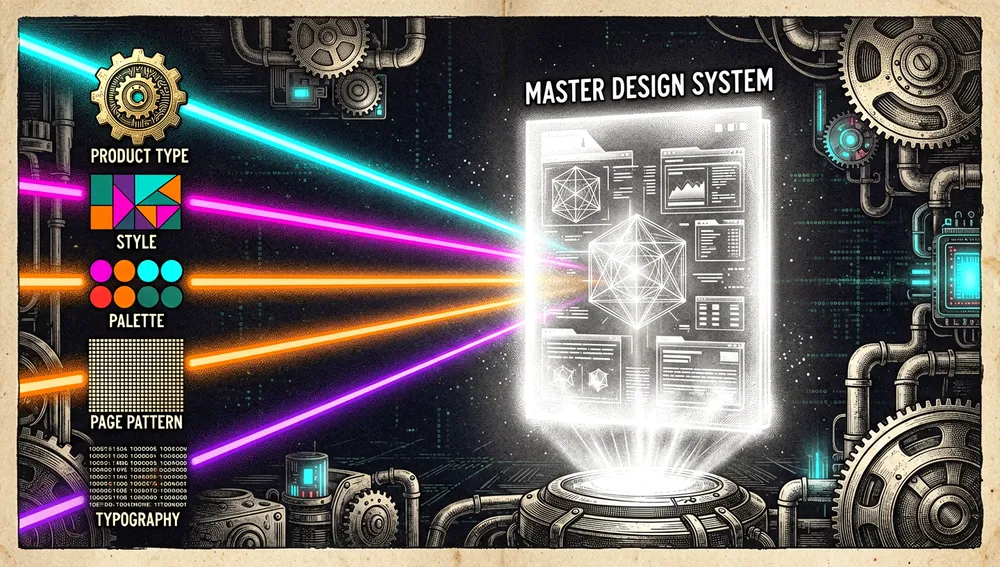
Version 2.0 introduced the design system generator: it runs five parallel searches across product type, style, palette, page pattern, and typography; then it applies rules and filters anti-patterns. The recent evolution also shows real distribution friction: pull request #393, created by mrgoonie, had to change the package from uipro-cli to ui-ux-pro-max-cli because ownership of the previous npm name wasn’t available for the publishing token. The installed command stayed uipro.
Philosophy and principles
The proposal is built on turning repeatable design decisions into queryable data, rather than asking the agent for a generic aesthetic. Its observable principles are:
- Contextual recommendation: it cross-references product type, style, color, typography, and page pattern before proposing an interface.
- Explicit anti-patterns: each industry rule can flag choices to avoid; for example, the README’s example excludes AI-associated purple-and-pink gradients for a banking interface.
- Accessibility and upfront verification: the example output requires a minimum 4.5:1 contrast, visible focus,
prefers-reduced-motioncompatibility, and checks across several widths. - Instruction portability: the canonical source lives at
src/ui-ux-pro-max/; assistant templates are generated from it instead of being permanently edited at each destination.

This is a declarative recommendation methodology, not independent proof that a combination of rules produces better products or higher conversion.
How it works
The normal flow is conversational: a request to build, design, review, or improve an interface triggers the skill in compatible environments. In Kiro, GitHub Copilot, Roo Code, and KiloCode, the README documents the /ui-ux-pro-max command.
The command line installs content per assistant, for example:
npm install -g ui-ux-pro-max-cli
uipro init --ai claude
uipro init --ai codex
uipro init --ai all
It also supports uipro update, uipro versions, uipro uninstall, and the --global flag. The project warns that uipro-cli is a previous package and that the current npm name is ui-ux-pro-max-cli.

For a direct query, the Python search tool works without extra dependencies or network calls, according to the README. Some documented patterns are:
python3 .claude/skills/ui-ux-pro-max/scripts/search.py "fintech banking" --design-system -f markdown
python3 .claude/skills/ui-ux-pro-max/scripts/search.py "glassmorphism" --domain style
python3 .claude/skills/ui-ux-pro-max/scripts/search.py "form validation" --stack react
With --persist, the generator saves a design-system/MASTER.md and per-page overrides. Hierarchical retrieval checks the page’s file first, and if it exists, it takes precedence over the master file. Pull request #417 fixed a path traversal vulnerability in those parameters and states that the new validations restrict the names used when saving.

Official and semi-official status
The README documents direct installation through the Claude Code plugin marketplace via:
/plugin marketplace add nextlevelbuilder/ui-ux-pro-max-skill
/plugin install ui-ux-pro-max@ui-ux-pro-max-skill
That constitutes presence in Claude’s marketplace mechanism as described by the project itself, not certification of quality, safety, or results by Anthropic. For the rest of the assistants, the integration is semi-official in the sense that the repository generates its skill files or instructions for each environment; the sources consulted show no acceptance in OpenAI’s, Cursor’s, Microsoft’s, or other vendors’ official marketplaces.
Adoption is visible, but it doesn’t amount to a formal standard: as of August 1, 2026, the repository had passed 112 thousand stars and its README lists numerous agents. No formal standard designation or vendor endorsement that would allow claiming otherwise was found.
The ecosystem
Owner components and projects
nextlevelbuilder/ui-ux-pro-max-skillis the main repository and contains the data source, templates, Python search tool, and the command line incli/.ui-ux-pro-max-cliis the npm package that publishes theuiproinstaller; it isn’t a separate repository in the reviewed sources, but this repository’s distribution component.- The README links
NextLevelBuilder.io,GoClaw.sh,ClaudeKit.cc, andTOSE.shas other projects. The recovered sources don’t allow attributing a concrete technical function to them within UI UX Pro Max, so they’re recorded only as ecosystem links from the README itself.
Community translations, forks, and extensions
bbylw/ui-ux-pro-max-skill-cn: a community tutorial and translation into Chinese; 1,246 stars and 163 forks in the GitHub repository search. Its description presents itself as a complete, localized translation of the README, not an official distribution from the owner.dualseason/ui-ux-pro-max-skill: a tutorial in Chinese; 31 stars and 2 forks.regutierrez/ui-ux-skill: a fork rewritten in Python, according to its GitHub description; 22 stars and 1 fork.HYYH-code/ui-ux-pro-max-codex: a declared adaptation for Codex of Claude’s skills; 13 stars and 1 fork.NoamNativDraco/ui-ux-pro-max-with-Stitch: an extension declaring a flow for Claude Code with Stitch MCP; 4 stars.hylarucoder/benchmark-skill-ui-ux-pro-max: a benchmark harness named for the skill; 308 stars and 52 forks. Its description was empty in the GitHub response, so its methodology or results can’t be inferred.

The figures above come from the GitHub repository search performed on August 1, 2026. They identify existence and relative popularity, not support, quality, or verified compatibility of each derivative.
Repository numbers
Measurement: August 1, 2026, GitHub API and page.
| Metric | Value |
|---|---|
| Stars | 112,365 |
| Forks | 12,005 |
| Subscribers | 485 |
| Commits | 207 |
| Open issues indicated by the API | 119 |
| Main language | Python |
| License | MIT |
| Created | November 30, 2025 |
| Last metadata update | August 1, 2026 |
| Latest release | v2.12.0, August 1, 2026 |

The top contributors returned by the API, by number of contributions, were viettranx (51), mrgoonie (43), ia-abatista (10), clark-cant (6), and scarletkc (6). The repository page showed 207 commits at the time of consultation. The API exposes watchers_count, but in the general response it replicates the star count; that’s why subscribers_count is reported as actual subscribers. The open_issues_count field can include open pull requests, so 119 shouldn’t be read as an issues-only count.
How to contribute
CONTRIBUTING.md asks contributors to fork and clone the repository, add the upstream remote, and install cli/’s dependencies. The central rule is to edit src/ui-ux-pro-max/, the source of truth, not the copies in .claude/ or .factory/.
The documented flow is to create a branch from main, sync data, scripts, and templates to the CLI assets, build with Bun, and test both a local install and the Python search tool. The README lists additional checks: npm run sync:assets, npm run check:assets, npm run validate:csv, domain and stack tests, npm run typecheck, and npm run build. It asks for Conventional Commits messages, one pull request per change, references to related issues, a completed template, and no direct pushes to main.

Releases are automated with semantic-release: dev generates beta versions and main generates stable ones. Pull request #425, by contato43agency-commits, documents a fix for outdated figures between the README and marketplace metadata — a concrete example that published data requires upkeep.
How the community received it
The recovered evidence contains concrete adoption and technical reservations, though no dedicated UI UX Pro Max launch post with broad Hacker News discussion was found.
- In Show HN 47035304, Reebz described UI UX Pro Max as the design tool in their workflow for Claude Battery and wrote that they recommend the plugin. The thread had 1 point and 4 comments at the time of retrieval. It’s a positive-use testimonial, not a controlled evaluation.
- In Show HN 47347399, twwch explained that, after three iterations of a redesign request with UI UX Pro Max, they considered AIComicBuilder’s interface finished. The thread had 1 point and 3 comments. It shows a favorable experience, but doesn’t allow attributing causality or measuring the result’s quality.
- The most concrete criticism comes from the project’s own maintenance. In pull request #417, ruredi reported that the skill had received a high-risk rating in a third-party audit and detailed the reasons the change sought to eliminate: installation instructions executed by agents, forced-activation language, unused instruction-shaped data, and path traversal in
--persist. The pull request was merged on July 10, 2026, and it declares tests for the fix. The external rating is attributed toruredi’s description; the audit itself wasn’t retrieved directly, so it isn’t presented as an independently verified result. - Change #393, by mrgoonie, confirms a separate operational objection: installation could become confusing due to third-party ownership of the
uipro-clinpm package. The fix was publishingui-ux-pro-max-cliwhile keeping theuiprobinary.
The balanced reading is that there are signals of usefulness in real projects and a community that contributes changes, but also security, metadata, and packaging problems that have had to be publicly fixed.
UI UX Pro Max versus other proposals
| Proposal | Verifiable match | Verifiable difference |
|---|---|---|
regutierrez/ui-ux-skill | Its GitHub description states it’s a fork of UI UX Pro Max and that it provides a UI/UX skill. | It states it’s rewritten in Python; the source doesn’t allow confirming it retains the same rules, data, CLI, or platform coverage. |
HYYH-code/ui-ux-pro-max-codex | Its description presents it as a Codex adaptation of UI UX Pro Max’s skills. | It’s Codex-specific rather than the cross-platform install the main project’s README lists; no sufficient documentation was recovered to compare its implementation. |
NoamNativDraco/ui-ux-pro-max-with-Stitch | It states it uses the UI UX Pro Max skill for Claude Code. | It adds a flow with Stitch MCP; the main repository doesn’t declare that dependency in the sources consulted. |
These derivatives aren’t presented as independent competitors with equivalent capabilities: the recovered sources describe them as forks or extensions. Comparing design results without recovered evaluations would be speculative.
Use cases and who can benefit from this repository
- Developers building an interface with a code assistant can install the skill or run
uipro init --aito generate the resources for the environment they use. Given a design request, the library combines product type, style, palette, page pattern, and typography, and also returns anti-patterns and a checklist. - Designers and product teams needing to maintain a visual direction across screens can query the local search tool for styles, industry rules, and stack recommendations. With
--persist, the generator savesdesign-system/MASTER.mdand per-page overrides, so a page can depart from the master system without losing it. - Maintainers of a skill distributed across several assistants can edit the canonical source at
src/ui-ux-pro-max/, sync the CLI assets, and run the documented data, domain, stack, type, and build checks. It’s a flow meant to avoid keeping divergent copies by hand at each destination.
The library’s recommendations don’t replace brand, accessibility, or conversion review. If --persist is used, output names and paths must stay within the expected directory; the fix in #417 shows why that validation is necessary.
Resources
- Repository: https://github.com/nextlevelbuilder/ui-ux-pro-max-skill
- Documentation and installation: https://github.com/nextlevelbuilder/ui-ux-pro-max-skill#installation
- Official skills and source: https://github.com/nextlevelbuilder/ui-ux-pro-max-skill/tree/main/src/ui-ux-pro-max
- Official CLI: https://www.npmjs.com/package/ui-ux-pro-max-cli
- Project site: https://uupm.cc/
- Contributing: https://github.com/nextlevelbuilder/ui-ux-pro-max-skill/blob/main/CONTRIBUTING.md
- Reviews and discussions: https://github.com/nextlevelbuilder/ui-ux-pro-max-skill/pull/417, https://github.com/nextlevelbuilder/ui-ux-pro-max-skill/pull/393, https://github.com/nextlevelbuilder/ui-ux-pro-max-skill/pull/425, https://news.ycombinator.com/item?id=47035304, https://news.ycombinator.com/item?id=47347399
- Community and discussions: https://github.com/nextlevelbuilder/ui-ux-pro-max-skill/discussions
Note: this article combines the README, CONTRIBUTING.md, pull requests, the GitHub API and page, GitHub search results, and Hacker News, consulted on August 1, 2026. The figures change over time.



Comments