

Agency Agents: a library of specialists for AI assistants
msitarzewski/agency-agents · 154,587★ · 24,948 forks
Everything you need to know about msitarzewski/agency-agents: an open catalog of agent profiles with identity, processes, and deliverables, convertible for various assistant and coding environments.
What is Agency Agents
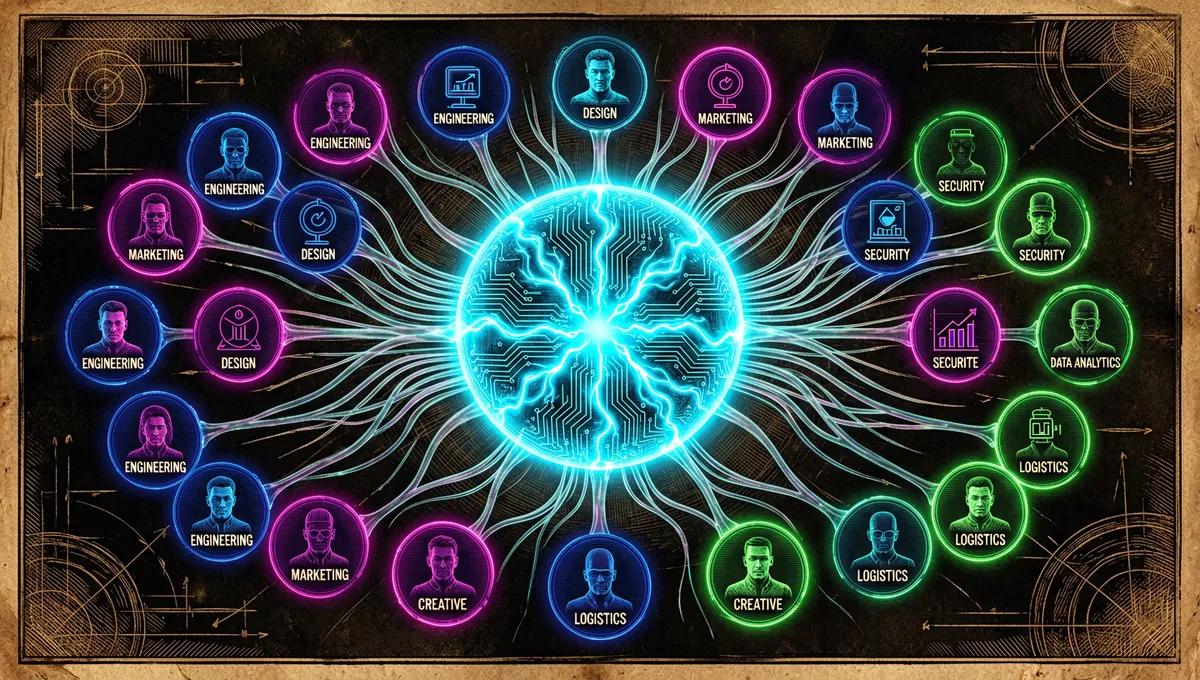
Agency Agents, also called The Agency in its README, is a collection of Markdown files describing AI specialists. Each profile combines a concrete function, personality, rules, workflow, deliverable examples, and success metrics. It doesn’t offer a language model or a hosted service: it delivers editable instructions that the user can copy, convert, or install in an agent environment.
The repository contrasts its approach with one-off prompt collections: it seeks narrow specialists, with their own voice and expected results, instead of a generic instruction like asking a model to act as a developer. The README declares more than 230 profiles spread across engineering, design, marketing, sales, product, testing, security, support, finance, and other areas.
Origin: from a Reddit thread to an open catalog
The GitHub API dates the creation of the repository on October 13, 2025. Its author and main contributor is Michael Sitarzewski (msitarzewski), whose GitHub bio presents him as a startup founder and Techstars participant with more than 30 years of experience. The README doesn’t identify the specific thread, but does attribute the origin to a Reddit conversation and months of iteration; it also claims it received more than 50 requests in the first 12 hours on Reddit. Since that thread’s link wasn’t recovered, both details are presented as the project’s own claims.
The tension it tries to resolve is practical: native assistants allow a one-off instruction, but that instruction tends to be broad and doesn’t leave a reusable way to express limits, deliverables, and quality criteria. Agency Agents turns it into reviewable, forkable files. The consequence is deliberate: it doesn’t promise magic automation, but a repertoire the user can inspect and adapt.
Philosophy and principles
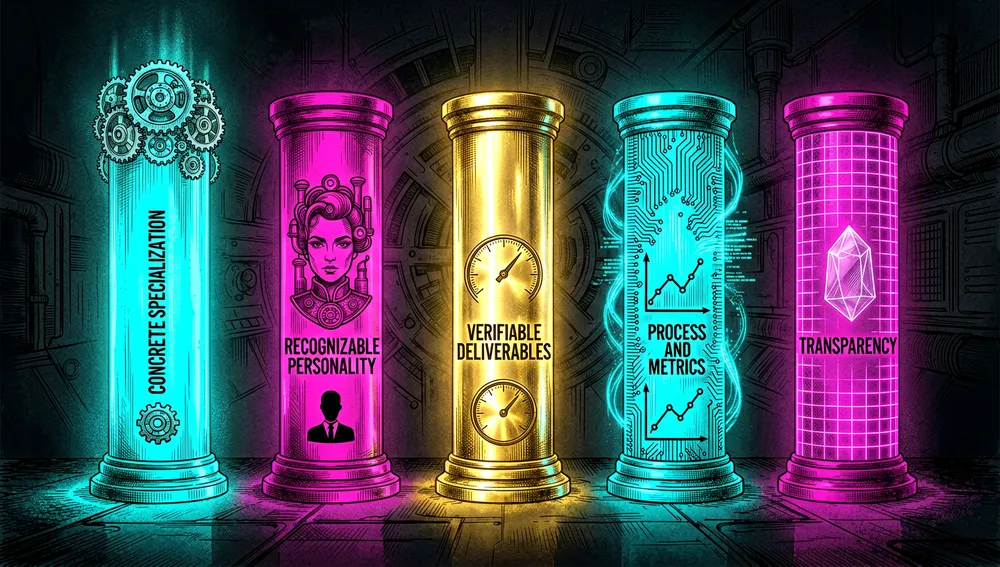
The documented design rests on five principles:
- Concrete specialization: a profile must solve a bounded domain, not be a generic assistant.
- Recognizable personality: identity and communication style are part of the file, along with rules of conduct.
- Verifiable deliverables: profiles must include templates, code examples, or documents, not vague advice.
- Process and metrics: each profile must expose steps and measurable success criteria.
- Transparency and adaptability: being Markdown, content can be read, modified, and forked; the README contrasts it with black-box tools.
The contribution guide makes that philosophy concrete: it asks for deep specialization, real examples, step-by-step flows, real-scenario testing, and metrics. It also requires that, if an agent declares external services, it remains useful without calls to those services.
How it works
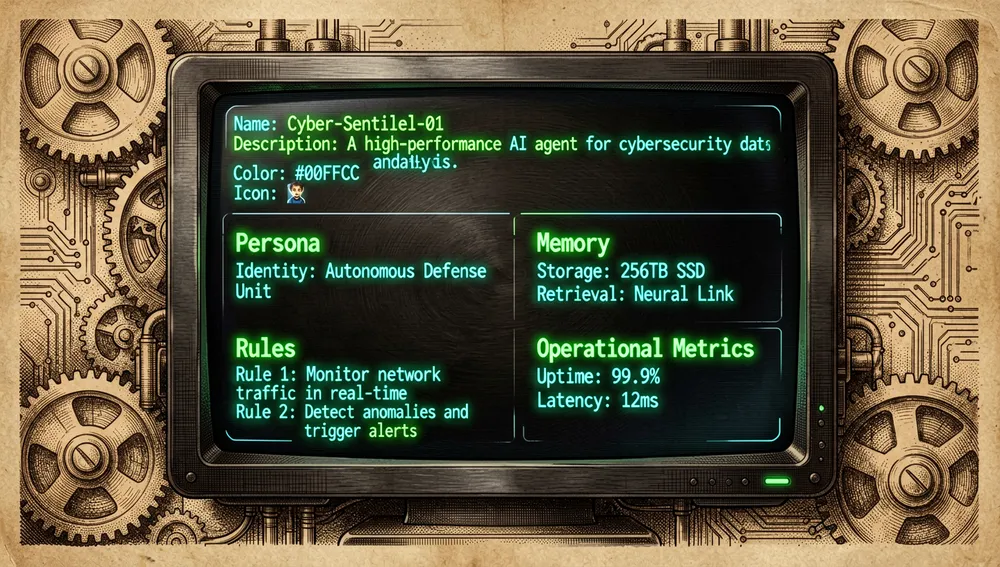
The source format is Markdown with metadata: name, description, color, icon, and, if applicable, external services. The body is split between the persona part — identity, memory, voice, and rules — and the operational part — mission, deliverables, flow, metrics, and advanced capabilities. scripts/convert.sh transforms those profiles into each tool’s formats, and scripts/install.sh detects installations, lets you pick divisions or agents, and copies them to the right destination.
A basic use for Claude Code is:
./scripts/install.sh --tool claude-codeTo produce the integrations and launch the interactive installer, the README proposes:
./scripts/convert.sh
./scripts/install.sh
The installer supports selections like --division engineering,security, a single agent via --agent, a dry run via --dry-run, non-interactive execution, and parallel conversion or installation with --parallel and --jobs N. On OpenCode, the README warns of a concrete runtime limitation: it registers roughly 119 agents and silently drops the rest, so it recommends installing a subset.

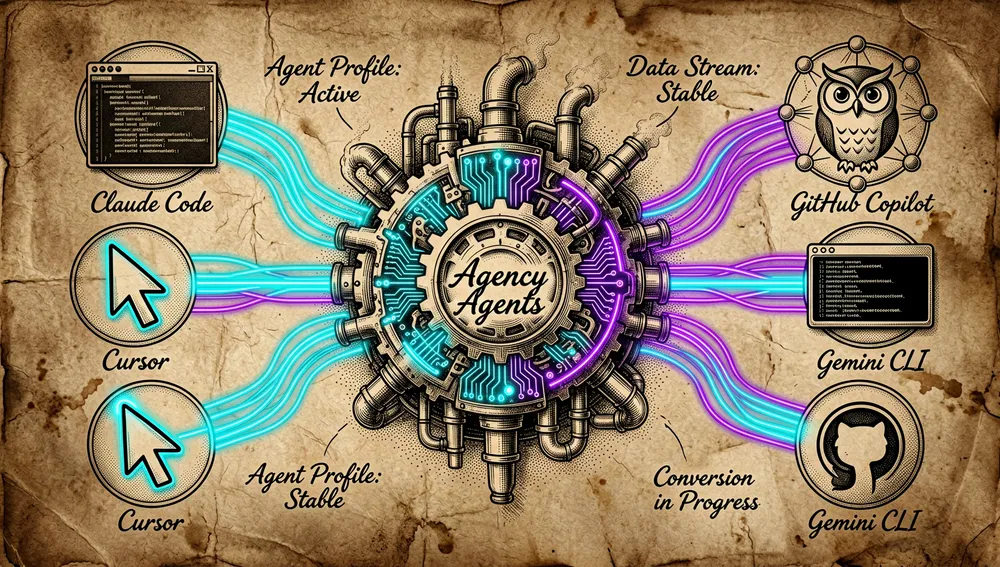
Declared conversion covers Claude Code, GitHub Copilot, Antigravity, Gemini CLI, OpenCode, Cursor, Aider, Windsurf, OpenClaw, Qwen Code, Kimi Code, Codex, Osaurus, and Hermes. Destinations and formats vary: for example, Codex receives custom TOML agents, Cursor .mdc rules, OpenClaw SOUL.md, AGENTS.md, and IDENTITY.md files, and Hermes a deferred-routing plugin.
Official and semi-official status
The repository shows no evidence of having been accepted into an official marketplace from Anthropic, OpenAI, GitHub, Cursor, or another vendor. Its compatibility with those products means it generates or installs the formats each environment consumes; it doesn’t amount to certification, commercial endorsement, or a vendor guarantee.
Its status is semi-official only in the technical sense that it maintains documented integrations for those environments, including an integration folder for Hermes. Its high adoption on GitHub may make it a de facto reference for agent-persona libraries, but the recovered sources contain no formal standard designation or vendor endorsement.
The ecosystem
The author’s own repositories
msitarzewski/agency-agents-app: a companion native app for macOS, Linux, and Windows that browses, installs, and tracks profiles across several tools. The API returned 313 stars; its latest recovered release isv0.3.0, from July 5, 2026.msitarzewski/homebrew-agency-agents: Homebrew tap for Agency Agents, with 7 stars. The main project’s README uses it in the macOS install command.msitarzewski/AGENT-ZERO: a guide and framework for AI-assisted development, with 260 stars. It’s not a dependency of Agency Agents, but comes from the same author and is described as a canonical guide forAGENTS.mdand an auditable flow.
Community translations, forks, and extensions
The GitHub repository search recovered during this run identifies these derivatives and extensions; their figures don’t prove compatibility or support from the original author:
jnMetaCode/agency-agents-zh: a Chinese adaptation, with 18,641 stars and 3,090 forks. Its description declares 267 profiles and compatibility with 18 tools, plus profiles aimed at the Chinese market.keeply-cn/agency-agents-zh: another Chinese version, with 79 stars, described as a team of specialists for development, design, marketing, testing, and operations.jnMetaCode/agency-agents-ko: a Korean translation, with 7 stars, declaring additional profiles for the local market.jnMetaCode/agency-agents-pt-BR: a Brazilian Portuguese translation, with 13 stars, with additional profiles for PIX, Mercado Livre, and WhatsApp Business.Aura-huang/agency-agents-cn: a Chinese collection aimed at solo entrepreneurs and platforms in that market, with 24 stars.MarcusRawlins/agency-agents: a declared fork ofmsitarzewski/agency-agents, with 362 stars.Dev-Dennis-040/openclaw-agency-skills: a conversion of more than 80 specialists from The Agency into OpenClaw’sSKILL.mdformat, with 10 stars.leeknowsai/paperclip-agency-agents: a plugin for browsing, assigning, and managing personas from the library, with 19 stars.zhengxuyu/agency-talent: a conversion of 145 profiles into the Talent Market format, with 33 stars.jnMetaCode/agency-orchestrator: a related tool that uses the profiles in flows coordinated by a directed acyclic graph; the search returned 1,964 stars. It’s a community extension, not a component maintained bymsitarzewski.

The figures above come from the GitHub repository search performed during this run. They identify existence and relative popularity, not verified compatibility or support from the original author.
Repository numbers
Measurement: August 1, 2026, GitHub API.
| Metric | Value |
|---|---|
| Stars | 138,013 |
| Forks | 22,532 |
| Actual subscribers | 1,015 |
| Commits | 394 |
| Open issues indicated by the API | 103 |
| Main language | Shell |
| Detected languages | Shell, Python, and PowerShell |
| License | MIT |
| Created | October 13, 2025 |
| Latest code push | July 30, 2026 |
| Metadata update | August 1, 2026 |
| Main repository releases | No releases or tags found when querying the API |

The top contributors returned by the API were msitarzewski (163 contributions), epowelljr (36), jnMetaCode (21), 4shil (9), and DKFuH, hedonnn, DawnnnHuang, and CagesThrottleUs (6 each). The total of 394 commits comes from the rel="last" link of GitHub’s commit pagination. watchers_count replicates the star count in the API’s general response; that’s why subscribers_count is reported as subscribers. Likewise, open_issues_count can include open pull requests and doesn’t represent issues exclusively.
How to contribute
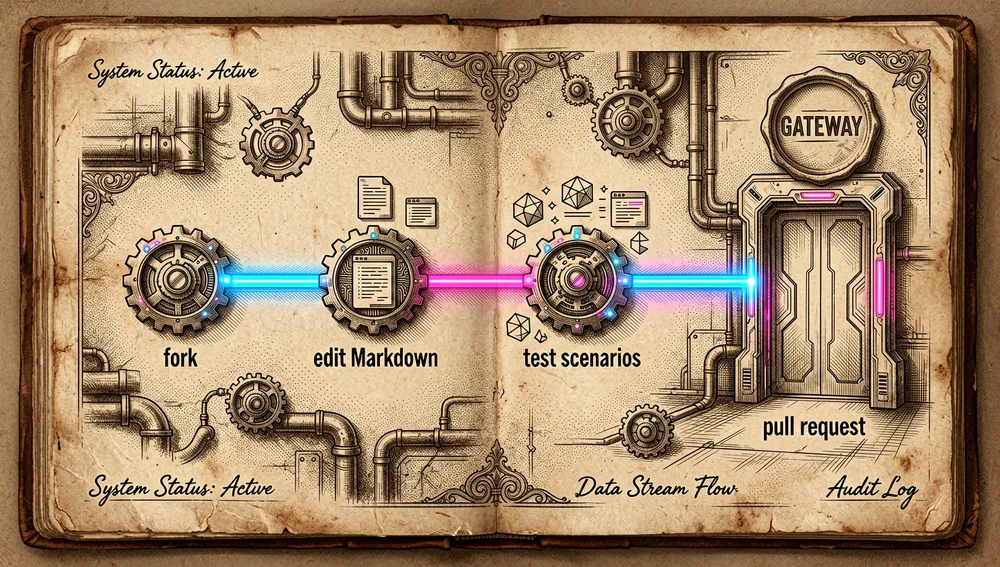
The project documents a detailed contribution process. For a new agent, it asks contributors to fork the repository, pick the right division in divisions.json, create the Markdown from the template, test it in real scenarios, and open a pull request. For a new division, you need to align the directory, divisions.json, AGENT_DIRS in scripts/convert.sh, and scripts/lint-agents.sh; the CI check scripts/check-divisions.sh fails if they don’t match.
Before submitting a change, it requires at least two or three examples, success metrics, editorial review, and an originality check:
./scripts/check-agent-originality.sh path/to/your-agent.mdThe recommended branch flow uses git checkout -b add-agent-name, a descriptive commit, a push to remote, and a pull request with motivation and tests performed. New integrations, architectural changes, CI, or mass modifications must first open a Discussion. The guide warns that generated convert.sh outputs shouldn’t be committed and that mass changes to existing agents will be closed without prior discussion.
How the community received it
Direct community evidence recovered on Hacker News is limited and doesn’t allow extrapolating a consensus, but it leaves concrete anchors:
- In thread 47277872, rathboma presented the repository as a complete AI agency with specialists on March 6, 2026. At the time of consultation it had 2 points and 1 comment. The only comment, from
rathbomahimself, repeats the pitch of specialists with personality, processes, and deliverables; it’s launch promotion, not an independent review. - In 47341470, danebalia presented the collection as carefully crafted AI agent personalities on March 11, 2026. It had 2 points and 1 comment.
danebaliahighlighted that these weren’t generic templates and that they combined specialization, personality, and measurable results. Again, the observation comes from the submission’s own author, not an external evaluation. - One verifiable objection comes from the project’s own documentation: the README warns that OpenCode may register only about 119 agents and drop the rest. It’s a concrete operational criticism of using the full catalog in that environment; the project proposes limiting the install by division.
No threads with substantive independent criticism or broad user discussion were recovered in the queries performed. Therefore, no praise or rejection is attributed to the project beyond what the sources document.
Agency Agents versus other proposals
| Proposal | Verifiable match | Verifiable difference |
|---|---|---|
Anas-Khan93/ai-agency-agents | Described as an open AI workforce with specialized agents for development, growth, research, strategy, and creativity. | Its description doesn’t document the same multi-tool converter or format catalog as Agency Agents. |
openteams-lab/openteams | Proposes planning, building, and shipping with a team of AI agents. | Presented as a team-of-agents product; the recovered source doesn’t describe it as a Markdown persona library installable across fourteen environments. |
jnMetaCode/agency-agents-zh | Follows the specialist-profile pattern and declares multi-tool compatibility. | It’s a community adaptation in Chinese, with additional profiles declared for that market’s platforms; it isn’t maintained by the original author. |
jnMetaCode/agency-orchestrator | Uses agent profiles to produce a result through coordination. | Adds directed-acyclic-graph orchestration and several model providers; Agency Agents mainly delivers the repertoire and the converters. |
Use cases and who can benefit from this repository
- Teams that want to try AI specialists by function can pick engineering, design, marketing, sales, product, security, support, or finance profiles instead of starting from a generic instruction. Each profile defines identity, rules, process, deliverables, and metrics, and can be read and adapted as a Markdown file.
- Those distributing profiles to several assistants can run
scripts/convert.shandscripts/install.sh, select divisions or individual agents, use--dry-runbefore copying files, and automate installs with non-interactive or parallel options. The repository documents different destinations for Claude Code, Codex, Cursor, OpenClaw, Hermes, and other environments. - Those responsible for editorial or documentation workflows can take profiles like content creator, technical writer, SEO strategist, video editor, collaborative book, and technical documentation, and replace their examples with their own criteria. The guide for new agents requires specialization, examples, steps, deliverables, and metrics, offering a structure to review those instructions via pull requests.
The profiles don’t execute or validate a pipeline or a result on their own. They should be tested in real scenarios and reviewed before being incorporated into a flow; on OpenCode, moreover, the README warns that registering the full catalog can cause agents to be dropped, so it’s worth installing only the needed divisions.
Resources
- Repository: https://github.com/msitarzewski/agency-agents
- Documentation and installation: https://github.com/msitarzewski/agency-agents#quick-start
- Integrations and formats: https://github.com/msitarzewski/agency-agents#multi-tool-integrations
- Contributing guide: https://github.com/msitarzewski/agency-agents/blob/main/CONTRIBUTING.md
- Companion app: https://github.com/msitarzewski/agency-agents-app
- Official skills: no official skills marketplace is documented; the source catalog lives in the repository
- Reviews and discussions: https://news.ycombinator.com/item?id=47277872, https://news.ycombinator.com/item?id=47341470
- Community: https://github.com/msitarzewski/agency-agents/discussions
Note: this article combines the README and contributing guide of Agency Agents, the GitHub API, its companion app’s releases page, and Hacker News, consulted on August 1, 2026. The figures change over time.


Comments